My Look at a Texas PGA TOUR Player With Plenty of Firepower

Masters Champions Jordan Spieth is taking a well deserved break but another “can’t miss kid” with Texas ties is teeing it up at the Zurich Classic of New Orleans this week.

Less than a decade ago Colt Knost was golf’s next big thing. The year was 2007 and the game’s best amateur player, by a long shot, was the just turned 22-year-old transplanted Texan. He dominated the USGA’s Amateur Public Links Championship beating Cody Paladino 6 & 4 at the Cantigny Golf Course in Wheaton, Illinois. Big deal, you say? Does the fact that between 1997 and 2004 the APL champions all went on to become PGA TOUR members, some winners and one, Trevor Immelmann, won The Masters change your impression?

Then later in the summer of ’07 Colt Knost made it, and himself, a very big deal winning the United States Amateur Championship beating Michael Thompson 2 & 1 at The Olympic Club. That victory meant Knost joined Ryan Moore as the only men to win the APL and the U.S. Am in the same year. The only two in 88 years!

image

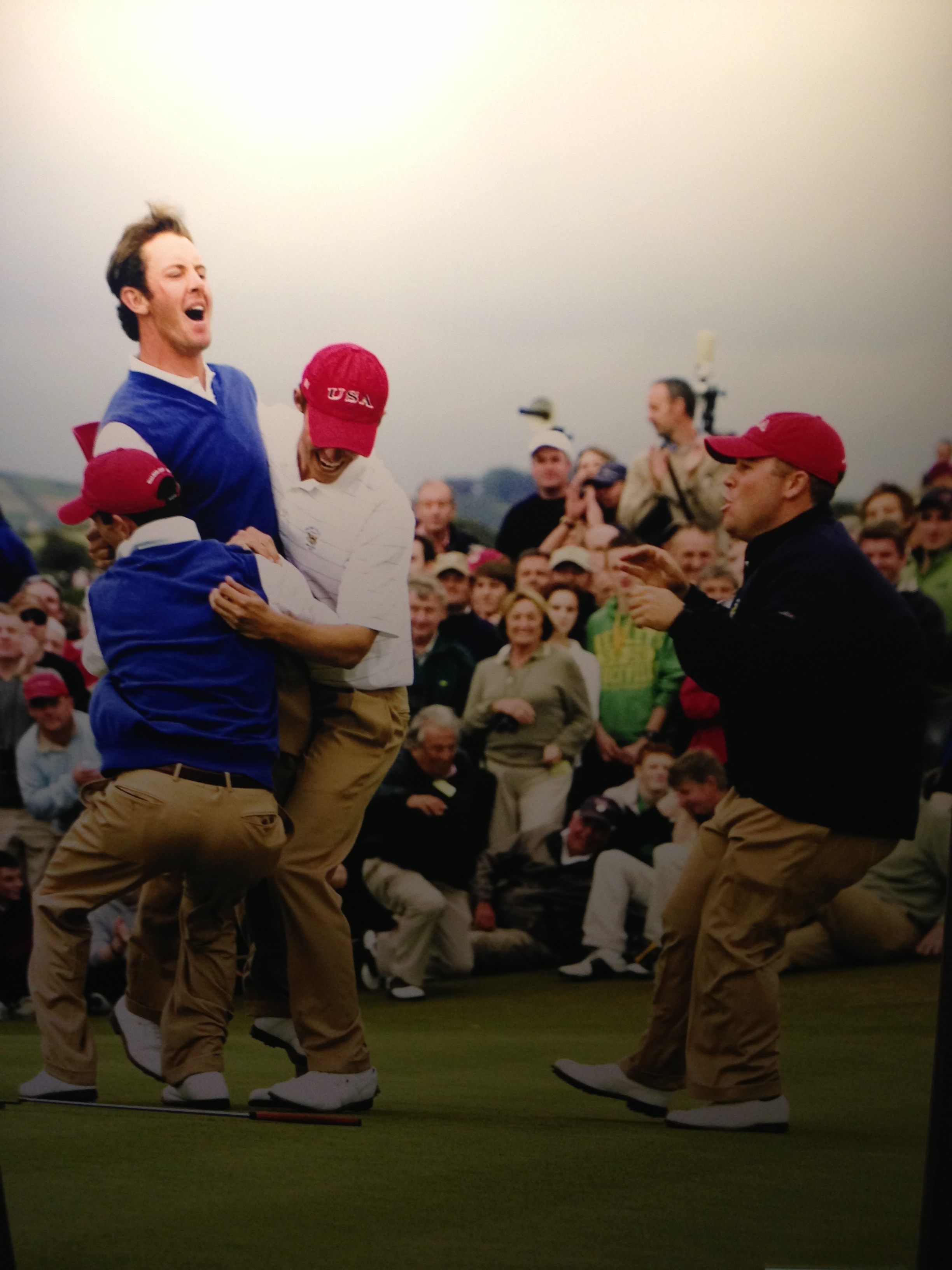
Then adding to his golf resume Knost one-upped Moore by making a Walker Cup Team, going 2-0-2 in the 2007 match, helping lead Rickie Fowler, Billy Horschel, Dustin Johnson, Webb Simpson and his other U.S. teammates to a one point victory at Royal County Down in Northern Ireland. Knost now had a bucket loadof medals, mementos and memories, he also had automatic invitations to play in the 2008 Masters, United States Open Championship and British Open.

He held tight to the former and cast the latter to the wind turning pro after the Walker Cup Match. Colt Knost figured he was good enough to earn a starting time at those major events as a professional. Then life and golf happened and Knost is still waiting to play on the weekend at a major.

He did qualify for the 2012 U.S. Open but missed the cut. He’s still waiting to tee it up in golf’s other majors. I caught up with Colt, currently a member of the PGA TOUR, ranked 81st in the FedEx Cup standings after a strong start to the season, and asked him if he ever regretted the now almost eight year old decision to turn pro,

“I really don’t regret it,” he told me from his Dallas home, “I would have loved to play in The Masters but it was my time to go. My stock wasn’t going to get any higher and I had the opportunity to play in some great events.”

After a disappointing T-85 at the PGA TOUR Qualifying Tournament at the end of 2007 Knost found himself on what was then the Nationwide Tour and that’s where our Golf Channel broadcast team got to know him. He was both full of talent and personality and he quickly became one of our “go to guys” for sound bites, features and technology testing. Good round or bad, he was always friendly, funny and willing to give us some of his time. Sure we showed him on TV because of that but mostly we showed him because he could flat out play. He had success out there, winning twice in 2008 and earning his PGA TOUR card by finishing 6th on the year end money list. But success wasn’t in the cards on tour, at least not then.

“I think I put too much pressure on myself early on to perform and play well,” he said about his first full year (2009) on tour. “it’s a big culture shock when you step out on the PGA TOUR. There are so many outside distractions and things get kind of overwhelming for a young kid.”

He was back on the now web.com Tour in 2010 and while he didn’t win that year he did earn another shot at the PGA TOUR thanks to a 15th place finish on the money list. He was having fun then and despite some ups and downs he’s still having fun,

“I’m having a blast,” he told me. “I’ve realized how lucky I am to play this game for a living. I love traveling and being out there with the guys each week. It’s a blast and it’s nice to have a lot of the guys come up to me and tell me how happy they are that I’m back out there.”

The man he joined in the USGA record books, Ryan Moore, and the guy he beat in the U.S. Amateur Championship, Michael Thompson, are both PGA TOUR winners and I asked Colt if he ever talked to those two players about going from one level to the next,

“I haven’t reached out to them. I have to some other guys such as Justin Leonard, Harrison Frazar and Pat Perez that I talk to and listen to. But for the most part I know what I need to do and am working hard to get to where I want to be.”

Where he wants to be is slipping into a green jacket or holding a U.S. Open trophy on some future Sunday evening but until then, and possibly long after that happens, his fondest memory in this individual game is centered around a bunch of guys celebrating as a team,

“I think I probably remember the Walker Cup the most. It was the most fun I’ve ever had in golf. And at the time I don’t think any of us realized how special that team was going to be.”

image

Look it up. Ten players, five future PGA TOUR winners, one future major champion, one U.S. Amateur Champion, one future FedEx Cup million dollar winner, and two NCAA Individual Champions. Special indeed.

This piece isn’t meant to be a cautionary tale nor an advice column for future U.S. Amateur Champions. Colt Knost made the decision to turn pro for all the right reasons, his reasons. What this is, I hope, is a reminder of how great a player Colt Knost was and still is. One day he will
hear, “Fore please, Colt Knost now driving” from the first tee at Augusta National and when he does he will have arrived there with a ton of experience and on his own terms.
You can follow Colt and his fellow PGA TOUR pros at the Zurich Classic of New Orleans starting Thursday on Golf Channel and at pgatour.com

United States Amateur trophy photo courtesy USGA

Posted in Golf, golf on tv, sports | Tagged , , , , , , , , , , , , , | Leave a comment

All of The Masters Coverage Today Makes Me Happy and a Little Sad.

As exciting as The Masters Tournament has been lately, or the 2015 edition might end up being, I can’t shake this feeling that something is missing. Maybe better said, something has been lost. I am an avid golf fan, with a 60th birthday easily in sight, and I remember The Masters as the one sports event shrouded in mystery, fueled by anticipation and defined by discovery.

It wasn’t that long ago television times were purposely set for later in the day and shortened, sometimes by more than half, of what the other major championships offered. The first six holes were enigmatic to anyone who hadn’t stepped foot on the hallowed grounds and the Par Three Contest was reserved for stories passed down from friends, relatives and eloquent scribes. Now no less than six different coverage options are available to view, starting bright and early in the morning, on devices that can fit in your back pocket. The Par Three is just another ESPN television event.

We weren’t allowed to actually see what happened during morning play for the first 36 holes. One was expected to occupy oneself with something else during a large portion of the day on the weekend. “You’ll get nothing and like it” was the mantra from the behind the gates on Washington Avenue and believe it or not we did! We liked it a lot. Then it changed.

Some dictionaries define change this way, “to make the form of something different from what it is or from what it would be if left alone.” I’ve heard again and again, from people young and old, that “change is good” but despite the fact that real progress has been made in regard to the amount of information we can now get and how it’s delivered I, for one, am not convinced this particular change is ALL for the best.

Now before you write me off as a dinosaur, a curmudgeon, or worse, a crazy person, consider this; it was just more than 30 years ago that there was NO early round coverage from Augusta. In 1982 the USA Network aired a Thursday round at The Masters for the first time and some of us remember that CBS carved out a half hour of programming time, “after your late local news” (11:30 PM ET), for a Jim Nantz/ David Feherty half hour highlights show. It took until the turn of this century for Augusta National to allow CBS the ability to televise the leaders on Sunday from the first tee forward. For you “Millenials” that’s less than 15 years ago, just a drop in Father Time’s bucket of seconds, minutes and millennia.

To further clarify, I am NOT saying, or trying to imply, any of this progress and change is bad, it’s just different. From these “looking back on the good old days” eyes it’s just a little lamentable. In some weird nostalgia-filled way it’s akin to Christmas mornings past for me. I remember the excitement of knowing some of my presents were not so secretly hidden in the corner of a closet in the house. I know my parents, may they rest in peace, would be disappointed, yet probably not surprised, to hear that, unable to contain my curiosity, I peeked under the wrapping paper of the biggest box. Suddenly I was thrilled to know what one of my gifts would be in a week’s time but all of the sudden what I would describe now as melancholy enveloped me. A small part of the magic of Christmas morning was gone.

Today I can look at a Masters leaderboard, follow a featured group, or watch action from the most famous corner in golf starting Thursday morning. I can even, not only know what’s going on but, be told how to feel about it thanks to Jason Sobel, Steve Elling, Shane Ryan and a hundred others on Twitter. It’s great you say but, again in some small fashion, doesn’t it all make it a little less special and a lot less spiritual?

The United States Open is different. The television coverage is, and has been, a beautifully orchestrated all day affair from the announcement on the first tee Thursday until the kissing of the trophy ahead of a Sunday sunset. The British Open has its own stateside tradition of bagels, birdies, and being done with more than enough hours in the day to enjoy an afternoon round of your own. But The Masters, Thanks to technology, and in my opinion, has lost that one unique thing it owned alone… Its mystery. Once upon a time the event’s iconic tag line, “a tradition unlike any other”, also referred to the way we could, and did, watch it. I don’t know about you but part of me misses that.

Posted in Uncategorized | Leave a comment

A Sail Through Paradise Part Four

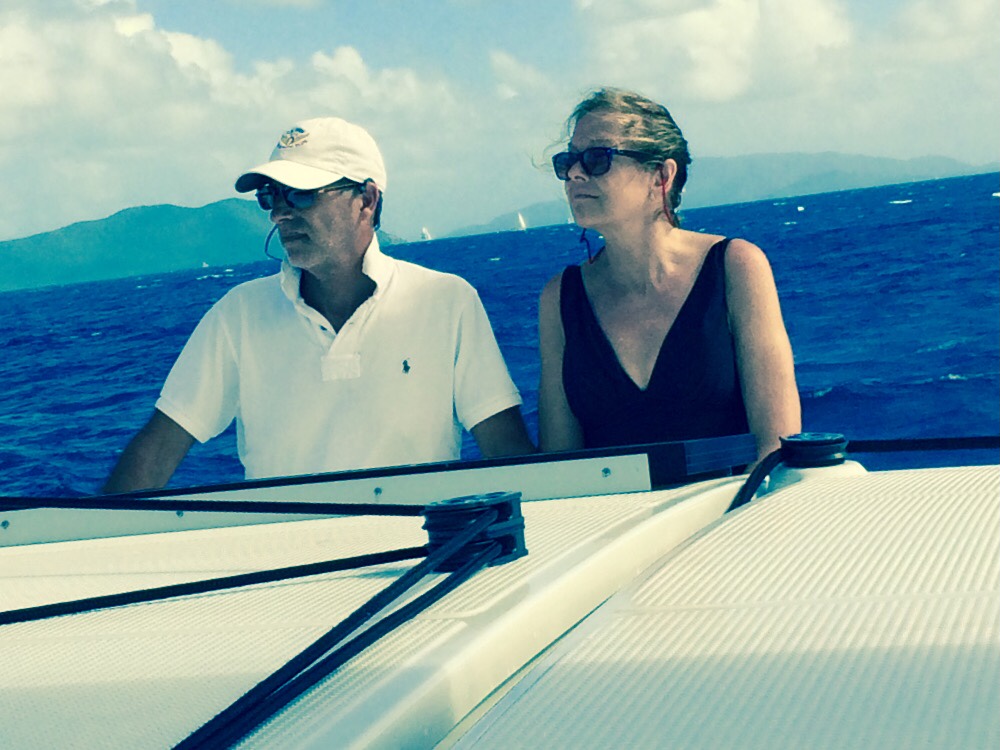
If this is a return visit, you know this trip started on St. Thomas where we boarded a catamaran and set out for St. John and then Tortola. The journey included me, my wife, mother and father-in-law and my wife’s Uncle Jim. Of the five of us, only Uncle Jim, knew what he was doing on a boat.

Once again we awakened early, but not quite early enough to catch a glimpse of our French flasher from the day before. The slip which harbored his catamaran was empty leaving us to speculate that they had headed out at the crack of dawn to entertain someone else. Instead of making coffee on board Days Like This we ambled over to the local coffee shop for a morning espresso pick me up. We were alone so as Sarah waited to order our drinks I searched out the local public facilities to do what I had not been inclined to do on the boat. Allow me a little leeway here because for some people (hand raised high) performing normal bodily functions on a 41 foot catamaran is both humbling and vexatious and except for “number one” I didn’t do it. Quite frankly using the facilities on shore wasn’t that much better.

If you’re a stickler for security, privacy or cleanliness when you shower or go to the bathroom prepare to react in varying stages from discomfort to mortification if you plan a trip like the one we enjoyed. Heads on most sailboats, including ours, are small and cramped and when you have to go everyone knows you have to go. The other options are never going or using the very public facilities on shore each time we sailed into a harbor. Some of those were clean(ish), and all had doors (some lockable) but none were anywhere close to being private. You got in, you got out and you hoped nothing you owned hit the ground. Okay no more complaining… Off we go to Norman Island.

thecaves

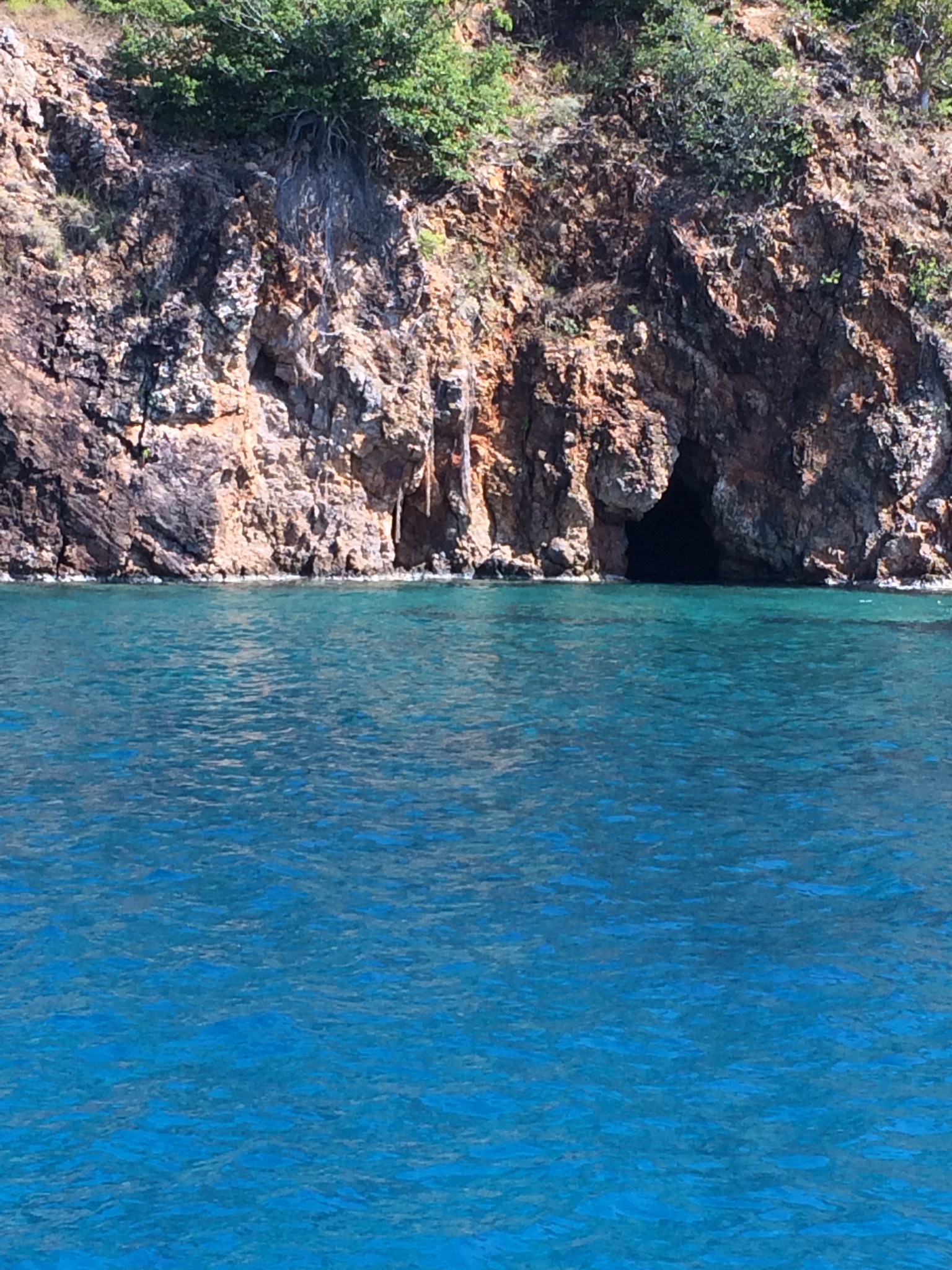
Known as a wonderful snorkeling spot Norman Island was a couple of hours away under wind power so Jim suggested we get underway toot sweet so we could be sure to land one of the moorings near “the caves”, three openings of various sizes that offered excellent underwater viewing and a heightened sense of adventure. I was sure Jim, Bob, Sarah and Susan would enjoy the experience very much. We left Soper’s Hole Marina and hoisted the sails. Several tacks would again be in order and I am not the slight bit embarrassed to admit I had forgotten most of what Captain Jim told me the day before in regard to the “which rope attaches to what winch” process. With his understanding, and help, I managed. As Lyle Lovett started singing, “If I had a Boat” in my head we started to ride the wind.

humpybeasts1

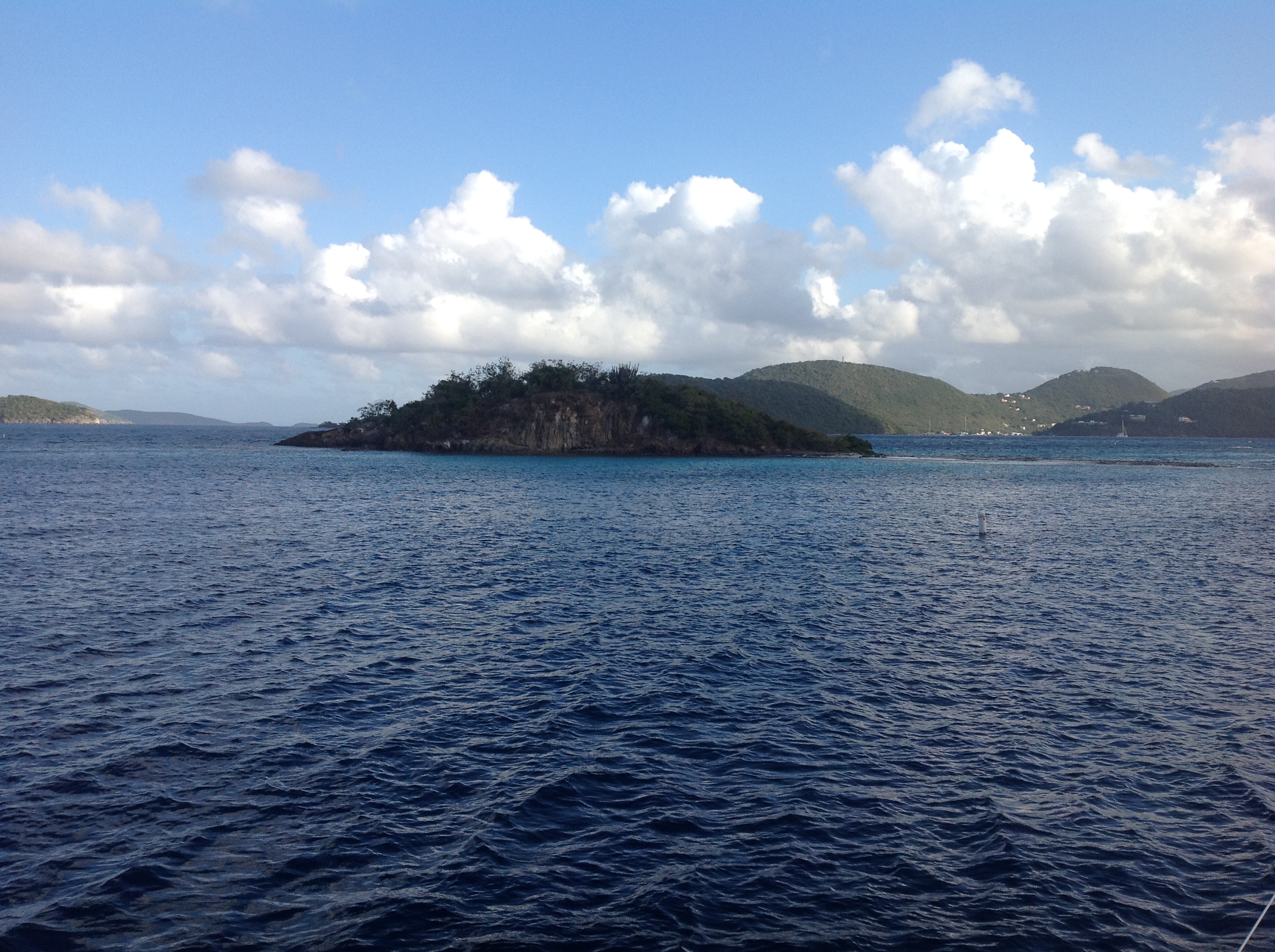
The islands, which looked to me like the backs of fantastic beasts the day before, now took on a different countenance. These new land masses looked like fairy tale giants, cut loose from massive beanstalks, having fallen to the waiting earth below from kingdoms high in the clouds. These giants landed flat on their backs, mouths agape, with bulbous bellies and battered toes pointing straight up to their old haunts in the sky. As we sailed closer I saw those giants had long ago turned to stone and dirt and, like their neighbors closer to St. Thomas, had filled in nicely with scrub brush, trees and cactus plants as well.

keithandjim

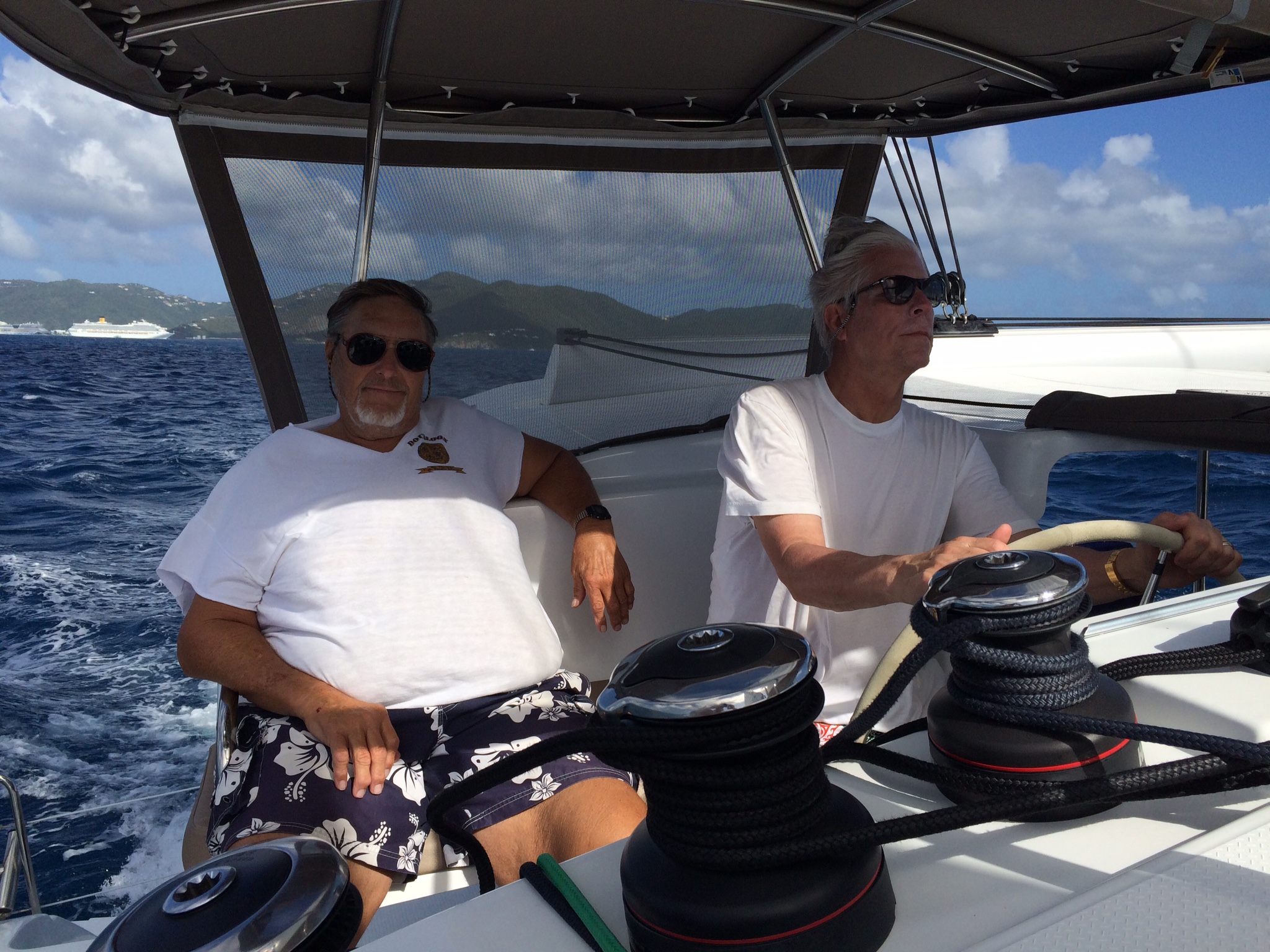
For a brief stretch I took the wheel and gained even more respect for how well my father-in-law, Bob, had piloted our vessel on earlier occasions. We arrived at Norman Island and, as Jim had predicted, found a mooring near the prime snorkeling spot after only a brief wait. Securing a mooring is a mini adventure of its own, especially with this team of Gilligans. As Jim slowed the boat, and steered us as close as possible to the buoy, it was my job to extend the portable hook and snag the rope that dangled beneath the surface. Once I made the connection I hoisted the rope over the bow and it was then Sarah’s job to tie it tightly to the cleat. If either of us failed, Jim would have had to circle around so we could try it again. For the second time on the voyage that wasn’t necessary and we were ready to enjoy the rest of the day. As we sat safely secured to the mooring we observed a parade of people, in groups as small as a few and as large as two dozen, arrive, splash around the three separate slits in the side of the island, and leave. Eventually Jim, Sarah, Bob and Susan “snorkeled up” and swam over to see what the fuss was all about. I watched. At one point I did actually jump in the Caribbean and spent a few minutes treading water in the clear, blue sea before sensing impending doom and climbing back on the boat.

After everyone had seen what there was to see inside “the caves” they all made it back too and Jim decided this was as good a place as any to spend the night, so we did just that. More boats came and went but a couple came and stayed including a lovely mono-hulled sailboat and a beautifully appointed power yacht christened Harmony. We knew it was called that because the owner had taken the time and spent the money to put the vessel’s name on a brightly lighted sign on the side of the yacht. Harmony anchored a few hundred yards away and as we sipped our sundowners as started dinner preparations we speculated that a rock star or a music mogul was on board, I mean who else would name a yacht, Harmony? Despite breaking out the binoculars for a closer look we never saw a soul, let alone a soul singer.

Another lovely evening was spent on board. We enjoyed a wonderfully cooked meal of Mahi Mahi and corn on the cob, poured a drink or two and shot the breeze. We never ran out of things to say and always enjoyed each other’s company. As the winds began to pick up a little we watched a huge Japanese industrial ship in the distance, brightly lit and of seemingly singular purpose, move methodically across the water. As it became smaller and smaller we grew more and more tired and finally decided it was time to hit the sack. Then in the middle of the night we averted disaster.

islands

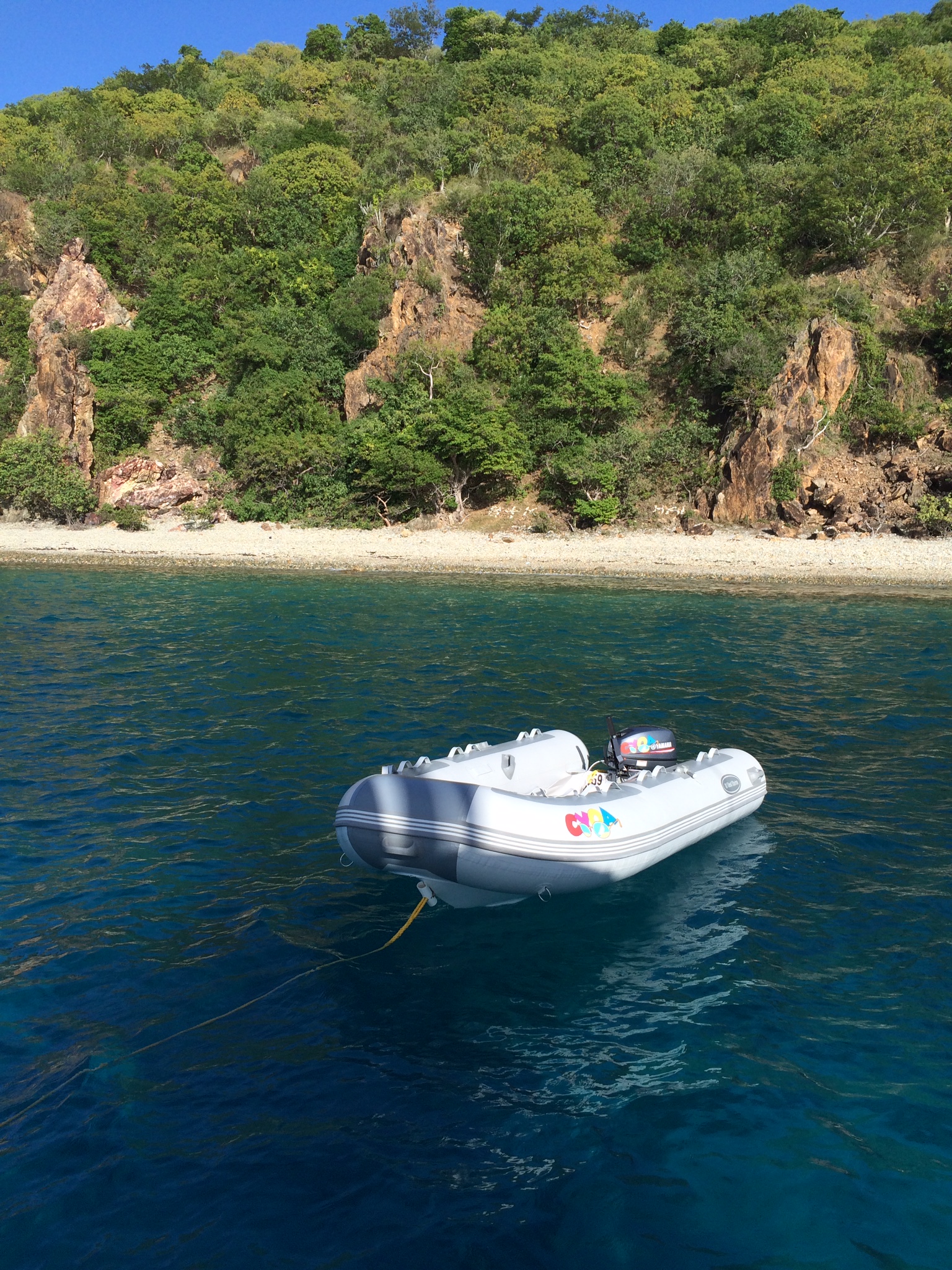
Susan was apparently awakened by a loud and persistent thumping noise. It wasn’t Bob experiencing a nightmare but it was the dinghy banging on the side of the catamaran. The only way this could have been possible was if our line had come loose from the mooring causing the cat to slide around allowing the dinghy to come alongside. That is precisely what had occurred. It also meant our catamaran was no longer attached to anything so it was slowly being pushed by the wind and the waves closer to the shore. Susan woke up Captain Jim and in doing so woke both Sarah and me. As I tried to rattle the sleep out of my brain the four of them sprang into action. Sarah climbed onto the deck through the hatch in our cabin as Jim went straight to the wheelhouse to fire up the engines. Bob and Susan joined Sarah in untangling the dinghy. Once that was accomplished Jim brought the cat around and the mooring line was attached again, this time even more securely. I lay there on the bed not because I didn’t want to help but, thanks to the four capable souls already taking care of business, I couldn’t imagine what, if anything, I could do to contribute. With that particular bullet dodged everyone returned to their respective bunks and the rest of the night slipped by without incident. The next morning we noticed Harmony had moved on so we untied Days Like This from the mooring, this time on purpose, and headed out ourselves. The next stop was Cooper Island.

bobandsusan

Another several hour sail awaited us and we enjoyed the sun and the sea along with dozens of vessels. One, in particular, was impressive and kept us company for most of the trip; it was a 70 foot grey cat that was christened, Maverick. I wondered where Goose and Iceman were and even though I said it loud enough for everyone to hear only Bob responded as he chuckled. Have I mentioned how much I like my father-in-law? It didn’t take long for Maverick to overtake us and the big cat was long gone when we reached our next destination, Cooper Island. Stopping here would mean spotting, and securing the boat to, another mooring which we did expertly. On shore we would find a restaurant, a rum bar and a coffee shop where we could get another latte in the morning. Everything there was within reach via a brief dinghy ride or swim. We had lunch, a dip in the water, and then relaxed. Just like the previous day many other sailing ships joined us in the bay. There were catamarans, mono-hulls and yachts but one distinguished itself more than the others. It was a yacht, large enough to have a helicopter pad, and it was both impressive and weird looking.

Painted a shade or two lighter than Army green the attention grabbing ship exhibited no outward markings. The bow looked like a dozen other luxury yachts except that it had a more impressive than normal array of globes and spheres that we speculated served as navigational and communication aids. While the front looked “normal” the stern was anything but. It was the same color but a third as high as the bow and appeared much more utilitarian than luxurious. To me it looked like something that might be commissioned by MI6, the CIA, Mossad, or the KGB. I immediately dubbed it “the spy ship” and kept me eye on it because I was sure it was doing the same to us. There were a few windows but they were covered. We noticed one or two people on board which I immediately identified as agents or plants. While my imagination ran amok my in-laws swam ashore to get a fruity beverage.

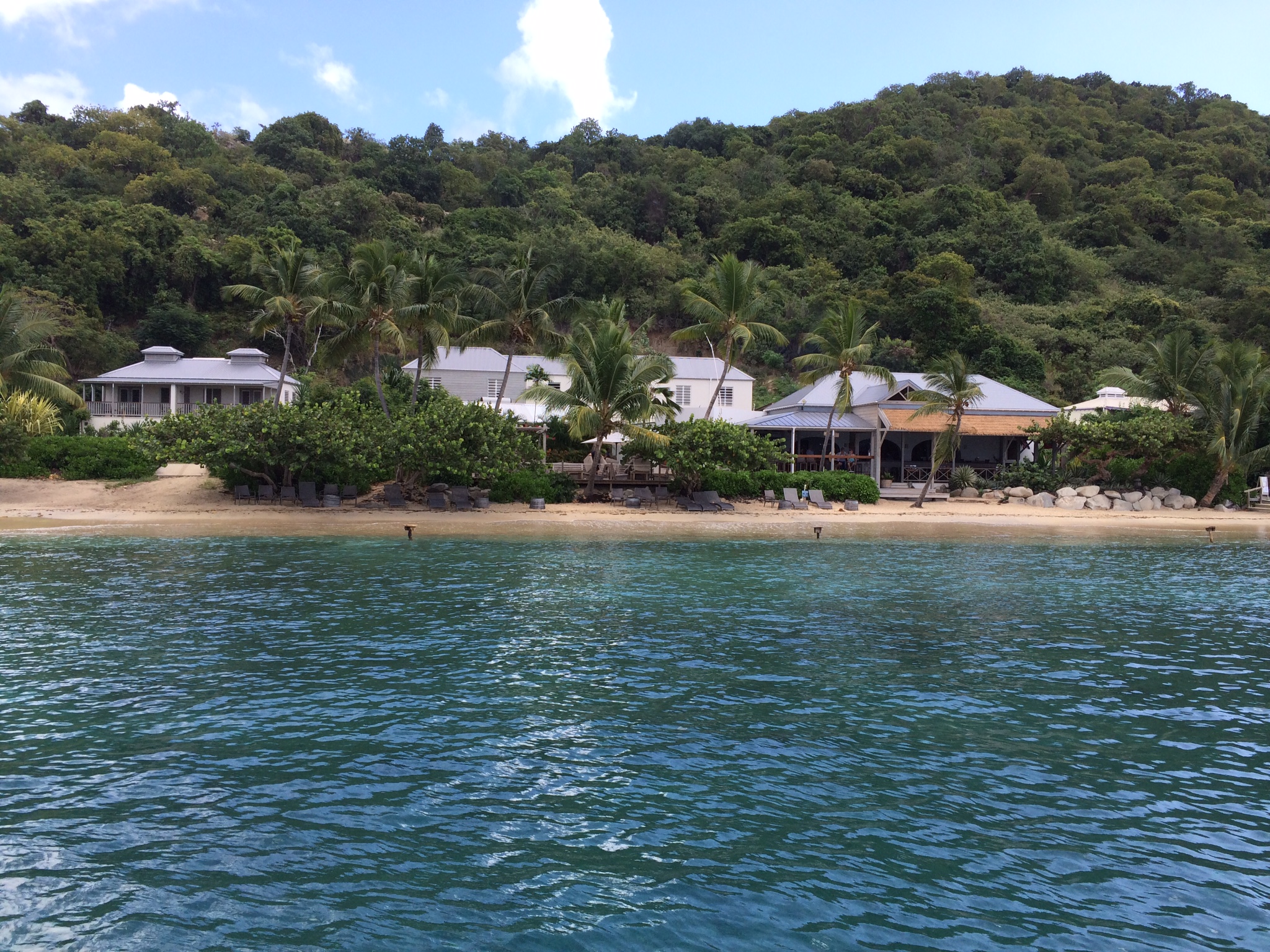
Under the watchful eye(s) of the spy ship we spent the afternoon swimming, reading, relaxing and practicing our knot tying (well we swam, read and relaxed) then we also enjoyed another captivating Caribbean sunset. Eventually we changed for dinner and, as gracefully as we could, climbed aboard the dinghy and motored to shore. Cooper Island is really cool. The northwest corner of the island overlooks Manchioneel Bay which is where our cat bobbed in the water along with dozens of other boats and 1 spy ship. The restaurant, Rum Bar and coffee shop, of which I spoke earlier, were all part of the Cooper Island Beach Club, an eco-friendly resort also featuring a handful of guest rooms, a boutique and a dive shop. It seemed like the perfect place for a paradise getaway but on this particular trip we were there for the food and the grog.

cooperislandbeachclub

Dinner was delicious as our group enjoyed pasta with lobster, shrimp and scallops, Mahi Mahi, and something called West Indian Roti which was a chicken curry dish wrapped in homemade flatbread. It all went down easily with a glass or two of The Chocolate Block wine, a South African red blend. As we ate, a gentleman of undetermined age was seated, alone, at a table nearby. Clothed in shorts and a faded Hawaiian shirt he displayed an easy air and chatted with the wait staff like he was no stranger. Susan immediately pegged him as the owner of the spy ship (this might be a good time to mention that my mother-in-law hadn’t bought in to my theory about the clandestine nature of our neighboring boat). Then, in an amazing display of naivety and lack of loyalty, my wife agreed with her mother while Uncle Jim and Susan’s husband agreed that it was certainly possible. I noticed I was now of singular mind so I dug in my heels and stuck to my guns. This fella was no more than an island hopping freeloader, I opined, (he wasn’t even wearing shoes). He clearly spent his time bouncing around the Virgin Islands enjoying the food, drink and the kindness of others. I admitted he could be independently wealthy but he was no way, shape or form, enigmatic enough to be the owner of, let alone a passenger on, my spy ship. We agreeably agreed to disagree, paid the check and set out for the Rum Bar for a night cap.

I enjoy a good drink and have, over the past decade or so, dabbled in experimenting with vodkas, gins and bourbons. Until the moment Captain Jim and I bellied up to the Rum Bar I had never given more than a passing thought to the sugar cane and molasses based spirit. I had no idea what I’d been missing. The bartender proclaimed his little corner of the world was the “finest establishment of its kind in all of the Caribbean” and looking at the menu and the vast variety of bottles it was hard to argue. At his disposal, and by default ours, were more than 70 different types of rum. Some were known to me and inexpensive while others were exotic and exorbitant which made them all the more intriguing. I somewhat reluctantly steered clear of the most expensive so Jim and I “settled” on a flight of three. Jim’s choice was a caramel colored liquid from the Dominican Republic called Vizcaya VXOP Cask 21. The barkeep suggested a second sipper; a tasty offering from Guyana called El Dorado 21 year old Special Reserve and my choice was solely predicated by the name on the bottle. I was bound and determined to give Pyrat Rum a try. There was a slight problem because there were two types of Pyrat but the problem was easily solved when the man behind the bar informed us that a 2 oz. glass of the Pyrat Cask 1623 would put close to $90 on my American Express bill. We decided on the much more reasonable XO reserve and took our treasures to the table where Sarah, Bob and Susan waited.

We all sipped and in turn marveled at how tasty the liquid was, each different but all delicious. Maybe it was the setting, most likely it was the company, but all three rums went down smoothly. My favorite was the one I chose. It tasted, at first, like caramel with a hint of orange but ended up more reminiscent of licorice. It affected the perfect end to a wonderful evening. As we headed back to the dinghy to get back to the boat we noticed the drifter/spy ship owner was long gone. We made it safely back to our boat and spent a restful, uneventful, night. When we woke up the next morning many of the boats that had accompanied us through the night had shoved off, but the specter that was the spy ship remained.

lifepreserver

Under another brilliant blue, cloudless, Caribbean sky we untied our line from the mooring and motored out of Manchioneel Bay on our way to the next stop; British Virgin Gorda. Exiting the bay Jim steered us as close as he possibly dared to the spy ship still anchored, impenetrable, and no doubt monitoring all the comings and goings on the tiny island. We passed, all of us staring, and noticed a man (who was not the drifter from the evening before) and a woman on the deck and my mother-in-law waved. I scrutinized their response, what appeared to be an innocuous wave back, looking for anything that would give them away. I noticed nothing “spy like”.

“See,” said Susan.

“Clever co-conspirators,” was my reply.

Up next British Virgin Gorda and The Baths

Posted in general observations | Tagged , , , , , | Leave a comment

A Sail Through Paradise Part Three


Overnight the wind had gone from blasting to merely blowing which meant we could unfurl the mainsail, let out the jib, and spend the morning of our next day on the water, riding the breeze, under sail. The next destination was the British Virgin Island of Tortola and Captain Jim wasn’t about to let us be mere passengers during the voyage. We were tasked with untying and tying knots, unhooking and hooking clips, steering the boat so the wind always filled the sails on Days Like This and our most important job; not falling overboard. The last assignment turned out to be the only one the four of us executed expertly. In case you didn’t know… sailing is hard.

Depending on the power Jim put behind the engines, or the strength of the wind, the cat could travel along at anywhere from 4 to 8 knots per hour. At any rate in this fast paced, hurry up, hustle to work, the store or the church on time, world we were not going very fast. But we were lucky enough to have someplace to go and literally all day to get there.

islands

Islands dotted the landscape and looked, using a modicum of old school imagination, like great, humpy beasts. Through an eons old lens I could see scales on huge backs exposed to the sun, wind and rain. Over time those scales turned to trees, rocks and shrubs. On either end of the massive backs the heads and tails remained submerged waiting and always ready for action if and when the time was right. They were all different, interesting and individual, some inviting, others not so much. By contrast the sea was incredible in its sameness despite the fact that each ripple on every single wave, bouncing us up and down or shifting us from side to side, was unique.

bobatthewheel

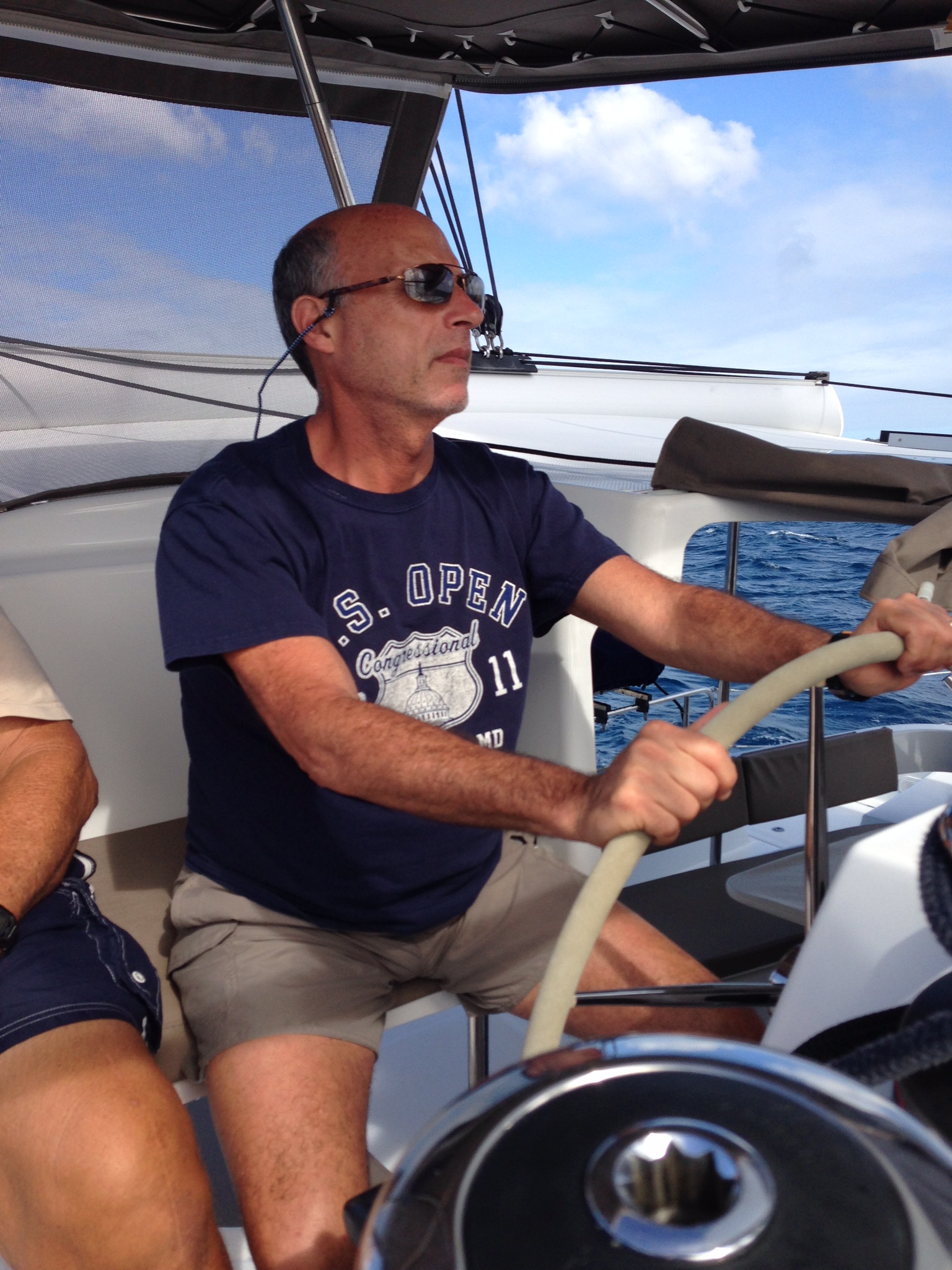
My father in law, Bob, was the first to accept Jim’s offer and take the wheel. I watched as Bob smoothly slid into the captain’s perch and Jim simply pointed to a spot in the distance (the top of a distant hill or the edge of a landmass on the horizon) and told Sarah’s dad to “go that way.” At that point it was up to Bob to keep the boat headed in the desired direction. Sometimes that was easier said than done. You see a sailboat is actually a tricky bugger to drive. What feels like a tiny turn of the wheel suddenly becomes a change in direction of multiple degrees. Then an attempt to correct actually becomes a massive over correction in the other direction. Bob handled the wheel with a light touch and heeded Jim’s additional advice to keep an eye on the anemometer at the top of the mast. If it was spinning like mad we were headed in the right direction but if it slowed it meant we were not taking maximum advantage of the wind. Of course the sight and sound of the sail starting to flutter and flap, begging for more breath, was also a significant sign as well. Bob was more than equal to the task of keeping us on track and then we got to tack!

My old friend Webster states that this is simply, “changing the course of a sailing vessel by bringing the head into the wind then causing it to fall off on the other side.” Not all that easy when the folks attempting to accomplish the task were four terrestrial beings from New Jersey. Once again having a seaman like Jim proved invaluable. With a smile on his face and in his voice he barked out orders. Okay, okay he didn’t really bark out anything but he did tell us what to do. On the cat there was four different colored ropes connected to various parts of both the mainsail and the jib. There were also two winches around which those ropes could be wrapped to help raise or lower them. When it was time to tack Jim told, then showed, me how to wrap the rope around the winch. Once wrapped my job would be to pull the rope as hard and fast as I could trimming the sail while Bob turned the wheel all the way to the right or the left (depending on the tack)in the effort to change the direction of the boat. If I tired, and I did, there was a winch handle I could turn to make the job a little easier. With a little help, and a lot of teamwork, the mission was accomplished, the sails swallowed the wind and we were headed in a different direction. Jim informed us that we would probably have to tack 6 or 7 more times before reaching our ultimate destination of Soper’s Hole Marina on Tortola. He was right about the number of tacks, we needed 7, but wrong about thinking he wouldn’t have to tell me each and every time how to attach the right rope to the right winch, “Sailing takes me away…”

sopersmarket

The marina at Soper’s Hole would be our home for the rest of the day and that night. Job one was getting a slip and docking the boat. Job two was to walk to Her Majesty’s Customs Office and wait while Jim, with papers and passports in hand, did what he had to do to make sure we could be the Queen’s guests for the next few days. While we waited Susan and Sarah enjoyed some sort of carrot smoothie concoction whipped up in a 20 year old blender by a wonderfully friendly Tortolian (is that right?). Apparently Jim was convincing enough that the customs officials allowed us to carry on and we walked back to the boat to spend the rest of the day.

There was a public shower and some of the members of our group decided it might be a good idea to take advantage of that. While we debated when and in what order we would do just that, a gentleman (I am making an assumption here but it was a male) strolled out to the back of his boat berthed a few slips away. Most, if not all, catamarans have a hose with a spray nozzle attached to the stern to wash off the salt, sand or dirt off either the deck or the body of a passenger. The man, who appeared to be in his 60’s was about to do just that. We assumed he was French because the boat flew a small French flag and that was the language he appeared to speak to someone else aboard his boat. What we didn’t have to assume was what he looked like naked, because he was.

“Oh my,” said my Mother in Law.

“Oh boy,” said my wife.

“Isn’t that special,” was my contribution.

“Not really,” said Bob.

We averted our eyes and enjoyed a good chuckle. My wife and Susan opted for a slightly more private option to get cleaned up and headed for the showers. Later that day we re-provisioned (more ice, booze, snacks, cold cuts, juice and some fresh fish for dinner the next night on the boat). That night we enjoyed dinner and drinks on the patio of the restaurant overlooking the marina and then headed back to the catamaran and to bed with thoughts of what the next day would hold, not the naked Frenchman, in our heads.

soperssunset

Next up Norman and Cooper Islands

Posted in general observations | Leave a comment

A Sail Through Paradise Part Two

After dinner, drinks and a good night’s sleep we woke early and visited the coffee shop/breakfast spot near the dock. I savored the last triple espresso, vanilla, breve latte I would have for a week. It was delicious. Back on board we secured our belongings and with the help of a couple of CYOA Charter deckhands we shoved off and headed out to sea. On the way Captain Jim took us on a brief tour of the main marina at St. Thomas so we could see a number of multi-million dollar yachts that were on display. We would get a look at even more of these beautiful boats as we travelled from island to island.

We left St. Thomas under motor power because, as Jim predicted, the winds were whistling upwards of 30 knots and coming from a direction into which it would be impossible to sail. We ended our marina tour and turned toward the channel that would take us to St. John Island. With a smile in his voice Jim said, “We call this stretch Puke Alley…” I didn’t hear what he said after that because I had ducked below to take a Bonine (hoping I wasn’t too late). I popped open the container, dropped two pills into my mouth and swallowed. Then I read the label which said the recommended dose was ONE a day. “Oh well,” I thought “I’m either about to be really sick or really not sick” and I headed back up top. Once there, it didn’t take long to see and feel why this particular part of the Caribbean had earned that not so subtle nickname. Days Like This bobbed and weaved over the waves and then slipped and slid between them. We all held on tight and were often splattered with ocean spray and occasionally doused with a substantial splash. The sea water was cold but it felt great. We loved every minute of it and the double dose of Bonine worked like a charm.

flagonboat

Despite the stronger than normal winds, we were just one of dozens of boats on the water, some headed into the marina and others, like us, headed out. It was weird because even though the sails on the catamaran were safely tucked away, the orchestra leader in my head struck up the band with sailing songs. As I looked out on the horizon the lyrics to the 1979 Christopher Cross song, “Sailing” meandered between my ears,

“It’s not far down to paradise at least it’s not for me

And if the wind is right you can sail away to find tranquility

Oh the canvas can do miracles…”

“You okay?” my wife, Sarah, interrupted my internal, very personal concert.

“Yeah, good,” I answered as the cat took another dip, then hit another wave soaking us all.

“Sailing takes me away…”

Christopher Cross’ song wasn’t the only one that bounced around in my brain during the trip. At various times on deck or at the wheel I silently sang along to Jimmy Buffett’s “Son of a Sailor”, Crosby, Stills and Nash’s “Southern Cross”, “Brandy” made famous by Looking Glass, or Lyle Lovett’s “If I had a Boat.” And, of course, the only time I actually went in the water, I immediately heard the “Da Dum, Da Dum, Da Dum” from the soundtrack to Jaws. Before you call me completely crazy, I dare you to climb aboard a sailboat in the middle of a lake, the sea, or an ocean and NOT think about sailing songs. In fact at one point during the adventure our entire group tried to recall the lyrics of “Dead Man’s Chest”. “Fifteen men on a dead man’s chest, yo ho ho and a bottle of rum,” was as far as we got before cracking open the bottle of rum.

Dayslines

Exploring our surroundings I noticed we were joined on our journey by a handful of frigate birds, with wings spread wide, alternately riding then fighting the wind that wasn’t too strong for them. We even saw an intrepid giant fly (it looked like a big, black bumble bee) trailing the catamaran for several hundred yards before disappearing. It either gave up or just gave up on us and found a more interesting vessel to tail. There were also countless other cats, mono hull sailboats, power yachts, ferries, water taxis as well as an occasional tanker and cruise ship. That was what was ON the water. I’m sure there were millions of other things, mostly carnivorous, beneath the boat at varying depths that I couldn’t, nor did I want to, see and you can’t convince me otherwise.

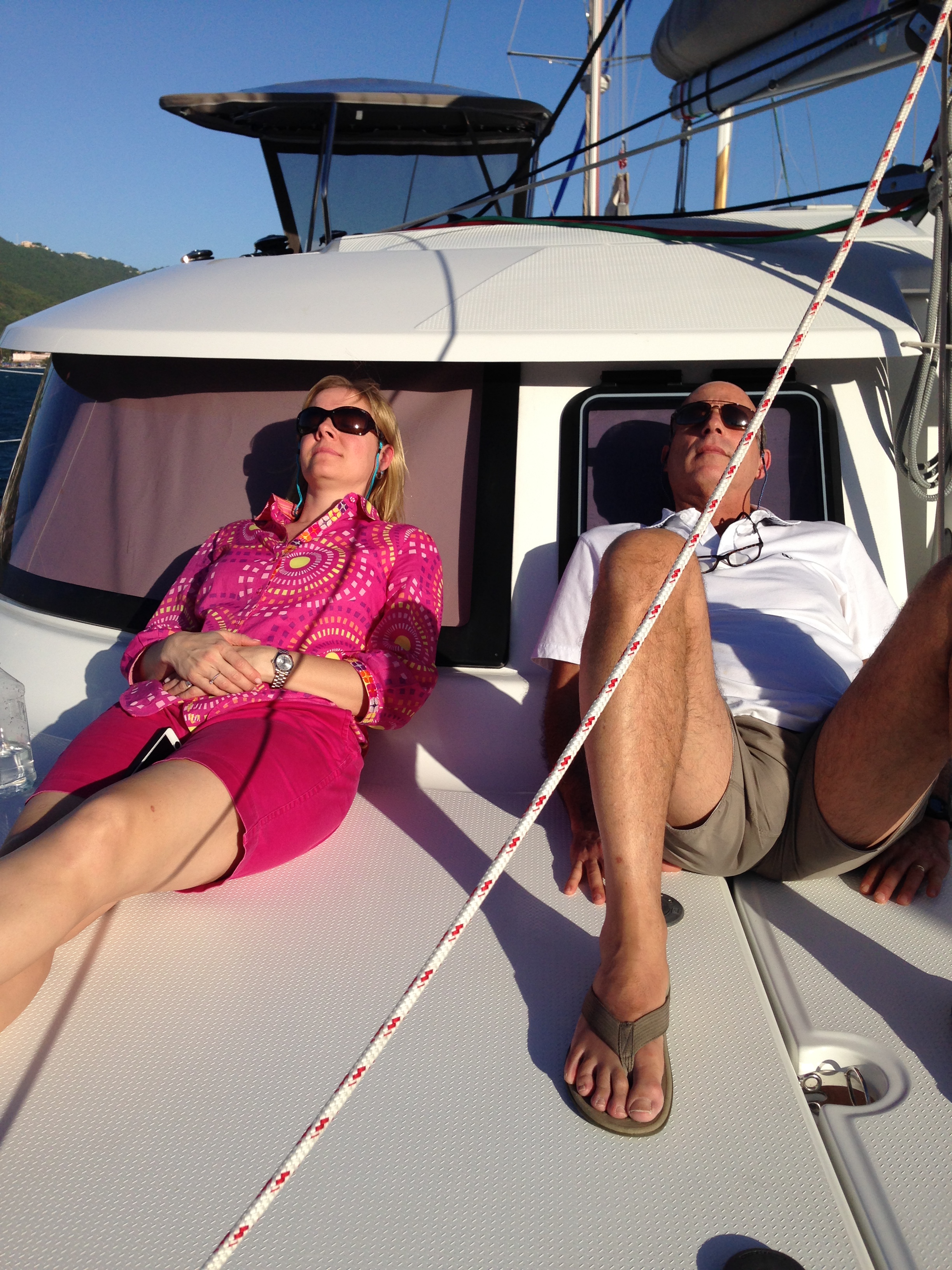
On rough seas it took us several hours to travel the roughly four miles between St. Thomas and the neighboring U.S. Virgin Island of St. John. The closer we got the calmer both the winds and the waves became and we could see the bay that, once we found our mooring, would be home for the rest of the afternoon and night. On the island, above the shoreline, we also spotted a very old stone structure standing sentinel. Jim informed us that what we were looking at what was left of the Annaberg Sugar Plantation which produced sugar, molasses and rum, thanks to slave labor, back in the late 1700’s and early 1800’s. Jim added that 2/3rds of the island was dedicated National Parks land and there was a walking trail that would take us to the old plantation. We decided to take the hike in the morning and since it involved being on Terra Firma I was all for it. After attaching the cat to the mooring ( a task, by the way, that proved a little more nerve wracking than I’d like to admit) Sarah, Susan, Bob and Jim decided to do a little swimming and snorkeling. I stayed on the boat and read the Jo Nesbo mystery that I had brought along.

keithreading

That night we enjoyed a delicious meal (even at sea my mother-in-law is a gourmet cook and my father-in-law expertly handles a bar-b-cue), cracked open the Cruzan, Hendricks, and McCallan, played a fun card game called Over/Under and marveled at the stars. There were no lights on land to adumbrate the heavens. We gazed upon the stars and tried to identify the constellations spotting only Orion and his brilliant belt. I mused that there must be thousands of constellations and wished I could identify more. Actually there are 88 constellations (a fact we all discovered while playing Over/Under) but I still can’t identify as many as I would like. We drank a little and laughed a lot and went to bed early that night. We woke up early the next day too. Coffee was made using an old fashioned percolator and a breakfast of fruit, yogurt, protein bars, and peanut butter on toast was available, in addition to my daily dose of Bonine of course.

stjohnhikeselfie

After breakfast we all hopped into the dinghy (FYI there is no graceful way to get in to or out of a dinghy) and headed ashore to hike up to the plantation. Jim had navigated the trail on many occasions so he decided to head back to the catamaran and take care of some “captainy” things leaving us with a radio and a “have a good time.” It was a comfortable and interesting walk starting along the water and then turning uphill to get to the ruins which turned out to be impressive and thought provoking. We saw where the slaves ate and slept as well as where they helped make the sugar, molasses and rum. The most dramatic and complete structure was the windmill that supplied the power to the plantation. The main building was also striking featuring huge stone blocks which comprised what was left of the walls. After about a half an hour we headed back down the hill passing curious tourists on their way up and catching more than a whiff of cannabis that lingered after one particular group.

stjohnwindmill

We made it back to the beach stopping for shelter under the thick foliage on a couple of occasions to avoid, as best we could, a passing shower. We hailed Jim on the radio and he picked us up then skippered the dinghy back to the cat. After climbing back on board we prepared to head to, this time under sail, to the British Virgin Island of Tortola.

Up next… another country, a new adventure.

Posted in general observations | Tagged , , | 2 Comments

My Most Memorable Golf Channel Moments

On January 17th The Golf Channel celebrated its 20th birthday. I know these days it’s just Golf Channel but in those days, 20 years ago, the “The” was still part of the name of the network. I was hired in October of 1994, three months before launch and worked there happily and proudly for 18 years. Initially my job was to produce all of the channel’s live domestic tournament coverage but as the number of events airing on TGC added up, that became impossible. So instead of all, I produced most of the events and headed up the production and announcer teams that worked at every one.

My time there was fun; fascinating, frustrating, fulfilling and will forever help define me. Reading reflections over the past month and a little more, from a number of quarters, I figured why not chime in and list the “Top Moments in Golf Channel History” from my perspective, my view from inside the building and inside the truck. So in no particular order, here goes:

THE 1995 HEALTHSOUTH INAUGURAL

The European Tour’s Dubai Desert Classic (won by Fred Couples) is rightly listed as the first tournament televised by the Golf Channel during the week of January 17th, 1995. It aired, in the morning, January 20th – 23rd but it wasn’t the only tournament on the network’s air that week. What isn’t mentioned as often is that The Golf Channel televised a domestic event that week too, The LPGA Healthsouth Inaugural. It was the first tournament produced by a team of Golf Channel hired personnel. Denny Schreiner, Donna Caponi, Kay Cockerill and Peter Kessler were the faces of the telecast and Hall of Fame member Pat Bradley was the champion.
TGCposter

THE ARNOLD PALMER GOLF GALA

In the 90’s the great Arnold Palmer sponsored and participated in a one day, 18 hole, two against two, star studded exhibition at Laurel Valley Country Club benefitting The Arnold Palmer Hospital for Women and Children and various charities in Palmer’s home town of Latrobe, Pennsylvania. In 1997 The Golf Channel was 2 and had just made the move from a pay-per-view service with thousands of viewers to a basic cable offering boosting the viewership by tens of millions. But to reach Joe Gibbs’ and Mr. Palmer’s goal of profitability it still had a long way to go and hundreds of cable outlets still to conquer. Televising The Arnold Palmer Golf Gala that August would go a long way toward making or breaking the network. Palmer invited 1996 British Open Champion Tom Lehman, friend and future PGA Champion Davis Love III and 1997 Masters Champion and phenomenon, 21 year old Tiger Woods. Palmer teamed with Tiger (it WAS his event after all) and they beat Lehman and Love in front of thousands of people in person and many, many more who watched on cable television.

THE DAY THE WORLD “GOT” THEIR BIG BREAK

It was early in 2002 and David Manougian was The Golf Channel’s President. He decided that what the channel needed was an off-site retreat for a few dozen top executives and producers to bond; exchange banter and bounce ideas back and forth. We gathered at a swanky hotel and spent a couple of days discussing what would make Joe Gibbs’ baby better. During one session we broke into groups of 5 or 6 and accepted Manougian’s challenge to “create a show that would anchor an Original Productions Department and help further put The Golf Channel on the map. I think our group came up with a “Hickory Shaft Challenge” that would mirror shows like the old Shell’s Wonderful World of Golf with modern day pros using old equipment. But the gem of the session was the brainchild of a group led by Jay Kossoff who called their show The Big Break. In it average, every day, aspiring golfers would compete in elimination challenges for the opportunity to earn a sponsor’s exemption to a PGA TOUR event. The concept was met with applause in the room and then became a franchise and a ratings bonanza. It was so popular (despite the fact that the sponsor’s exemption ended up being, not to a PGA TOUR event but, to several Canadian Tour events) that during one tournament featuring Big Break I winner Justin Peters, our team (that included PGA TOUR winner Curt Byrum) was out to dinner and while we waited for a table Peters arrived at the same restaurant. While Byrum and our play-by-play announcer Grant Boone sat chatting with Justin, I watched more than a dozen people approach and ask Peters for his autograph completely ignoring the TV guy and the TOUR winner.

TIGER WOODS

The greatest player of all time deserves more than just one memory. I’ll share a few. The first Tiger related story involves the Golf Central newsroom, a hirsute Scott Van Pelt, and a 20 year old Tiger Woods on TV winning his third straight United States Amateur Championship. After the first pumps flew I put my foot in my mouth and bet Van Pelt a hundred bucks that Woods, while a great amateur, would never, ever win on the PGA TOUR. We all know how that turned out.

The second Tiger memory involved our live production team and the opportunity to be the network of record for Tiger’s first PGA TOUR victory. Woods was playing in The Quad City Classic (now The John Deere Classic), just his third PGA TOUR tournament as a pro, and heading into Sunday he held a one shot lead over veteran Ed Fiori. The excitement among our group was palpable but it disappeared quickly when Woods made quadruple bogey 8 on the fourth hole and four putted the seventh hole and made 7 before we came on the air live. Fiori would win, Tiger finished T7 and ESPN, with my friend and mentor Andy Young producing, aired Woods’ first win, in Las Vegas, a few weeks later.
1996ldrboard

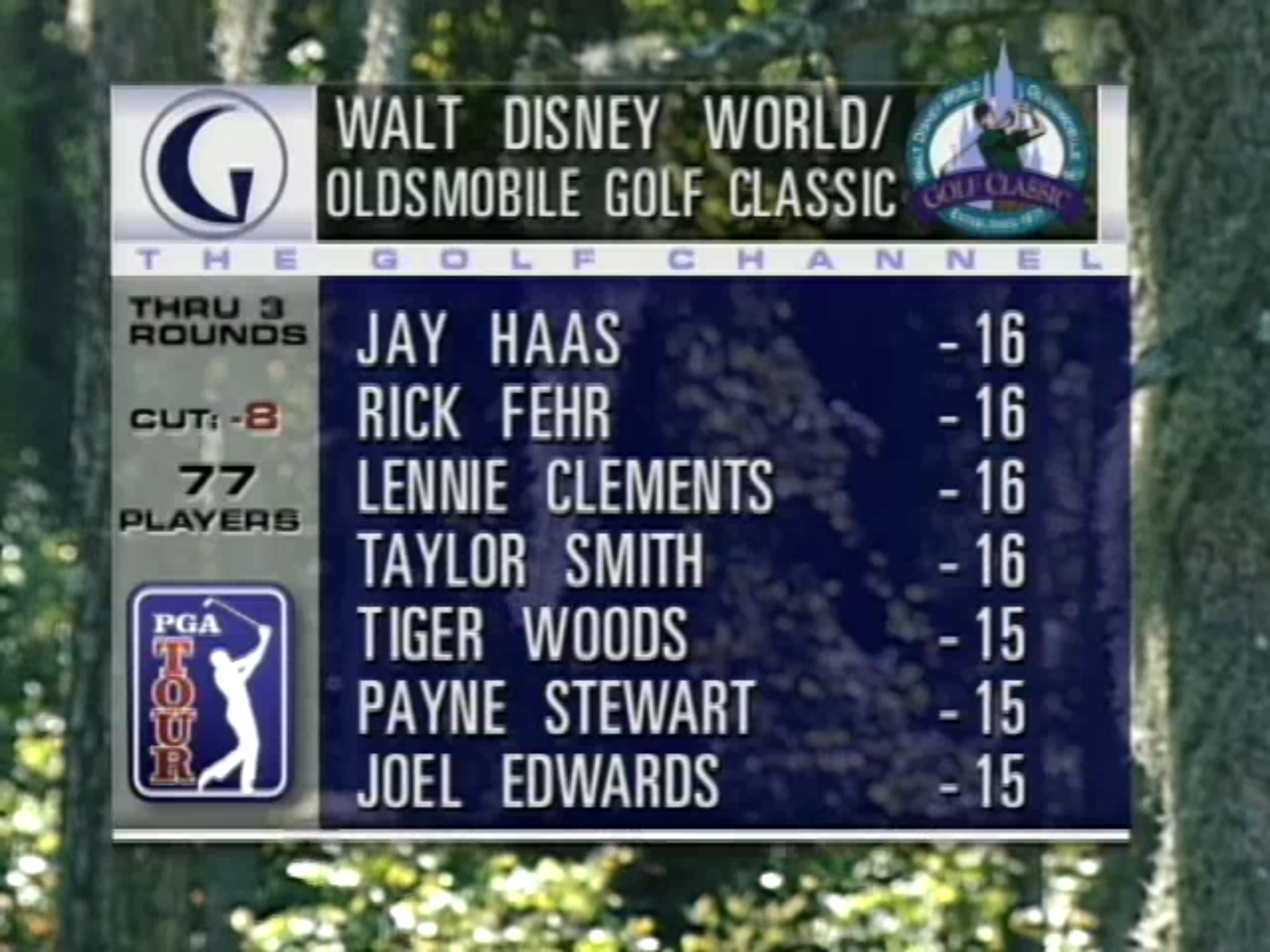
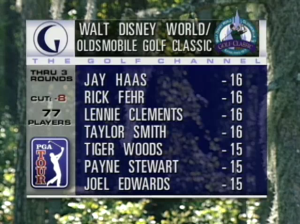
I did get a Tiger Woods win on my resume eventually (actually a week after he won in Vegas). It was our turn to produce the PGA TOUR event as the world’s best came to Orlando and Walt Disney World. This time Tiger didn’t disappoint as he went head to head with 1995 United States Open Champion Payne Stewart shooting 66 on Sunday to win by one. Woods’ 21 under par score was actually tied by a little known pro named Taylor Smith after he birdied the 72nd hole. Smith was subsequently disqualified because he used a putter with split grips that did not conform to USGA specifications. Instead of a playoff it was Tiger’s second win in seven events and gave him $734,794 for the year (good for 23rd on the money list). I’ll never forget Donna Caponi, interviewing Tiger Woods on the 18th green with Mickey and Minnie Mouse looking on.

GOLF’S TOUGHEST TOURNAMENT

The PGA TOUR Qualifying Tournament, or Q-School, was something Tiger Woods never had to experience but it was an event that I was lucky enough to produce 18 times. Our first was a “rehearsal event” that never saw air because we did it more than a month before The Golf Channel even launched. Woody Austin was the medalist and Chris Patton blamed our camera guys for not getting his card. Over the next dozen and a half years we watched Mike Weir, Pat Perez, JB Holmes, Carl Paulson, Scott Verplank and others win the thing. We showed the world David Gossett and Harrison Frazar shooting 59 and applauded as Ty Tryon, Boo Weekly, Billy Horschel, Bill Haas (with dad Jay watching), Rickie Fowler, Frank Nobilo, Webb Simpson, Jason Dufner, Jimmy Walker and hundreds more get their cards. We watched Joe Daley hit a putt in the middle of the hole and have it bounce back out and followed Roland Thatcher on to the roof at the Bear Lakes clubhouse to play his shot on the final hole. It was, until the PGA TOUR pulled the plug after the 2012 edition, the most dramatic and exciting tournament we televised each year.

CASEY MARTIN

He played golf on one leg and with all heart. Casey Martin was born with Klippel Trenaunay Weber Syndrome, a rare congenital medical condition in which blood vessels and/or lymph vessels fail to form properly. It affected his right leg making it painful to walk down the street, let alone around the hills and valleys of a 7,000 yard golf course. He played college golf at Stanford with Tiger Woods and turned pro in 1995. In 1997 he paid his $3,000 entry fee and went to Q-School playing well enough at early stages to earn a tee time at the finals. That’s when the PGA TOUR said “not so fast” and told Martin he could play, but he had to walk. Under the American’s with Disabilities Act Martin sued the TOUR and won getting a temporary restraining order allowing him to play, using a cart. He “won again” when we showed our viewers his rounds of 70,69,72,74 and 70, good for a card on what was then the Nike Tour.

One month later The Nike Tour season started in Lakeland, Florida and our cameras were there. So were Casey Martin, his clubs and his cart. His case was under appeal and his game was top notch evident by a superb Saturday 65 that gave him the 54 hole lead. In obvious pain, Martin held on Sunday to win by one and our cameras zoomed in on a tearful, exhausted and clearly exhilarated champion. The next time we saw Casey Martin was after the Supreme Court had, by a 7-2 decision, decided he could play and he could use a cart while doing it. Martin was now a news story and a celebrity and more than 200 reporters (including Stone Phillips from Dateline NBC, The New York Times, People Magazine, ESPN and The Wall Street Journal) joined us in Austin, Texas for his return. He played professionally on and off until 2006 including one full year (2000) on the PGA TOUR. He’s now the head golf coach at The University of Oregon.

AIMPOINT AND GOLF CHANNEL’S FIRST (AND STILL ONLY) EMMY

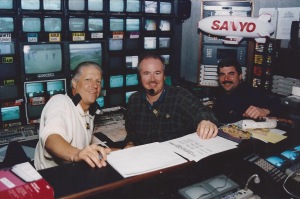
People in television production LOVE winning awards and an EMMY awarded by The National Academy of Television Arts and Sciences is the Holy Grail. Golf Channel earned it’s only one in 2007 thanks to a little blue line. The concept was simple and based on a formula invented by Mark Sweeney, and technology supplied by a company called Vistas Unlimited. A 1st and 10 like line would show the viewers the line of putt on which a player would have to ideally follow to make it. We showed it live and more often than not it worked to perfection. It was great television because you could tell immediately if a player had any chance at all of converting. Some in the industry didn’t like it because of that, but it was precisely that fact which made me wish we could use it on every putt, on every green. Unfortunately the expense made that impossible but it was used on several holes per telecast and at all our biggest events. The “Academy” took notice and awarded us the golden statue in 2007.
KeithEmSmarty

JANUARY 11, 2005

That was the day I learned, along with everyone else, that The Golf Channel belonged. On that day PGA TOUR Commissioner Tim Finchem, Golf Channel CEO David Manougian, CBS’s Sean McManus and NBC’s Dick Ebersol sat together and told the world via a teleconference that Golf Channel would be the exclusive cable home of the PGA TOUR for FIFTEEN YEARS. The news was surprising and stunning. In addition to what was the Nationwide Tour, the network was also granted the rights to broadcast the Champions Tour and, most importantly, the first three PGA TOUR events of the year and the seven tournament Fall Series that, at the time, took place at the end of the season.

ANNIKA, KARRIE AND THE BRIGHTEST STARS IN THE LPGA SKY

I already mentioned Golf Channel’s first domestic broadcast was the LPGA HealthSouth Inaugural won by future Hall of Fame member Pat Bradley. The field also included LPGA stars of the day Beth Daniel, Patty Sheehan, Meg Mallon, Nancy Lopez, Dottie Pepper, Betsy King and many more. Two players who weren’t there when we broadcast our first LPGA event would become that tour’s stars for the 19 years that followed, Annika Sorenstam and Karrie Webb. Since the moment Arnold Palmer and Joe Gibbs flipped the Golf Channel switch, Karrie Webb and Annika Sorenstam were on the road to stardom and we showed them get there. Between them they have been responsible for 113 victories. In the years from 1997 to 2005 Sorenstam won 60 times, many of them on our air, as she rose to the top of her profession. Webb, her main rival, won 25 times in that same span as both took the torch passed down from Daniel, King, Lopez, Mallon, Sheehan and Bradley then, in turn, passed it to Creamer, Wie, and Thompson.

THE SOLHEIM CUP

Golf Channel was eight years old and The Solheim Cup had just become a teenager when PING and the Solheim family took a risk and made TV history by deciding to move its namesake, worldwide women’s golf competition from broadcast television and NBC’s production to cable and ours. Channel execs promised to present live coverage of the event, from beginning to end, no matter the time or the place. It was, in true Vito Corleone fashion, “an offer they couldn’t refuse” so off to the Barseback Golf Club in Malmo, Sweden we went in 2003. The Europeans, led by the great Annika Sorenstam, got the best of their American counterparts and won for just the third time in eight tries. The days were long and the coffee terrible, but the experience was exhilarating.

FOLTZY

Jerry Foltz played junior golf with and against my younger brother. For one event, The Eddie Hogan Cup, I actually once served as the chaperone for the Nevada team that included them both. I followed on the periphery Jerry’s career in pro golf and was happy for him when he won on the Nike Tour in 1995. One year later our paths crossed again. We were on unfamiliar footing in Pensacola in 1995 as we aired the first of our 14 Nike Tour events. There were a few recognizable names and faces but for the most part we didn’t know Hugh Royer III from Franklin Langham from Tom Scherrer so we asked the Tour for help. Their solution was to have the nice fella named Art Sumrall, who re-gripped the players’ clubs, come in the truck, sit next to me, and identify golfers while we were on the air. That lasted about 10 minutes. What sounded good in theory was a disaster in practice. The monitors in the production truck were only 5 inches in size and about five feet away. They were also black and white so as I asked Art to identify someone I didn’t know I got one of the following two answers, “I don’t know, I can’t see a face” or “Don’t know him, he’s one of the new guys!” I took a commercial, thanked Art and watched him shuffle out the truck.

Lucky for me, a year later, Jerry Foltz was struggling through a back injury, considering his options, and looking for another career. He was also the unofficial “Mayor of the Nike Tour”, friendly with everyone, so when he presented his services to help us identify guys in 1996 I jumped at the offer. It was just a matter of time before I expanded his role and put him on the air as an announcer. A decision I will never regret.
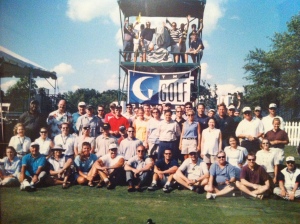
TGCgroup

ARNOLD PALMER

Like Tiger, Mr. Palmer deserves more than one moment and, again, I have three. The first was 1997 during a bright, sunshiny day (thanks Johnny Nash) in Park City, Utah. The Senior Tour, now The Champions Tour, was at the Park Meadows Golf Club for the Franklin Quest Championship and Golf Channel backer and golf legend Arnold Palmer was in the field and warming up on the practice tee. I had known of Mr. Palmer since the day I first picked up a club, and had covered him with ESPN and Golf Channel for almost a decade. Our crew was also on the practice tee getting ready to videotape some feature or another that would air in the broadcast that day. Mr. Palmer was several dozen feet away alternating between whacking balls and adjusting his leather grips. He paused and at the same time I looked his way. Then he stood straight, took one hand off the club with which he was practicing and waved me over. That was not the memorable thing, what he said was. “Keith,” he called and I almost fainted. I was too far away for him to read the credential around my neck so I realized, as I started his way, that Arnold Palmer, the most influential and popular golfer of all time, knew my name.

Months later Mr. Palmer was back in action at The Pittsburgh Senior Classic played near his hometown. The Quicksilver Golf Club was the venue and our crew, cameras and announcer team was there when, on Friday, a 67 year legend was making a run up the leaderboard. It was late in the round and Palmer was putting for a chance to take the lead and our on-course guy, Doug Tewell, was with the group. Doug had called a lot of golf and knew where to stand to be able to use a normal tone of voice to call the action so he was “in position” to call the birdie putt that would give Palmer the tournament lead. Arnie settled in, ready to delight the hundreds of fans who had circled the green and Tewell set the stage. Then, suddenly, the great Arnold Palmer, with hearing aids in both ears, stood straight up, turned in the direction he believed Doug Tewell to be and said, “I can hear you Doug.” In the truck we were mesmerized, on the golf course Tewell was mortified, on the green Palmer resumed his business, missed the putt, and ended up shooting a 3 under par 69. Tewell forever would say he called the rest of the round, “from the grill room in the clubhouse” and we got a lifelong memory. My guess is Arnold Palmer remembers it too.

One incident Arnold Palmer probably doesn’t remember is one I’ll never forget. We were in Golf Channel founder Joe Gibbs’ hometown of Birmingham, Alabama for the Senior Tour’s Bruno’s Memorial Classic. Our booth was near the 18th green and in it, was the standard desk, behind which the announcers would sit, and a couch. For some reason we decided that it would be a good idea to have players join us in the booth after a round and offer them a more relaxed environment in the form of a couch. During one of the telecasts Mr. Palmer agreed to spend a few minutes with our viewers and Mr. Gibbs joined him. I was informed that they were on their way and from our production truck several hundred yards away I told the booth crew to get ready. Palmer and Gibbs walked in and Arnie was asked to sit on the couch and get mic’d up. I’m told Palmer froze, took one look at the couch, tuned to Joe and said, “I’ll be damned if I’m sitting on that.” His expectation was that he would sit alongside our commentators behind the desk. To the crews credit they stuck to the company line and tried to explain that the couch was a “new initiative” designed to “show the player in a more relaxed light” but Palmer was having none of it and stated the only way he would do the interview was if he joined our guys at the desk. Suddenly the voice in my headset was my ultimate boss, the guy who started the channel, Joe Gibbs who said simply, “get your butt up here right now.” I tried to explain that I was a little busy, producing a show that was currently airing live on his network and then said, “Tell Mr. Palmer he can, of course, sit anywhere he likes.” The couch stayed on as a part of our Champions Tour coverage for years but Arnold Palmer never sat on it. Not once.

MAJORS

On Twitter recently Rich Lerner called Golf Channel, “the little engine that could” and I appreciated that reference. We broke a lot of ground, toppled a number of barriers and made our share of history long before Comcast paid billions for Joe Gibbs’ brainchild. We also televised a number of golf’s major championships. Don’t get me wrong, I would never claim that we broadcast a United States Open Championship, Masters Tournament, a British Open or a PGA but we were, and the network still is, the television home for The LPGA Championship on the LPGA Tour (we broadcast it for the first time in 2006) and the Tradition on the Champions Tour (our first was 2008). It was an opportunity to showcase the game’s greatest players competing for some of their most coveted championships. At Bulle Rock Golf Course in suburban Maryland I produced LPGA Championships that saw Se Ri Pak, Suzann Peterson, Yani Tseng (twice) and Cristie Kerr win and in rural Oregon we were there when Eduardo Romero was victorious. Every event was fun. The majors were special.

INSPECTOR GADGET

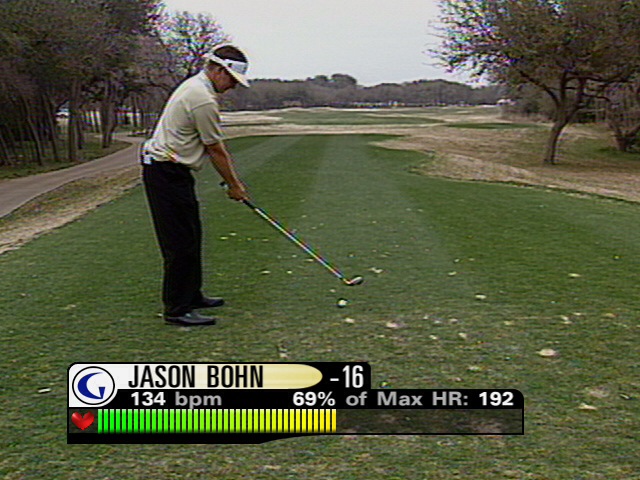
One of the best things about producing Nike/Buy.Com/Nationwide Tour events for Golf Channel was the ability to use that tour as a laboratory for technology and production ideas. We did a show without announcers, several shows with players, who had just finished their rounds, as announcers and announcers who were players wearing microphones. Those things had all been done before but we also tried things that had never been attempted. I thought we could use a JUGGS radar gun (the same device used by baseball scouts) to measure the speed of a golf ball as it left the clubface. It worked, much to the surprise and delight of a skeptical Curt Byrum who was our professional guinea pig on the practice tee. One player who wasn’t delighted was Bobby Wadkins who, at a Canadian Tour event, threatened our volunteer operator that he would “shove the device where the sun don’t shine” if it wasn’t turned off. That was interesting but nothing compared to the heart rate monitor Mortara Instruments developed for us to illustrate the nerves never before displayed. Surprisingly dozens of players agreed to wear it (I guess not so surprisingly when you realize it meant they would be on TV). Of the group, Laura Davies was the calmest, barely making the instrument beep while Robert Floyd, not “The Volcano” Steve Pate, set “the record high” with a reading of more than 180 beats per minute. Jason Bohn played the best with the thing on making a Canadian Tour record eight straight birdies while several players agreed to wear it only to rip it off before reaching the first tee.
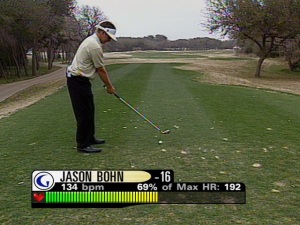
heartrate

LOOK WHO’S IN THE TRUCK

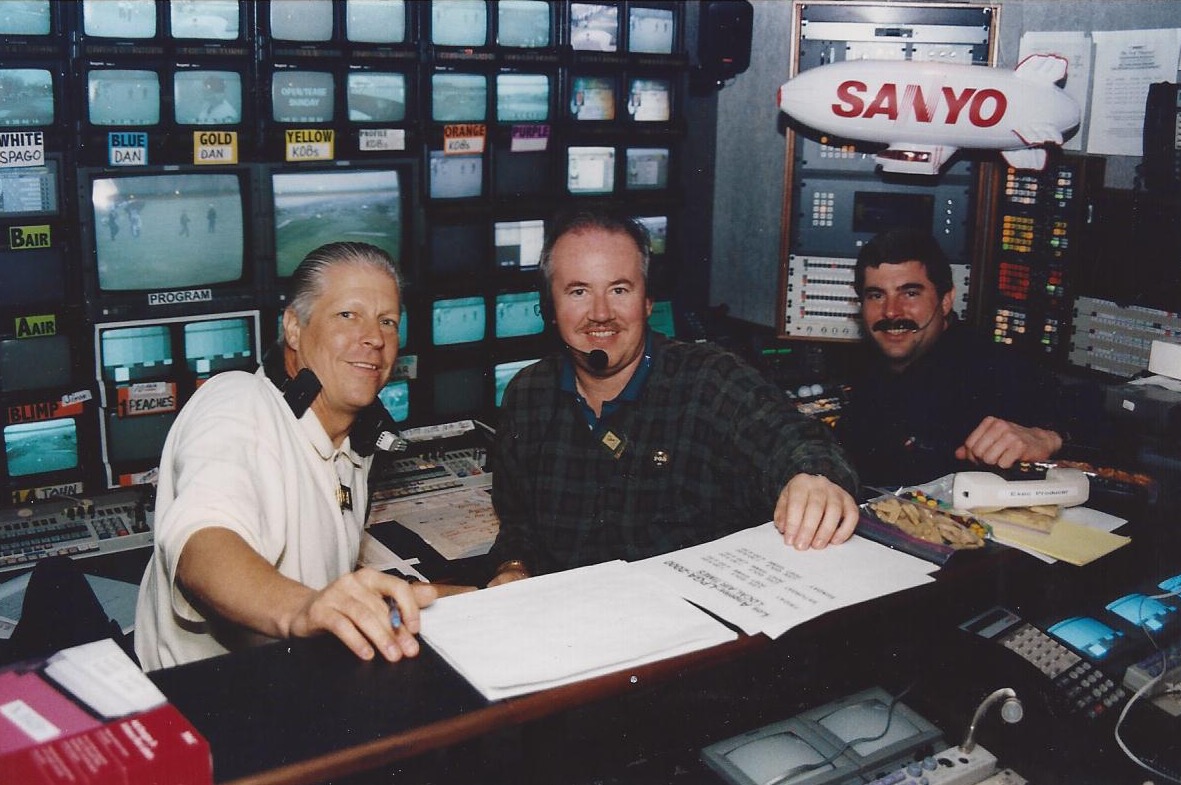
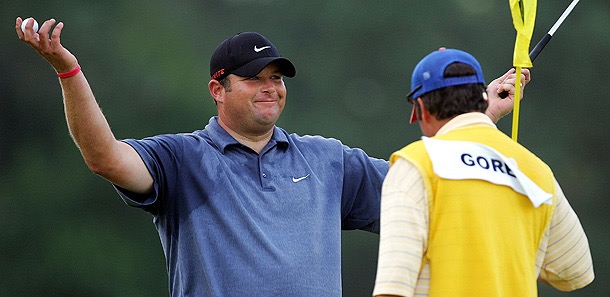
Along those same lines we were lucky enough to have a great group of players who were willing to play along with us on both the Nationwide tour and the LPGA tour. The idea was simple, get a professional player just coming off the golf course to perform a job normally executed by a professional member of the crew and then have a camera show them screwing up. On various occasions Beth Daniel, Jason Gore and Ron Whitaker ran camera, Meg Mallon counted us to and back from commercial, Keegan Bradley spent a few segments in the tape room, Colt Knost operated the graphics machine, James Hahn produced and Rocco Mediate directed. It was funny, fascinating and mistake filled but many watching agreed that it was “good TV.”

TRYING OUT PLAYERS AS ON COURSE ANNOUNCERS

I will take a sliver of credit for hiring Brian Anderson, Grant Boone, Craig Perks and others and take full credit for giving a microphone to Jerry Foltz, Curt Byrum and Brandi Seymour (remember her?). Finding talent to broadcast golf on television isn’t easy, finding good talent is even more difficult. In 17 years I “tried out” more than my share of guys that simply didn’t make the cut. Three of my favorite memories involve Morris Hatalsky, Mike Hulbert and Mike Donald.

Mike Donald almost won the United States Open Championship in 1990. He was tied with Billy Ray Brown after 54 holes and four shots ahead of Hale Irwin when Sunday started. Irwin shot a 67 that included a 45 foot birdie putt on the 72nd hole. Donald, playing in the final pair saved pars at 12 and 14 before not saving par at 16 and falling into a tie with Irwin. He had a chance to win outright but his birdie putt at 18 missed and off to the 18 hole playoff the two went. Again Donald was out front, this time by two shots, when they got to the 16th tee. Irwin birdied and the lead was one. Both parred 17 and Irwin made par on 18 which meant Donald had a second chance to be a U.S. Open Champion. His par putt slid by which meant for the first time in history The United States Open would be decided in sudden death (previously ties after 18 necessitated another 18 hole round). Irwin birdied the first hole of sudden death to become the oldest winner in the championship’s illustrious history. Mike Donald drifted into obscurity. That’s where we found him (actually it was Virginia Beach) on the Web.com Tour. We were at a sushi bar on Friday night and so was Donald after missing another cut. We talked, reminisced, and for some reason I asked him if he would like to join our broadcast the next day as an on course announcer. He jumped at the chance. The first time we sent it his way he started his commentary with, “UM, yeah, okay…” I cautioned him to get right to the commentary without the first three words and sent it to him again a few shots later. “UM, yeah, okay” began Donald. After that shot I again asked him nicely to not say “UM, yeah, okay” and just get to the call. He responded, “UM, yeah, okay” and proceeded to start every single call that day with those three words. After the show I thanked him and wished him well.

Morris Hatalsky never said, “UM, yeah, okay”. As a matter of fact MoCat didn’t say said anything at all. Before the Valero Texas Open one year a PGA TOUR media official mentioned that Hatalsky was interested in doing some on course announcing. He knew of my proclivity to try players out with a mic after they had played in the morning and thought he’d be good at it. “Why not”, I thought and said and Hatalsky joined us for lunch and our afternoon production meeting on Thursday. I gave him my standard spiel which included, “you’ll hear my voice telling us where we’re going before you hear Grant actually say it on the air so don’t respond to me, wait for Grant. In fact, in your ear I will even say something like, David Toms second at 13 Morris is there, wait for Grant”. And “Don’t start a story or make a comment as the ball stops rolling because chances are I’m off to another shot.” Got it” said MoCat. “Just relax and have fun,” I added, “It’s just golf TV.” Hatalsky smiled and finished his lunch. We went on the air and I said pretty much the exact words I had said in the trailer over the headsets and waited… Hatalsky said nothing. A few minutes later Grant Boone was instructed to send another shot Hatalksy’s way and he did… Hatalksy said nothing. This continued for about a half an hour until frustrated I asked if Morris’ equipment was functioning properly. “It worked fine,” said Morris Hatalksy from over my shoulder in the truck. “What are you doing in here?” I asked, “Why aren’t you with the Toms’ group out there?” I added. “Couldn’t do it,” the 4-time PGA TOUR winner said. “I already have too many voices in my head,” he added a little sadly, “I don’t need any more.” He set the equipment on the shelf behind me and said, “Thanks for the opportunity,” then left the truck.

Mike Hulbert won three times on the PGA TOUR including the 1989 B.C. Open and it was there, at the En Joie Golf Club a few years later, I handed him a headset and told him to follow the group that included his friend and fellow PGA TOUR winner Peter Jacobsen. During the broadcast “Hubby” did a nice job, he was succinct and well-spoken. Jacobsen played well and was in contention which warranted a post round interview. This could be accomplished in a couple of ways; have “Jake” come to the announce booth or have the on course announcer conduct the interview near the scorer’s tent near the 18th green. I chose the latter and said to Hulbert as Jacobsen walked off the last green and into the tent, “Nice job Hubby, now I want you to talk to Jake.” Jargon for, “I want you to interview him.” “Okay and thanks,” answered Hulbert as I went back to the action on the course and waited for Mike to corral Jacobsen. I waited and waited until too many minutes later I asked in Hulbert’s headset, “Hubby, what’s going on? I wanted you to talk to Jake.” The answer I received was priceless and unforgettable, “I talked to him,” said my on course announcer, “he’s feeling great and said to say hello.” The truck erupted in laughter and I groaned, “No! I wanted you to interview him for the show.” “Oh,” said an embarrassed Mike Hulbert, “I thought you just wanted me to talk to him. I think he’s signing autographs, let me go get him.” He did and moments later, headsets askew “Hubby” talked to “Jake” again, this time on TV.

THE 2007 MERCEDES CHAMPIONSHIPS

The historic 15 year partnership between the PGA TOUR and Golf Channel was struck in January of 2005; it went into effect in January of 2007. For the very first time I would produce the TOUR’s first event of the season, its tournament of champions, The Mercedes Championships. That was special but what made it even more so was that I would be able to do it with both my parents in attendance. My folks had “retired” and moved to Maui decades earlier and while they had been present when I produced Champions Tour events and Senior SKINS Games they had ever seen me in the truck for a PGA TOUR event. They had become fixtures in the media room, disseminating information to reporters, but took the time to spend a few minutes watching me work. My Dad even asked our engineer in charge to make a recording of the broadcasts with the audio from my headset included and gave them to me after the tournament ended. It was a wonderful week made even better by my mom and dad’s presence. Sadly it would be the last time that would happen. My dad was under the weather that January, he thought it was a cold, the doctor said it was a mild case of pneumonia, it was neither. Lee Hirshland died of cancer that May and my mom, Virginia, followed him 14 months later. They never saw me produce another show but I am so grateful we were able to be together that week.

LIFELONG FRIENDS

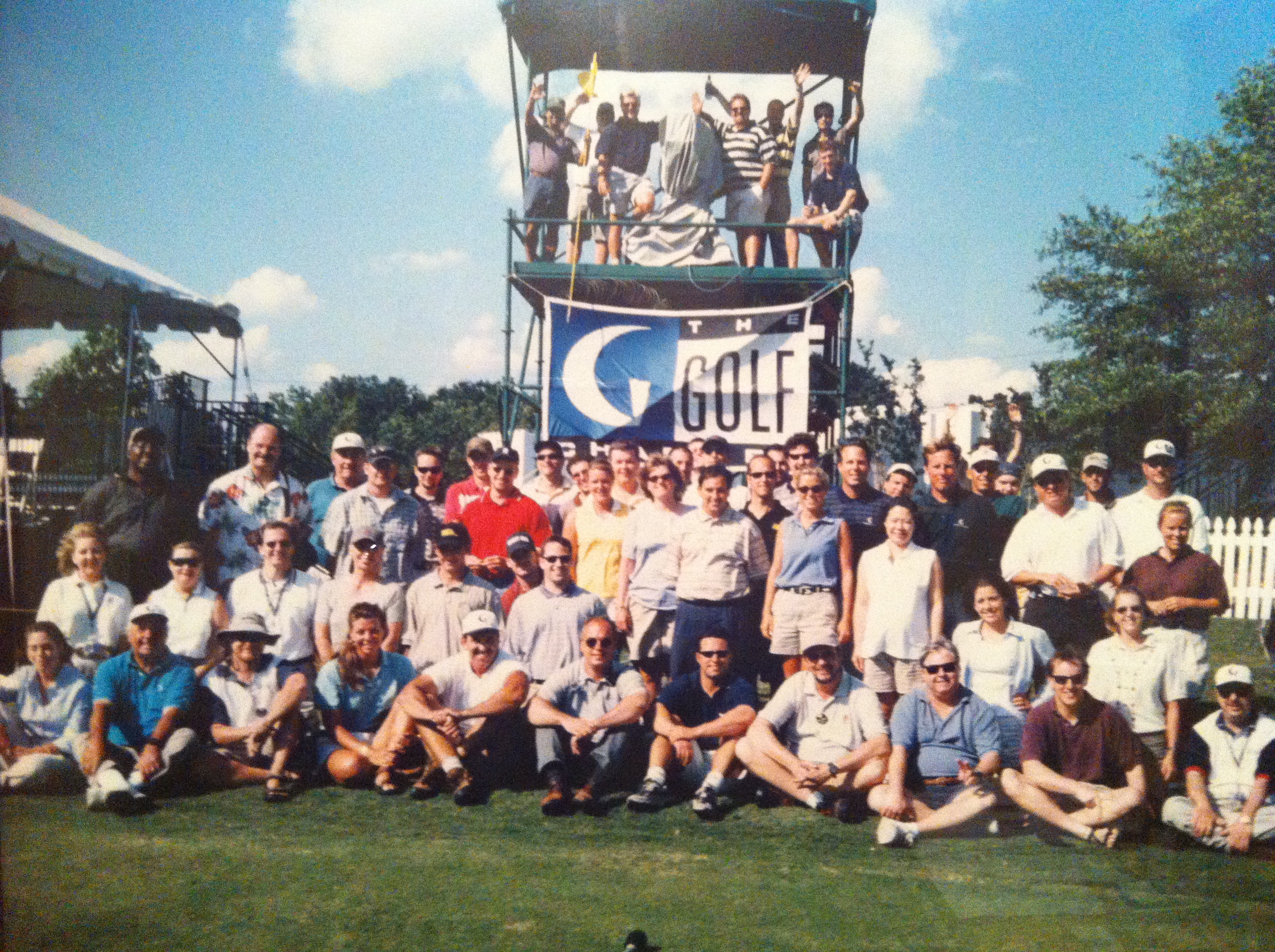
I am hopeful everyone with whom I ever worked at Golf Channel feels a sense of pride this 20th anniversary year and takes a moment to reflect on being part of a groundbreaking accomplishment. I was there 18 years and while I certainly made an enemy or two, the number of friends I made still boggles my mind. I wouldn’t bore you, nor could I come close to listing them all here, but I will say Bob Greenway, Gary Stevenson, Jeff Gershengorn, Karel Schliksbier, Peter Esposito, Emmet Loughran, Chuck Whitfield, Elizabeth Wright Starrs, Jerry Foltz, Brian Anderson, Daisy Phipps Pulito, Don McGuire, Frank Nobilo, Kay Cockerill, Donna Caponi, Grant Boone, Mark Lye and Curt Byrum will all always each occupy a special place in my heart. Hundreds of hard working production people & technicians, talented broadcasters, amazing players, Tour officials and brilliant businessmen have all come in and out and back in to my life thanks to Joe Gibbs and his dream. Working there was a dream come true for me and my hope is for 20 more tremendous years for “the little engine that could”.

Posted in Uncategorized | Tagged , , , , , , , , , , , , , , , , , , , , , , , , , , , , , , , , , , , , , , | 2 Comments

A Sail Through Paradise Part One

I am a landlubber. In fact I just might take “landlubbing” to the extreme. I get little enjoyment from going in the water. I see nothing relaxing about lying under the sun, at a beach, on the sand. Landlubber IS a word, not just a Disney pirate insult. Webster defines it as “an unseasoned sailor or someone unfamiliar with the sea.” Yep that’s me. I would go even further and add, “Someone who prefers the land to the water” to my version of the definition.

It hasn’t always been that way. I was born on the Hawaiian Island of Oahu and was told I spent hours as a small child not only at the beach, but in the Pacific Ocean. I even have pictures to prove it. We left Hawaii when I was two but I remember family vacations as a kid, in the car on the way to our ultimate destination agreeing only to stop the night at a hotel or motel with a swimming pool. I think the way I feel about spending time in the water changed during the summer of 1975. I was 19 and, like millions of others, went to see the movie Jaws and read the Peter Benchley book on which it was based.

Deep down I’m sure I realized there were always beasts, big and small, with sharp teeth deep down in the water but after Jaws I couldn’t get it out of my head that those creatures, deep down, were swimming around just waiting to sink those teeth into me. So ask me how I spent the seven days between January 3rd and January 10th this year. Why, on a catamaran sailing the Caribbean around the Virgin Islands of course.

The winter getaway to paradise was the brainchild of my wife, Sarah, and happily included her parents, my in-laws, Susan and Bob. She chose the Virgin Islands because 1) they’re beautiful and 2) because her uncle Jim has been a sailboat Captain, living on Water Island near St. Thomas, for more than 30 years. He agreed to be our skipper and we were fully prepared to be his willing crew. I stood alone in my trepidation. My wife and her parents could not have been more excited about the prospect of the sun, sand and brilliant blue water that awaited us. I was perfectly fine with the sun part it was that pesky sea and sand that was the source of my concern.

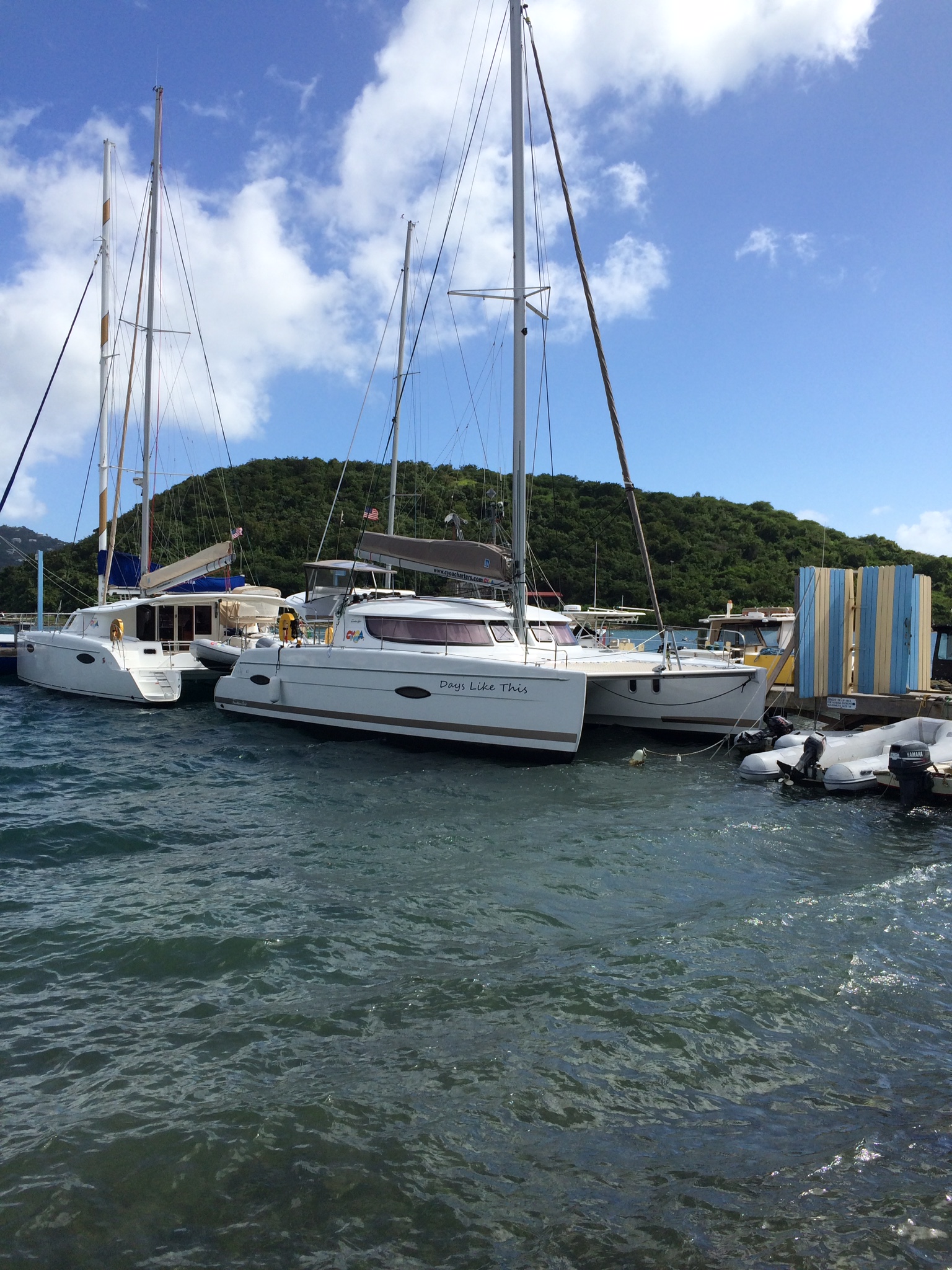
Our flight left Newark International Airport at 7:15 AM on Saturday. It was 17 degrees. Four hours later we arrived on St. Thomas where it was 65 degrees warmer on the thermometer. We were greeted, first by a Cruzan rum representative who handed out shots of mango flavored liquor, and then by a taxi driver holding up a sign on which we saw our name. In a heavy accent he told us his name was Wells. He showed us where his van was and we waited for and in short order grabbed our bags. Wells helped us put our stuff in the back and we all climbed in for the ride. Along the way our driver introduced us to “St. Lucia country music” by way of a homemade mix tape to which he sang along. The ride was short, a couple of songs worth, and we arrived at the marina where our Caribbean home away from home was docked. For the next week a 41 foot catamaran which someone had named Days Like This (as in “Mama said there’d be…) was home.

dayslikethis

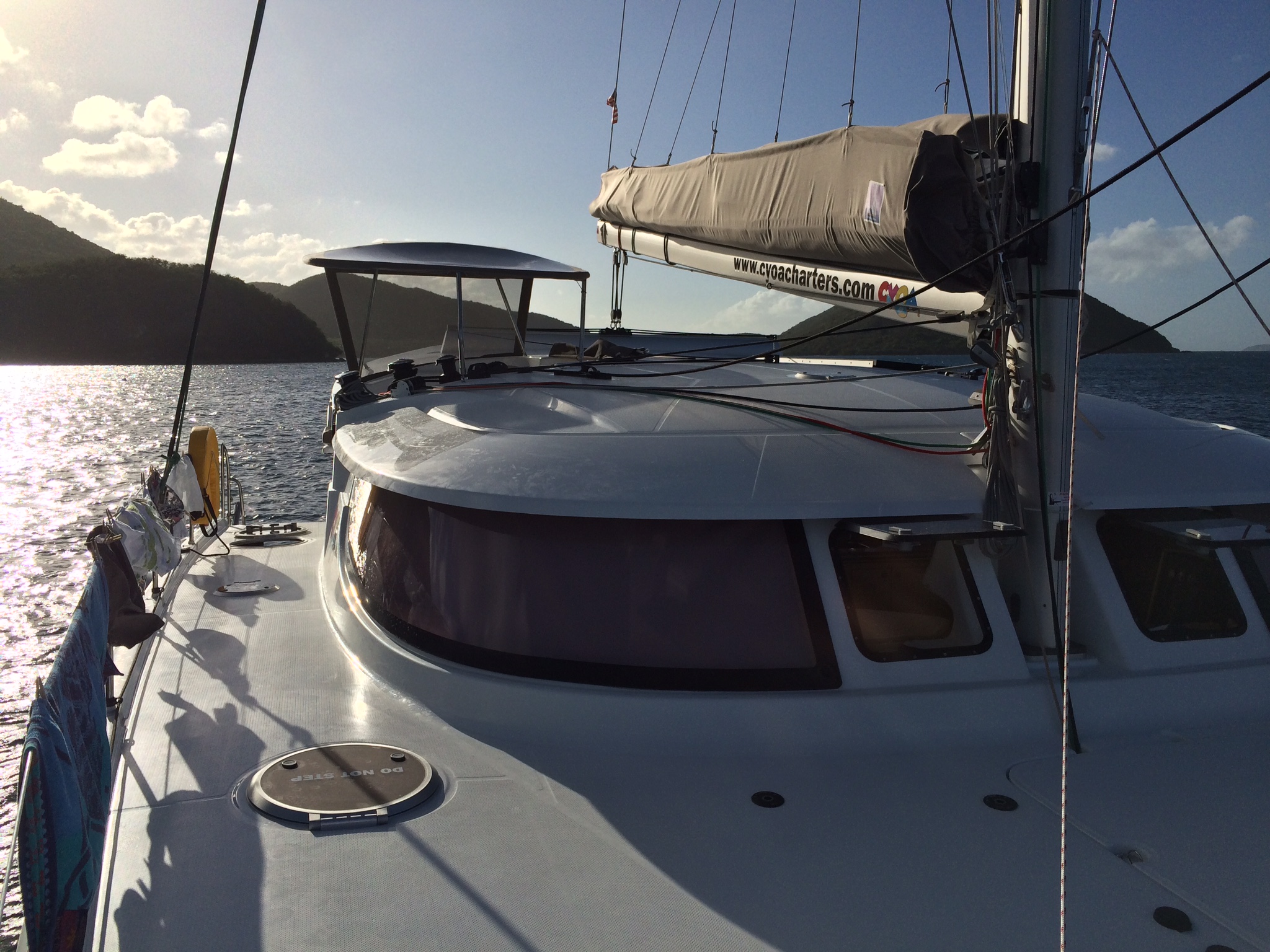
We disembarked the van, thanked and paid Wells, grabbed our gear and headed toward the slip hoping to change from jeans, jackets and long sleeved shirts to shorts swimsuits and tee shirts as quickly as we could. As we rounded a corner we saw Uncle Jim, henceforth referred to as Captain Jim, headed our way. After hellos and hugs we headed aboard Days Like This to change and stow our stuff. My father-in-law Bob had already started to tan. The boat (aside alert… I once asked my pop, who was in the Navy, the difference between a boat and a ship. With a straight face he answered, “A boat is what hangs off the side of a ship.”) was impressive. 41 feet long, about 20 feet wide it featured a mainsail, a jib, a trampoline like netting for relaxing on the bow and a bar-b-cue and two sets of steps for climbing in and out of the water at the stern. Below decks we found berths and heads for at least six people.

dayonestthomas

We chartered Days Like This through a St. Thomas company called CYOA (Caribbean Yacht Owners Association www.cyoacharters.com) and while signing paperwork in the office we found out our “ride” was only a year old and in tip top shape for the journey. We also bought croakies for our sunglasses and I picked up a string with clips designed to keep a ball cap attached to a shirt collar, both things came in handy while sailing in a 20 knot wind. We were very lucky to have Uncle Jim as our Captain. He grew up around and on boats, has sailed a mono-hulled sailboat across the Atlantic Ocean on more than one occasion, and has piloted charters and party boats around the Virgin Islands for years. He was our “Skipper” and we were all “Gilligans”. We left the office and headed for a nearby restaurant to grab lunch and discuss our plans for the six day sail.
Over lunch, and our first adult beverage of the trip, we discovered Jim had already given the itinerary some thought. His plan was to spend the first night docked right where we were, giving everyone including him, a chance to acclimate to the cat. He had sailed vessels of all shapes and sizes in all kinds of water but he told us he had never taken the helm of a 41 foot motor catamaran. We weren’t concerned.

dayslikethisbow

Bright and early on day two we would head out, under motor power because the winds were expected to climb as high as 30 knots, to St. John Island where we would find a mooring (an anchored buoy off shore on which we would secure the boat), tie up, hang out, swim and snorkel, have dinner and spend the night. Day two at sea would be a day under sail heading to the British Virgin Island of Tortola. Once there we would head in to Sopers Hole Marina, find a slip, and settle in for the night. Jim also informed us while on Tortola we would have to pay a visit to Her Majesty’s Customs Office to announce our presence and intentions before continuing on the journey. On day three we would continue, under sail, and head to Norman Island to snorkel and swim in and around “The Caves”, then find a mooring and have dinner and spend the night on Days Like This.

sailboats

The next day we would stay in the British Virgin Islands and sail over to Cooper Island. Once there we would find another mooring off shore leaving us a quick and easy dinghy ride to dinner and drinks at one of the islands’ best rum bars and restaurants. After another night on the boat we would sail to our next stop, Virgin Gorda, dock the cat in a harbor slip, and check out the world famous “baths”, a popular snorkeling, swimming and hiking spot on the island. Dinner that night would be on shore followed by another good night’s sleep under the Caribbean sky. Finally we’d wake Friday morning, head back toward St. Thomas, and spend one last night on Days Like This moored in Honeymoon Bay. Sounded like a plan except of course for the swimming, snorkeling, caves and baths parts. We all expressed our enthusiasm for the itinerary and our excitement for the adventure. All that was left was to find Wells, have him shuttle us to the local supermarket and liquor store, and spend a fortune on provisions.

Up next… we shove off

Posted in Uncategorized | Tagged , , , , , | Leave a comment

Would a Return to Wordsmiths Make American Golf Broadcasts Better?

Another golf season is upon us which, for me, most certainly includes plenty of time sitting in front of the television imploring various announcers to just “Shut up!” I produced golf on television for two decades and spent some of that time saying those exact words, and a few more colorful ones, into the headsets of the announcers with whom I worked. Just ask Grant Boone, Jerry Foltz, Kay Cockerill, Curt Byrum, Frank Nobilo, Brian Anderson, Kraig Kann, Brandel Chamblee and many, many more. My philosophy and the message was simple, “Nothing you have to say is more important that what the player and his caddie have to say. In fact, more often than not what you have to say is less important than saying absolutely nothing at all.” I believe this to be especially true of the host or play-by-play announcer. In my perfect broadcast world his or her job is that of a traffic cop, getting the viewer from one place to the next, setting up the analyst or hole announcer, and occasionally setting the scene. Rarely more, mostly less. Sadly very few do this or even try to do this well.

Listening, for as long as I could, to the Sony Open in Hawaii broadcast on Thursday I heard Steve Sands, Mark Rolfing, Frank Nobilo, Gary Koch, Roger Maltbie and Jerry Foltz and I thought back to my youth. I have been playing the game for more than 50 years and watching it on television for almost as long. I remember, as a kid, hearing the accented voice of the great Henry Longhurst who once described a professional’s shot that ended up in a greenside hazard as having “found a watery grave.” I then vividly remember repeating those same words, many times during the course of various rounds, when one of my shots, or the shot of a friend or brother, ended up wet. “It’s found a watery grave,” we would say in our best attempt at a British accent.

Before he was hired as an announcer Longhurst plied his trade as a writer, serving as the golf correspondent for The Sunday Times for 40 years. He worked golf telecasts for the BBC starting in the late 50’s until his death in 1978. He also worked on American telecasts starting in 1965 when the late, great Frank Chirkinian hired him at CBS. Chirkinian once said about the hiring of Longhurst and others, “The best announcers I ever hired were good writers. Henry Longhurst, Ben Wright, Jack Whitaker and Jim Nantz, all good writers.” That’s my problem with most golf broadcasts today; there are too few writers, too few thinkers and too many prolific talkers and former players.

Like Longhurst, Ben Wright never played the game professionally but wrote and spoke about it extensively since 1954 when he became a sportswriter and golf correspondent for The Daily Dispatch in Manchester, England, The Daily Mirror in London and eventually the Financial Times. That’s where Chirkinian “discovered” him. Ben Wright once told me Chirkinian said he was, “nothing more than a caption writer in the picture business,” and if he (Wright) “couldn’t improve the pictures with your best chosen words then keep your mouth shut.” Man do I miss Frank Chirkinian. Every golf fan, over a certain age, knows Wright lost his gig for comments he made during an interview at the LPGA Championship in 1995. Many fans, of any age, don’t know that it was Ben Wright who actually first uttered what many consider the two of the most famous words in golf broadcasting. He did it a little more than half an hour before a colleague echoed Wright’s words and to this day gets credit for them. Ben Wright was in the tower behind the 15th green at Augusta National in 1986 when he understatedly but excitedly proclaimed, “Yes Sir!” after 46 year old Jack Nicklaus rolled in an eagle putt. Then after he had the good sense (probably with Chirkinian threatening firing or death through his headset if he spoke) to let the TV audience enjoy an uninterrupted, enthusiastic and lengthy ovation he added for good measure, “There’s life in the old bear yet.” My guess is Frank Chirkinian accepted those seven words as improving the pictures with Ben Wright’s best chosen words.

Sadly that and much of Wright’s great work is long forgotten. Instead what we remember is the Verne Lundquist call two holes later when he simply said, this time after Nicklaus made another crucial putt (this one for birdie), “Yes Sir!” Longhurst and Wright, they were legendary broadcasters, amazing storytellers and for most of us, more importantly, they were the perfect golf watching companions.

I am fond of saying and I’m sure my friends, family, and those who once worked for me are sick of hearing that viewers don’t tune in to golf broadcasts because of the announcers. Not anymore, in fact probably not for at least a dozen years. I think some used to, heck I used to. I looked forward to listening to Longhurst on CBS or Peter Alliss on ABC. I always enjoyed what Ben Wright had to say and almost always enjoyed the back and forth banter between Wright and once upon a time funnyman Gary McCord. I joined millions in thinking David Feherty was a hoot but lately even the irreverent Irishman seems to have lost a step. It seems now, more often than not, we just get babble, constant inane chatter, much too wordy descriptions of action we can easily see for ourselves and repetitive platitudes. Maybe American golf broadcasts have gotten so hard to listen to because producers and the network brass for whom they work have gotten away from hiring wordsmiths and have instead fallen in love with handing microphones to ex-players, between jobs on the PGA TOUR and the Champions Tour.

I hired my share of those guys too when it was my job to staff golf broadcasts. Some became very good broadcasters but the majority of them did not and sadly, because of that, we all suffer as viewers. I think if I were still in the game today and had the same autonomy I enjoyed while heading up the Golf Channel teams, instead of combing through the PGA TOUR media guide looking for a 46-year-old one-time TOUR winner I would take a flyer on a scribe or two. Alan Shipnuck, Gary Van Sickle, Doug Ferguson, Ron Sirak, Ryan Ballangee, Adam Schupak, Geoff Shackelford, Jeff Babineau, Beth Ann Nichols and Brian Hewitt are just a few of the folks who write and speak about golf for a living and they know how to use words descriptively. So what if they’ve never played the game professionally? Neither did Longhurst or Wright. They might be good, they might not but I’ll bet you dollars to doughnuts what they said and how they said it would be intelligent and it might just be interesting and entertaining as well.

In the meantime we’ll just have to remember phrases like “it’s found a watery grave” and try to enjoy the shows.

Posted in general observations, Golf, golf on tv, sports | Tagged , , , , , , , , , , , , , , , , , , , , , , , , , , , , , , , , , | Leave a comment

Is This Golf’s Best Kept Secret?

Nestled among the pine, oak and maple filled hills of western New Jersey you can find one of golf’s treasures. While this bounty is not buried you will definitely need a map to discover the spot. The jewel is the USGA Museum and I believe it is golf’s best kept secret.

usgaexterior

The building, which houses the museum, is not exactly impressive but it is exactly interesting and inviting. It looks like a stately manor house which, not surprisingly, is precisely what it is. This particular structure was designed and built by renowned American architect John Russell Pope, as a residence for Thomas H. Frothingham, in 1919. An expansive and beautiful “front yard”, covered with snow the day we visited, gives one the opportunity to stand back and get a good look at the entirety of the building. Four, 20 foot, white pillars frame both the entrance to the museum and 12 1/2 foot banners featuring the reigning professional national open champions clutching their trophies. While it looks enticing it is impossible to tell specifically what and just how much is inside.

usgamuseumbanner

Whether you’re an avid golfer, have a passing interest in the game, or are just curious, once you enter the door you’ll be delighted you did. The first thing I noticed was how unpretentious it is. Directly in front of you is a simple, circular desk with brochures filled with information about the museum and its contents. Behind the desk was a smiling receptionist happy to answer any questions you might have. The price of admission is a modest $7 for adults, children between 13 and 17 years of age are half that and if you are 12 or under you get in free. In addition to that if you are a USGA member the cost of admission is a sawbuck (that’s $5 for anyone younger than 50 reading this). If you look right you see an oil painting of the sport’s most popular and famous player, Arnold Palmer. If you look left you see the entrance to a room featuring memorabilia from its most admired, Bob Jones.

usgapalmerpic

The beautiful thing about this museum is its placidity. Where you go, what you see, how long you stay is all entirely up to you. The entire building is a tribute to the game of golf and a compliment to the men and women who devoted their life to it, enjoyed it as a hobby, and played it at the highest level. There are thousands of objects on display. Some reflect the greatness of specific, others allow us to harken back to events, eras and athletes who made an impression on us through the years. I wouldn’t presume to suggest a method to your tour, but our group (2 golfers and 1 non-golfer) chose the “clockwise approach” and headed left into The Bob Jones Room.

usgajones

The space featuring facts about and memorabilia from golf’s greatest amateur is one of four rooms in the museum devoted to specific players. It was the first of the four, unveiled when the museum opened at this location on March 17, 1973, and later updated to its current form a little more than 35 years later on June 3, 2008. A fifth room, this one pledged to Jack Nicklaus, is currently under construction and scheduled to open sometime in the Spring. Check www.USGA.org early next year for details.

The other players honored with rooms are Ben Hogan, Mickey Wright and Arnold Palmer and all are impressive. I have been playing golf for 55 years and have long heard stories and known of Jones. He was a lifelong amateur, ambassador of the game, founder of Augusta National, and co-founder of The Masters Tournament. Thanks to Bobby Jones we also have the concept of golf’s grand slam. Before The Masters came along the holy grail of golf victories was considered to be The United States Open Championship, The British Open (or Open Championship if you prefer), The United States Amateur Championship and The British Amateur. Bobby Jones is the only golfer to win them all, and golf’s grand slam, in the same calendar year. That year was 1930. Since the “slam” went professional (Masters, U.S.Open, British Open, PGA) five players have won all four (Nicklaus, Hogan, Gene Sarazen, Gary Player and Tiger Woods) but none of them has matched Jones and won them in the same calendar year. I knew that. What I didn’t know is that Jones actually won the United States Amateur Championship five times (the 1930 win was his last), The United States Open Championship four times (the 1930 win was his last), The British Open three times (the 1930 win was his last) and the British Amateur for the first and only time during that historic year of 1930. All of his medals from those events and more are on display in that Far Hills, New Jersey room. I also didn’t know he retired from competitive golf at the “ripe old age of” 28. I didn’t know he was a lawyer by trade and I didn’t know he wasn’t fond of being called “Bobby”, always preferring and signing documents, “Bob”. Thanks to a visit to the USGA Museum I know that now.

usgajonesmedlas

We left the Jones Room and entered the part of the museum that honors Ben Hogan. This room is approximately twice as big, absolutely twice as bright and predominantly filled with memorabilia belonging to the player known at different times throughout his career as “The Hawk”, “The Wee Ice Man” and “Bantam Ben”. Hogan won four United States Open Championships during his impressive career. I think it’s safe to say Bob Jones shines brightest in the eyes of the USGA because of his amateur accomplishments, Hogan’s room, on the other hand, pays tribute to mostly, and rightfully, a PGA TOUR career. Displays show off trophies, a re-creation of his locker at Shady Oaks Country Club in Fort Worth, Texas, his Colonial Country Club plaid sport coat, and club heads from the various sets of irons he helped design for the golf club manufacturing company that bared his name.

There is also a section that tells the story of the horrific automobile accident that almost took his life and the subsequent comeback story the resulted in another U. S. Open victory. This exhibit features a film clip from the biopic, “Follow the Sun” starring Glen Ford. You can also gaze at the ceremonial Hickok Belt given to America’s top professional athlete every year from 1950 to 1976. The belt is made of alligator skin and features a solid gold buckle, a four carat diamond and 26 gem chips. Hogan won his in 1953. Three years before that Hogan won the U.S. Open at Merion and famed photographer Hy Peskin was there to capture what has become golf’s most iconic image, Hogan’s follow through after hitting a one iron from the fairway of the 72nd hole. The rights to that photograph were acquired by the USGA in 2013 and that photo is now prominently displayed in the Ben Hogan Room at the organization’s museum. The USGA also has the 1 iron but it was not on display the day we visited.

usgahogan

Our threesome exited the Hogan Room and walked along a hallway featuring displays that pay tribute to Bill and Renee Powell, pioneering African-American golf course owners of the Clearview Golf Club in Canton Ohio, the first integrated golf course in the country. We also walked by huge framed photos of Annika Sorenstam, Juli Inkster, and the victorious 2007 United States Walker Cup Team in mid jubilation. We also spent a few moments peering into a case that enclosed a photo of and the shoes worn by Michelle Wie during her U.S. Women’s Open win at Pinehurst Resort in 2014. That all brought us to the double doors that lead visitors into my favorite and, in my opinion, the most impressive room in the building, the entre into The Arnold Palmer Center for Golf History, The Hall of Champions.

usgawiezy

usgawalker

The middle of the oval room contains giant glass cases that display every one of the USGA’s thirteen trophies handed out to USGA champions including the U.S. Open trophy, the U.S. Women’s Open trophy, The Walker Cup, and the exceedingly grand Robert Cox trophy handed out each year to the U.S. Women’s Amateur Champion. It’s the only place on the planet where you can get an up close look at each and every piece of USGA hardware in one location. The other thing you see, engraved on nameplates all along the room’s walls, is the names of every single USGA champion since 1985 (the year the organization first started conducting championships). The first three names are C.B. MacDonald (U.S. Amateur), Horace Rollins (U.S. Open), and Lucy Barnes Brown (U.S. Women’s Amateur). It was of interest to me that the USGA has staged a national championship for both men and women since its inception. Chalk one up for gender equality.

It’s a fun and eye opening trip down memory lane to pick a year and then read the names of that year’s champions. It’s fascinating to realize that Johnny Miller (’64), Gary Koch (’70), Charlie Rymer (’85), David Duval (’89), Hunter Mahan (’99), and Jordan Spieth (2009, ’11) ALL won U.S. Junior Amateur Championships. It’s enlightening to remember Tiger Woods won six straight USGA championships, claiming every U.S. Jr Amateur and U.S. Amateur from 1991-1996. He then proceeded to capture three more USGA titles by winning the U.S. Open Championship in 2000, 2002 and 2008 bringing his total to nine and tying him with Bob Jones as the most decorated USGA champion is history. JoAnne Gunderson Carner leads the way for women with her name on the walls eight times. Personally I could spend hours in that room alone but we spent about 30 minutes there the day we visited and then moved on into the heart of the Palmer Center.

This part of the museum takes you on a chronological tour of the history of the game and treats you to dozens of displays and hundreds of artifacts including the red visor Arnold Palmer wore and then threw into the air at the 1960 U.S. Open, Jones’ Calamity Jane putter, the red, white and blue Foot Joy golf shoes that were on the feet of Johnny Miller when he hit every green in regulation and needed just 29 putts on the way to a record setting final round 63 and a 1973 U.S. Open win. There are pieces of history donated by Sorenstam, Greg Norman, Nick Faldo, Nancy Lopez, Payne Stewart, Babe Didrikson Zaharias and dozens more. There is even the makeshift golf club used by astronaut Alan Shepard to hit a golf ball on the moon February 6, 1971. Awesome.

Near the end of the line you reach another display worth more than a passing glance. The screens on a multiple television sculpture light up with highlights of golfs most watched rivalry – Palmer vs Nicklaus. After reminiscing with “The King” and “The Golden Bear” you make your way into the only room in the museum dedicated to a woman, The Mickey Wright Room. The tribute to this most accomplished professional includes, among other things, a video breakdown and analysis of her swing, regarded by many experts and players to be the finest in golf. Wright, who is notoriously private, has never seen the museum or her room in it, but happily offered to share memorabilia from her private collection. You can see clothing, trophies, clubs, a watch and the mandolin she played after rounds of golf on tour. The Mickey Wright Room at the USGA Museum is also now the home to her famous ‘Bulls-eye” putter, the one she used in 81 of her 82 tournament wins.

The final stop on the magical, clockwise, unguided tour is The Arnold Palmer Room. Much to see, both of the golf and non-golf variety, reminds you of the impact Palmer had on the sport. Jet fighter flight suits, replica tractors, oil cans, pictures, paintings and sculptures help tell the story of, and is a fitting tribute to, the man who made golf popular and remains it’s most beloved and impactful ambassador.

As you leave the building but before you leave the grounds you can try your luck with a replica putter and ball (circa 1925) on the all grass, very challenging Pyne’s putting course named for the family on whose land the USGA campus exists. You can also purchase memorabilia from a tiny, tasteful display of items.

Once you find this treasure of a museum (it’s approximately 30 minutes from the Newark airport, an hour outside New York City and an hour and 45 north of Philadelphia) you can spend an hour or an afternoon. If you know in advance that you’re planning a trip you can also call the USGA and arrange a guided tour of the Research and Test Center where scientists evaluate, measure and experiment with equipment that various manufacturers hope to bring to market, and competitors hope to use to win championships.

I have visited shrines in Cooperstown, Canton and St. Augustine and can say, without reservation, The USGA Museum belongs in that company. It is a “must visit” if you’re a golf fan, a sports fan or a museum fan. Get behind the wheel, plug 77 Liberty Corner Road into your GPS and head to Far Hills, New Jersey. You won’t regret it.

Posted in Uncategorized | Tagged , , , , , , , , , , , , , , , , , , , , , , | Leave a comment

In Your Perfect World Which Pro Golfer Wins Next?

The world of golf had reasons to celebrate recently when a couple of the “good ones” found their way back to the winner’s circle. Just two weeks ago good guy Charley Hoffman won on the PGA TOUR while long suffering, fan favorite, Christina Kim picked up a victory on the LPGA Tour.

The rarely reserved, largely liked Kim hadn’t won in 221 starts, since the 2005 Tournament of Champions, and in those ten years has battled demons, both personal and professional, including injury, depression and thoughts of suicide. But the 3-time U.S. Solheim Cup team member and self-admitted LPGA Tour “class clown” battled through it all and found the strength and her game during an emotional week in Mexico. Friends, family and fans rejoiced because Christina Kim was back.

Hoffman’s road to victory wasn’t anywhere near as hair-raising. Sure he hadn’t won in five years and more than 100 starts but he did win more than a million bucks a year between wins and was lucky enough to avoid anything resembling an injury. But Hoffman has always been well-liked by both peers and galleries and it was good to see him get a well-deserved third trophy.

So who would we, as fans, like to see win again next? I don’t know about you but I have a short list of both men and women. For my money it would be fun to see them all victorious but for the purposes of this discussion I’ll rate them from “least to most” on the “covermeboys like to see win again” meter.

John Daly

I’m not a huge JD fan but even I have to admit his winning again would be a great story. The two-time major champion hasn’t won on the PGA TOUR in more than a decade. Daly won once in 2004 then finished second (thanks to playoff losses) twice in 2005 before sliding into a downward spiral both personally and professionally. In ’04 and ’05 “Long John” took $4,119,428 PGA TOUR dollars to the bank playing in 45 tournaments and averaging $85,000 per start. In the 10 years since those two successful campaigns he’s come up woefully short managing just two top-10’s, earning a total of $1,566,133. He’s teed it up on tour 104 times, averaging just $15,000 per start, pocketing far less than his heyday average in exactly half of those ten years.

And talk about personal demons! John Daly is a walking, talking, smoking, “tee it high and let it fly”, lifetime invitee to the Jerry Springer Show (does Jerry Springer still have a show?). There might be as many people upset as thrilled were John Daly to win again but can’t you just picture the party?

Mike Weir

The 2003 Masters champion last won on the PGA TOUR in the Arizona desert at the end of the 2007 season. I remember because I was there producing Golf Channel’s broadcast of the Fry’s Electronics Open. 148 starts later the affable Canadian is still looking for his next victory. He did have one second place finish during a pretty good 2014 making 9 of 15 cuts and almost $900,000. Weir has gone through swing changes and battled several injuries in his quest to win again. He became the first Canadian born player to win a major championship when he donned the green jacket in ’03 and I have no doubt an entire country as well as millions of golf fans all over the world would happily raise a glass if Mike Weir was to finish atop a PGA TOUR leaderboard on any given Sunday going forward.

Those would be noteworthy but personally I am rooting especially hard for two pros to find their winning form again…

Laura Davies

Davies

Davies is a legend, about to finally and rightfully be inducted into the World Golf Hall of Fame. She has a larger than life personality and the golf game to match. 88 worldwide professional wins (20 on the LPGA Tour), three majors and seven-time LET Order of Merit winner Laura Davies won five times in Europe in 2010 but hasn’t won an LPGA Tour tournament since 2001.

Davies is also a “dame” in most every sense of the word. Appointed officially a DBE (Most Excellent Order of the British Empire) by the Queen of England in 2014 she is also the only player, on either side of the pond, to compete in the first twelve Solheim Cup matches and is that competition’s all time points earner with 25. In 1994 she became the only professional golfer, male or female, to win on five different tours in one calendar year.

She won the Wegman’s Rochester International by three shots over Maria Hjorth and Wendy ward in June of 2010 and no one who follows golf would have imagined she would not win another LPGA Tour event. If and when she does I will happily get in a very, very long line to congratulate her and celebrate.

Full disclosure… Through my work in golf television I personally know all of the players on my short list but there is only one that I can honestly call a friend. But that isn’t the only reason I would be just one of many who would like to see him win again.

Jason Gore

JGore

I met Jason after he turned pro in 1997. We were broadcasting events on, what was then, the Nike Tour and Jason was a rookie. He was no longer a rookie but was still “with” us out there in 2000 when Buy.com took over the sponsorship of that tour and again in 2003 when Nationwide Insurance became the umbrella sponsor. He was, and is still, a beauty. He was big, burly and a bomber, easy with a smile, outgoing and always available when we needed some for a feature, a soundbite, or an interview. We saw him win (once in 2000 and twice in 2002) and lose and he was always the same guy regardless of the outcome on the golf course. He did (and I’m guessing still does) a mean Garth Brooks imitation and in 2005 he became golf’s Cinderella story.

Gore qualified for the United States Open Championship at Pinehurst No. 2 that year and for 54 holes turned the golf world on its ear. Rounds of 71, 67, and 72 put him just three shots behind, and in the same final pairing with, 2001 and defending champion Retief Goosen. With the world watching and much of it pulling for the big California kid, Gore’s magical run ran out and he stumbled to a final round 84 and tumbled down the leaderboard to a tie for 48th. With the same positive outlook on life he returned to the Nationwide Tour and for a stretch of time you could argue that he was the best player on the planet.

He won three Nationwide Tour events in five weeks earning him an automatic promotion to the PGA TOUR. He picked up his first place check and his tour card on August 7th in Omaha. Six weeks later he beat defending champion Vijay Singh, Phil Mickelson and 151 others to win the 84 Lumber Classic. That was five professional wins in a little more than two months! It was impossible to believe at the time, and still hard to believe now, that the 2005 84 Lumber Classic would be Jason Gore’s only PGA TOUR title. After four more relatively successful PGA TOUR years Jason lost his card following the 2009 season. He did win one more time on the Nationwide Tour, in 2010, but subsequently fell victim to injury, self-doubt, and missed cuts. Things got so bad he was ready to give up and quit the game. On more than one occasion he and I had lengthy discussions about a future for him staying connected to the game he loved as an announcer. I thought then, and still do now, that he would be a good broadcaster but thankfully he regained his desire, reclaimed his passion and resurrected his game and headed back out on tour.

He once again earned his PGA TOUR playing privileges through what is now the Web.com tour last year and is giving it another go this season. To paraphrase Monty Python, were Jason Gore to win again on the PGA TOUR “there would be much rejoicing” and I would help lead the cheers.

It may be too late for golf’s “Grande Dame” to win again or too big a task for one of its biggest personalities in Gore but don’t tell that to them… just ask Christina Kim.

Posted in general observations, Golf, golf on tv, sports | Tagged , , , , , , , , , | Leave a comment