MLB Should Change How and When it Votes for Post Season Awards

This month Clayton Kershaw was awarded both the 2014 National League Cy Young and the NL Most Valuable Player for his work as the “senior circuit’s” best pitcher. It was the Los Angeles Dodger lefty’s second straight “Cy” win and the third time he’s been so recognized in the last four seasons. During that time Kershaw’s regular season record is 72 wins and 26 losses and he’s led his team to ZERO World Series appearances. In fact when the clock ticked past game 162 on the MLB’s schedule Kershaw’s record, since first appearing in the post season in 2008, is 1 win and 5 losses. In the most important series, the World Series entrée NLCS, Kershaw has pitched in four games, won exactly none and has given up 14 earned runs in 16 and 2/3 innings pitched. Hardly award worthy.

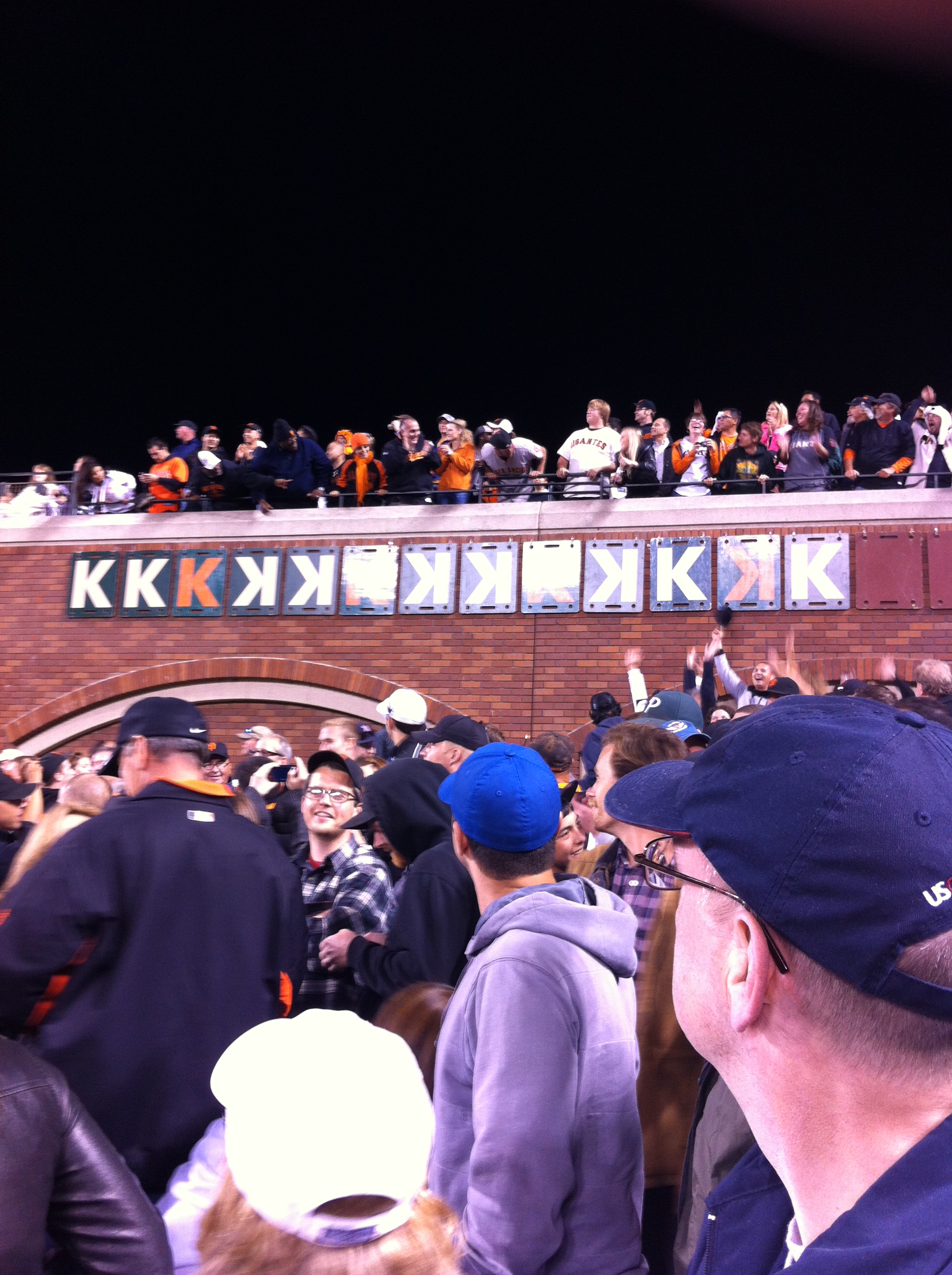
Is Clayton Kershaw a great pitcher? Absolutely. Is he deserving of his recent accolades? Probably. Would he rather have three World Series rings (like Tim Lincecum, Matt Cain, Madison Bumgarner and four other SF Giants pitchers) in that same time frame? My guess is yes. If Major League Baseball waited until the end of each League Championship Series to vote, would Kershaw still have three Cy Young Awards? My guess here is no.

It was Kershaw’s first, and so far only, Most Valuable Player award. It was also the first time in nearly half a century that a National League pitcher won both the Cy Young Award and was named the league’s MVP. The last time was when St. Louis Cardinal great Bob Gibson accomplished the feat in 1968. Not coincidentally, in my view, that was also the last year before baseball instituted the League Championship Series playoff format.

Baseball has changed the award before, why not again? First established in 1956 the award was given to just one guy, not two, and that guy was the best pitcher in baseball, period. That criteria lasted 11 years and saw Brooklyn’s Don Newcombe win the first one and, after the team moved to Los Angeles, Dodger pitchers win five in a row (Sandy Koufax won three, in ’63,’65 and ’66). Thanks to a new commissioner and fan requests baseball decided in 1967 to give the award to a pitcher in each league and that is the way it remains today.

Baseball has also changed the postseason on a number of occasions changing the way teams get into the World Series and making the 162 game regular season less and less important. Until 1969 the team that won the most National League games during the regular season played the team that won the most American League games during the same season in the World Series. In ’69 baseball expanded, adding two teams in each league, and established divisions. At that time, in both leagues, the winner of the six-team East would play the winner of the six-team West for the right to face off in the World Series. The postseason grew again in 1995 with the addition of the Division Series in each league. According to baseball-reference.com from the time the Cy Young Award was first given in 1956 to the establishment of the Division Series concept in 1995 more than 70% of the time at least one Cy Young award winner each year helped pitch his team into the World Series.

In 2012 Major League Baseball expanded the postseason for a third time creating the Wild Card game, a winner take all ticket to the League Division Series. In my opinion the extra games in the post season make it necessary to change how the game’s arguably most important and subjective awards are decided. Managers make managerial decisions differently (the refrain of “just get to the postseason and see what happens” is prevalent), players performances are more significant and certainly more scrutinized and those performances and decisions should be taken into account before awards are handed out.

Would Kershaw still have gotten the votes to be the National League’s MVP if ballots were cast up until the end of the LCS? That answer has to be maybe, even probably, considering that the next in line, in terms of votes, were Giancarlo Stanton and Lawrence McCutcheon. One couldn’t even lead his team to more wins than losses and the other left his at the altar of the LDS for the second straight year. But by the same token exactly how “valuable” was Kershaw if, when it mattered most, he couldn’t win either game he started in the first playoff round?

This year rookie manager Matt Williams skippered the Washington Nationals to 96 wins (the most in the National League) and then, many have said, managed to manage his team right out of the NLDS. He walked up the steps of the dugout and pulled starting pitcher Jordan Zimmermann after the right hander had just walked Giants second baseman Joe Panik with two outs and nobody on base in the top of the ninth inning. Zimmermann had just retired 20 straight San Francisco Giants including Buster Posey, who was the game’s next hitter, twice. Williams called for reliever Drew Stanton and got the ball from Zimmermann who walked back to the dugout, to thunderous home fan applause, and watched Posey single and Pablo Sandoval double away his 1-0 lead. The Giants would end up winning the game in 18 innings and establishing what proved to be an insurmountable two games to none lead in the best of five series. Would Zimmermann have gotten Posey to make the last out of the game? We will never know because his manager made the decision NOT to let him try.

As previously mentioned the Nats, under Williams, won 96 baseball games feasting mainly on the undermanned and outgunned National League East. No other team in that division won more than 79 of its 162 games. The Nats were 14 games over .500 in their division but only 17-16 against the NL Central and 10-10 in Interleague play. Before the season started every so-called expert picked Williams’ team to win their division and many also put them in the World Series. So what exactly did Williams do to win Manager of the Year? I guess he managed to not screw things up when it really didn’t matter. If you ask Nationals’ fans they’d probably tell you he only screwed things up when things mattered the most.

So I say it’s time to make a change. Go ahead and vote for several awards including Rookies of the Year, Silver Sluggers and Gold Gloves when the regular season ends but wait to vote for managers of the Year, MVP’s and Cy Young Awards until after the League Championship Series are played. Or hold two votes, one at the end of the regular season and another after the LCS, give a percentage importance to each part of the season and combine the results to establish award winners.

The point isn’t necessarily that the votes would automatically, or with any certainty, be different. In fact they may not. But gain, if it was done either way would Clayton Kershaw still win one or both of the awards in 2014? He might, although his postseason meltdowns have become the rule rather than the exception. Why not find out?

Would Matt Williams be holding the coveted national League Manager of the Year trophy? No way, that award would have gone to either St. Louis’ Mike Matheny or San Francisco’s Bruce Botchy and deservedly so. So why not wait? Patience, after all, is supposed to be a virtue.

And while you’re at it put Pete Rose in the Hall of Fame.

Posted in general observations, sports | Tagged , , , , , , , , , , , , | Leave a comment

In Defense of Baseball

In his 1956 biography, the great golfer and gamesman, Walter Hagen wrote, “You’re only here for a short visit. Don’t hurry, don’t worry. And be sure to smell the flowers along the way.” I didn’t know Hagen personally, never met the man, but I do know in addition to being one of golf’s great players and quite possibly the game’s most interesting character, Walter Hagen was a baseball fan.

In fact at one time in his life Hagen was an ambidextrous, fastball hurling, pitcher who dreamt of a professional baseball career. Instead he turned to golf and etched his name in the history books with 45 professional wins, 11 major championships and the credit for first uttering a phrase that would become, “stop and smell the roses”. I bring this all up because I believe it’s time we all take a page out of Hagen’s near 60 year old book, especially when it comes to America’s pastime, baseball.

The hue and cry these days is that baseball is broken because “it takes too long to play” or it’s “too slow”. Too long or too slow for who? My under-educated guess is that a large percentage of the people screaming for baseball to step on the accelerator haven’t stepped foot in any of the 30 major league ballparks around the country in the past five years. I’m fairly positive they haven’t experienced the entertainment that is minor league baseball at hundreds of other parks.

baseball1

Coming from a guy who cannot stand to wait for one extra second to hit a golf shot, I say baseball is just fine. No need to panic (or as San Francisco Giants fans spell it, Panik). Researchers put the clock at almost exactly 3 hours for the average time of a major league baseball game this year. That’s up a tick from last year but let’s take a longer look back at the evolution of time when it comes to the length of games played.

In 1960 games averaged 2 hours and 38 minutes in length.

In 1975 the average time actually dropped 13 minutes to 2 hours and 25 minutes

In 1984, just nine years later, games took five minutes longer on average.

In 2000, at the turn of the century, the time it took to play this century old game ballooned to 2 hours and 58 minutes. A 28 minute per game jump.

But in 2003 the time it took to play an average baseball game dropped again down to 2 hours and 46 minutes.

In 2010 the time was back up by nine minutes to 2 hours and 55 minutes.

So since 1960, more than 50 years ago, the average time for a major league baseball game has increased by a grand total of 22 minutes. Geez guys pick up the pace for goodness sake! By comparison NFL games now average 3 hours and 12 minutes (12 minutes longer than baseball). What’s more interesting and potentially embarrassing is the fact that the Wall Street Journal recently found that the average time the ball is actually in play during an NFL game is, wait for it, 11 minutes. Eleven out of 192. You can’t say that about baseball.

baseball4

That is but one reason why baseball is a far more enjoyable fan experience both at the ballpark and on the couch. Commercial breaks in baseball come almost exclusively between or at the end of innings or when managers make a pitching change. Commercial breaks in football many times occur after consecutive plays. While baseball’s TV ratings nationally may be down, locally the ratings for many teams are up year over year and attendance in 2014 was at an all-time high with more than 72 million fans going to games.

molinaball

Don’t get me wrong I am not denying that baseball games have gotten longer but I will not join the chorus of folks who claim that’s a bad thing. Instead I prefer to list a couple of reasons why I think games take up more time:

1) THE DESIGNATED HITTER – In 1973 the American League decided (purist alert!!!) to play a different sport and adopted the designated hitter rule. That decision led to several things including more offensive production, prolonged careers for aging players and longer games. For example, Red Sox games at Boston’s famed Fenway Park, on average, lasted 3 hours and 8 minutes. That’s the longest playing time in the game and a full 8 minutes above average. By contrast, San Francisco Giants games at the National League team’s AT&T Park last just 2 hours and 46 minutes, 14 minutes quicker than average.

There are anomalies; for instance games at home run friendly Coors Field (home of the National League’s Colorado Rockies) average 3 hours even while contests at Safeco Field (American League’s Seattle Mariners home stadium) go by in just 2 hours and 44 minutes but as a whole American League games take longer and drive up the average minutes.

2) THE SPECIALIZATION OF PITCHING STAFFS – As a kid I sat in the stands at Candlestick Park in San Francisco and watched Juan Marichal and Jack Sanford pitch compete games on more than one occasion. Dodgers’ fans can say the same about Sandy Koufax and Don Drysdale, Cardinals fans point to Bob Gibson and Braves faithful have Warren Spahn. These guys and their peers pitched. According to baseball-reference.com in 1963 the top five National League pitchers, in terms of total innings pitched, threw more than 284 innings led by Marichal with 321.1. Drysdale (315.1), Koufax (311.0), “Doc” Ellsworth (290.2) and Sanford (284.1) rounded out the top five. In 2014 the most innings anyone pitched was David Price (playing for two teams) at 284.1 which wouldn’t have cracked the top 15 in 1963. World Series hero Madison Bumgarner led the Giants’ staff but threw just 217.1 innings.

In addition Warren Spahn led the league, in 1963, with 22 complete games. The great Sandy Koufax started 40 games that year and completed 20! That year, in what has gone down in history as one of baseball’s greatest games, Spahn and Marichal squared off in a 16 inning duel and both went the distance! In 2014 L.A.’s Clayton Kershaw led the league with SIX compete games. That is now considered extraordinary and will no doubt earn the Dodgers’ lefty his second straight Cy Young Award as the National League’s best pitcher.

In baseball’s early days what we now call the bullpen didn’t exist. In fact, the only time a substitution could enter the game was because of either “injury or sickness”. If a pitcher was ineffective he would simply switch positions with another player in the field. That changed in 1923 when, according to experts, Washington Senators player Firpo Marberry became the game’s first relief pitcher. Fifty years later the “closer era” came to baseball and it took just ten years after that for the “saves” statistic to outnumber “complete games” in the sport. That development ultimately spawned pitch counts, middle relievers, and set up men. It also meant multiple stoppages of play and, of course, longer games.

baseball3

Baseball has changed and evolved over the years and the games are taking longer to play but, from this fan’s seat, in section 102, there is NO reason for alarm. The experience at the park, whether it’s AT&T, Fenway, Wrigley Field, Yankee Stadium or TD Bank Ballpark (home of the Atlantic League Somerset Patriots) is still the best in professional sports. It is also, by the way, among the most affordable.

Also, despite shouts to the contrary, baseball is still “America’s Pastime”. Dictionary.com defines “pastime” as “something that serves to make time pass agreeably; a pleasant means of amusement, recreation or sport.” By definition it is baseball that remains this country’s pastime.

So get off baseball’s back and get your butt to a ball yard. Oh and on the way don’t forget to “smell the flowers along the way.”

Posted in general observations, sports | Tagged , , , , , , , , , , , , , , , , , , | Leave a comment

It’s Not Just The Ryder Cup That’s Broken It’s Team USA’s Give-A-Damn

And who can blame them.

I read, listened and watched with interest as players (current and former), captains (former), fans and so called experts, bloviated and opined about the disastrous effects and far-reaching consequences of America losing the Ryder Cup this year. I am both intrigued and a little saddened by it all.

Yes Team USA lost and the reaction and race to blame was both swift and intense… but wait, weren’t they predicted to lose by many of the same people leading the hue and cry after the inevitable? Team Europe was stronger in spirit and on paper even before the stripes lost its stars Tiger, DJ and Duf. The surprise to me was that the Americans got out of the gate looking like they were going to put up one heck of a fight.

On the very first morning Patrick Reed and Jordan Spieth were surprisingly spectacular and Ian Poulter was positively ineffective. Still, had Jimmy Walker not chipped in late during his and Rickie Fowler’s halved match with Thomas Bjorn and Martin Kaymer AND Keegan Bradley not hit the shot of his weekend on the par 5 16th leading to a 1 up upset over Garcia and McIlroy, all of those eyes, bleary from watching commercial after commercial with a few golf shots mixed in, could have moved on with their lives secure in the knowledge that this was going to be the blowout everyone, save for family members and die hards, expected. Instead good ol’ Team USA gave them all false hope, in the form of a 2.5 to 1.5 four balls lead, that this year might be different. The fact is it was never going to be.

Should Captain Tom Watson have played Spieth and Reed again that afternoon? Probably. Should he have benched Keegan and Phil on Saturday? Maybe not in the morning four balls matches but certainly in the afternoon foursomes, (a discipline in which the two got shellacked on Friday afternoon). But no matter the machinations, this team was not going to win the Ryder Cup. So let’s stop blaming the “curmudgeonly” captain or the “petulant” prima donna. Let’s stop talking “pods” and “resets” and “task forces” and “overhauls to the system”. In my opinion what’s wrong with Team USA in the Ryder Cup is that to many American players the year-after-year burden of being involved in “us against them”, made for TV, arm wrestling tussles has drained them of their “give a damn”.

The Ryder Cup was established in 1927 as a golf match between the United States and Great Britain and Ireland. Fifty years later Jack Nicklaus suggested that GB & I invite the rest of Europe to join its team to make the matches more competitive. At the time, Team USA’s record was 18-3-1. The U.S won again in 1979, ’81 and ’83 but since then Europe has gone 9-4-1. Bottom line is THIS THING MATTERS to Team Europe. If the International Team could ever win another President’s Cup (1998 was the last and only outright International win) that competition would matter to them too. The simple fact is that it has all become too much for the American players who rightly put their passion, focus and attention toward winning things that DO MATTER to them, namely MAJORS.

There is not only too much golf on the schedule every year, there is simply too much golf trying to compete, in importance, with the major championships. And in 2016, for good measure, we add golf in the Olympic Games every four years. In addition to glut, many European players live and most play in America. In addition to that “opponents” every year or two in international “pillow fights” are teammates corporately. It all adds up to very little, if any, animosity in the game anymore.

What all of the pundits, experts, and opinion givers are not mentioning in this equation is the adverse affect the PGA TOUR created President’s Cup, which is played in Ryder Cup off years, plays. I think it matters because it means that almost all of the guys who make up Team USA playing Europe in the even years now have to manufacture the enthusiasm to play against something called “The International Team” in the odd ones. Odd indeed. By the way, they’ve played 10 President’s Cups and the USA is 8-1-1.

So all the talk post 2014 Ryder Cup is “How do we fix it?” and my contention is, in the current climate, we can’t. Why does it always have to be “US” against “THEM”? In one competition we seem to be outsmarted, outmanned, outmatched and outmaneuvered. In that exhausted state “our” team has to turn around and play in another head to “heads” competition and as Adam Scott stays great, Jason Day, Graham DeLaet and Hideki Matsuyama get great and Camillo Villegas, Geoff Ogilvy and Tim Clark get completely back to form, how long before the U.S. dominance in that one is also a thing of the past? Tennis saw top players decide not to play for their country in the Davis Cup and it’s my contention that that phenomenon is right around the corner in golf. It’s just too much too ask.

Before those things happen, let’s do this… Let’s stop getting our undies in a bunch about this past Ryder Cup or the next one. Dismantle the “task force” while there is still time and put an end to The President’s Cup altogether. The solution is to make the bold move and include the entire golf world in the Ryder Cup starting in 2016. You pick the two teams. Give Europe Africa and Asia and the USA can add Canada, Mexico, South America, Australia and New Zealand. Like I said mix and match them any way you want but have two international teams and play the thing every other year. Try that for a few years and so what happens, in the meantime LET IT GO!

And another thing… shouldn’t the penalty in football be “catch interference” instead of “pass interference”?

Posted in Uncategorized | Leave a comment

A Trip to Tokyo


In January our daughter, Hayley, moved to Tokyo. This wasn’t a whim. This wasn’t an act of fancy. This was a conscious, well thought out decision based on years of interest in, and respect for, the culture, as well as decades and dollars spent learning the language. She is Japanese Government certified fluent and graduated with honors from Beloit College in Wisconsin (one of the nation’s top International Studies schools). She had also lived in Japan previously, in high school, as part of a months-long student exchange program. She knew she wanted to go back even then. So after spending a year working in the international department at Golf Channel, she decided the time was right.

A one-way ticket later, she was living, working and navigating her way around as a foreigner in, for her, a not so foreign land. She is also fluent in Mandarin Chinese and thanks to her boyfriend John, with whom she now lives, is in the process of learning Turkish. But enough bragging. My wife had some business to attend to in Tokyo and I was lucky enough to join her so we scheduled a trip to visit our girl.

As part of the adventure we included a day long detour in San Francisco to see the baseball Giants win; thanks in large part to pitcher Yusmiero Petit who needed only 84 pitches to dismantle the Arizona Diamondbacks. I am a Giants fan, living in New Jersey, with season tickets to AT&T Park. Strange, unless you consider that I grew up in Reno (218 miles from baseball’s best ballpark) and was part of a family of fans. After a good night’s sleep (thanks Bill, Kirsten, Fletch and Bear) and an amazing breakfast at Plow in San Francisco’s Potrero Hill neighborhood, we made our way to SFO and boarded a United flight for our transoceanic trip to Tokyo’s Narita Airport.

The “Land of the Rising Sun” was 16 hours ahead on the clock so we departed at 1:35 PT on Wednesday and landed at 4:35 PM GMT+9 on Thursday. Thanks to miles and points we ended up in business class, so after excellent service and lay-flat seats we were actually in decent shape upon our arrival. We took Hayley’s advice and road an Airport Limousine bus from Narita to The Shangri-La Hotel adjacent to Tokyo Station. We rode through an amazingly diverse landscape, alternating between farmland and cityscapes, away from the setting sun and arrived after dark. We were scheduled to meet Hayley and John for dinner and because the ride was smooth and relatively quick we had plenty of time to check in, unpack and freshen up a little. It didn’t take me long, so while my wife got ready I took a moment to look out the window of our 32nd floor room. What I saw was impressive. Skyscrapers and lights which showed signs of humanity as far as my eyes could see. Tokyo is one of Japans 47 prefectures, its capital city, seat of the Japanese Government, and the most populous metropolitan area in the world. In 2010 Tokyo boasted 37,800,000 residents which is 10,000 more than Delhi, India, 12,000 more than Seoul, South Korea, 13,000 more than Shanghai and almost 15,000 more than Mumbai, the world’s top five. If you’re curious New York City claims 20,000,000 residents (ranked 11th in the world) and has half as many people as Tokyo. The Japanese capital is also home to more than 1/10th (or 51) of the Fortune Global 500 companies. It looked immense, energetic and magnificent especially from 32 floors up.

We hadn’t seen Hayley since putting her on a plane at the first of the year and we had never met John in person so we headed downstairs with a great deal of excitement and a certain amount of anxiety. We had seen pictures of Hayley’s boyfriend and I had skyped with the two of them so we knew John was a handsome, smart and self-sufficient young man. What we could only hope was that he was also right for Hayley and that they were good to, and for, each other. We left the elevator, walked down the short hallway and turned the corner into the small, well-appointed lobby. I took a deep breath, my wife took a long stride and we both smiled as we saw our daughter. A hug and a kiss for and from Hayley, then a firm handshake from and for John broke the ice as we headed into the lounge for a cocktail and a chat.

The conversation crisscrossed from how and when they met, to how and why they liked (or didn’t like) living and working in Tokyo, to some of their hopes and dreams for the future, to finally what we might do and where we wanted to go during our first trip to Tokyo. Last, but not least, we discussed a spot for a first-night-in-Japan dinner. All the while John was easy going and easy to be around. He was comfortable in his own skin, interesting and interested in us. He was also clearly captivated and impressed with Hayley and her ability and accomplishments. I thought I saw in John what I knew to be true about myself and the way I felt about my wife from the very first day I met her, he respected Hayley and that knowledge put me much more at ease. We knew Hayley had complete command of the language and a full understanding of the culture. What we didn’t know was that John also knew his way around and, while not fluent, had a better than rudimentary grasp on the language both spoken and written. My wife had come armed with a list of things to do and see so we talked about both “touristy” and “non-touristy” things at our disposal.

We decided we would see the Meiji Shrine, The Tokyo Sky Tree (the city’s version of the Space Needle in Seattle), Shibuya Crossing, Shinjuku and Asakusa. We also had trips to Karuizawa (near Nagano) and Roppongi so we suddenly had a full slate. But first and foremost we were all starving so we headed out into the Tokyo night to find dinner.

We had a special sushi dinner planned for the following evening, so we wandered a bit before deciding on a simple, casual Japanese dinner in a bustling little place that served a variety of small plate dishes. On the way I couldn’t help but notice two things; the city was incredibly clean and its residents were not interested in making eye contact, with foreigners or locals. Heads down, briefcases, hand bags and man purses in hand, everyone appeared to be in a hurry to get where they were going completely indifferent to who or what stood, walked or sat between them and the intended destination. It’s not that they were unfriendly, just disinterested. We arrived at a restaurant in which Hayley and John had dined previously. Like many, it featured a curtain instead of a front door and cubbyholes for shoes. We took ours off, found a space for them to reside while we ate and headed inside.

We were greeted by a hostess who exchanged a few words with Hayley and led us to our table. A narrow hallway was bordered on both sides by, what I assumed were traditional Japanese booths. Tables set into the ground which allowed for patrons to sit on the floor with room for feet and legs under the table top. The other thing I noticed while walking to dinner was that no one was standing on sidewalks or outside buildings smoking. On the way to our table I realized why… everyone who smoked, smoked inside. I asked John about this and he nodded and answered that it was indeed the custom. He chuckled and said that one of the things the hostess had asked Hayley was whether or not our group wanted to be seated in the smoking or non-smoking section. It reminded me of the time when airplanes offered to seat you using the same distinction. It didn’t matter then when you were inside a 150 tube in the sky and it didn’t matter inside a 250 square foot restaurant.

We ordered drinks, beer and sake, and perused the menu then picked gyoza, edamame, chicken skewers, a handful of pieces of sashimi (I couldn’t resist) and a couple of rolls filled with pickled vegetables (Hayley’s idea) and more. It was all excellent, as was the conversation, but after about an hour the long flight, the excitement of the trip and the fact that I have spent nearly 59 years on this planet began to take its toll. I hit a wall and suddenly I started comprehending about every third word that was being said. I knew it was time for this traveler to get a good night’s sleep and continue our excellent Japanese adventure in the morning. We agreed to meet Hayley and John at the entrance to Tokyo station bright and early the next day and said goodnight with hugs this time instead of handshakes. They headed toward their train and home and we went up to the room and hit the hay.

Next up: our first full day in Tokyo and more

Posted in Uncategorized | Leave a comment

The Best Golf Event You May Have Never Heard About


Did you know last month a United States team played in, and won, a major international sports event? I’m not talking about the Mike Krzyzewski coached, highly paid, overly endorsed, NBA employed hoops team that came away from the FIBA World Championship tournament undefeated, virtually untested, and victorious for the second straight time.

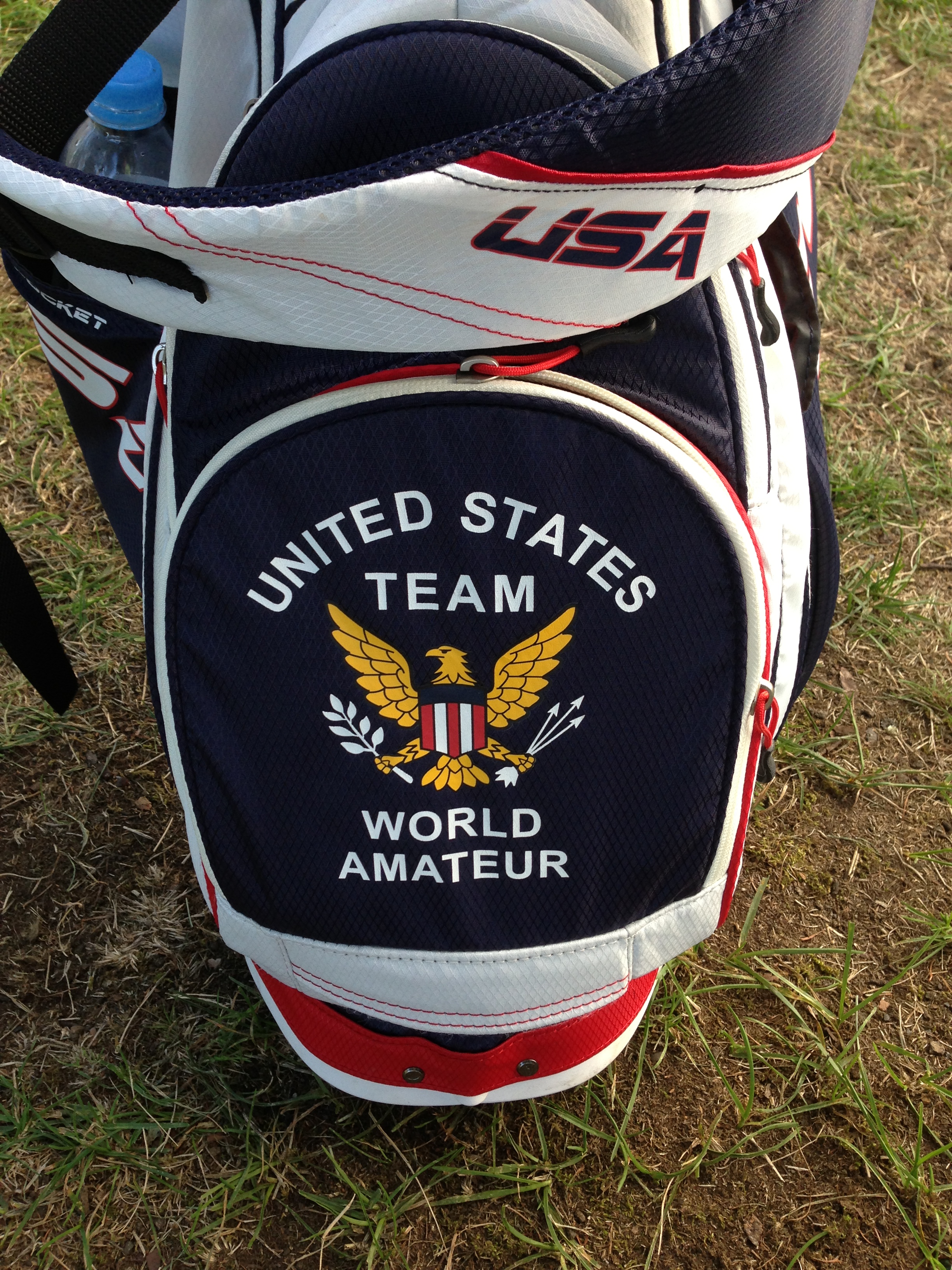
The American champions of which I speak was a three man team of amazing amateur golfers that travelled half way around the globe, played 72 holes and in an incredibly tense, action packed, down to the final putt drama claimed the World Amateur Team Championship for the second time in a row.

I produced USGA amateur championships on TV for The Golf Channel for nearly a decade and the only thing I knew about the World Amateur Team Championship was that it was played in even years at the end of the United States Golf Association’s championship season. After getting the opportunity to see it in person at the Karuizawa 72 Golf East Iriyama Course, near Nagano, Japan, this month I wish I had paid closer attention. It’s an historically important and terrifically exciting event and here’s why.

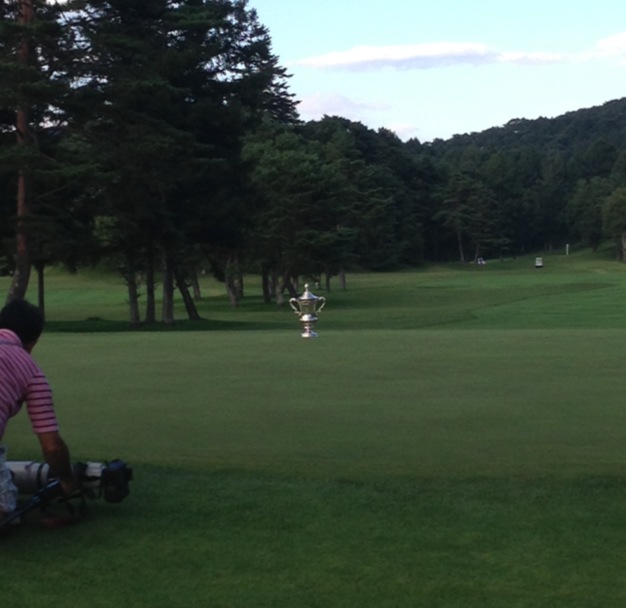
  1. IT HAS HISTORY – If you are a golf fan, even a casual one, you know the 34th President of the United States was an avid golfer. Dwight David Eisenhower had a loblolly pine on the 17th hole at Augusta National named after him. I say had because storm damage to the tree this spring forced the club to remove this well-known landmark. The 66 foot tall tree is now gone but another golf namesake remains – The Eisenhower Trophy, the prize for which amateur teams from all over the globe have been competing since 1958.

iketrophy

The competition was born in 1957 out of a desire by the Japanese to play a match against its American equivalents. Since, for years, the USGA had entertained like requests from other countries, the organization decided it was time to suggest a team competition and soon after approved, in principle, a plan for an event that would pit amateur teams from all interested countries against each other in a true world championship. They then met with counterparts at the R&A who liked the idea and agreed to host the very first competition, later that year, at St. Andrews (how cool is that?). 115 players from 29 countries, including the U.S.A. captained by Bobby Jones (how cool is that!), competed. Australia, led by Bruce Devlin, beat the U.S. in a playoff. The event was considered a rousing success and plans were made for a second iteration, this time in the states at Merion Golf Club, two years later. In 1960 Jack Nicklaus was the best amateur golfer in the land and that year he would play for team U.S.A. and lead the Americans to their first Eisenhower Trophy victory.

  1. IT FEATURES FUTURE SUPERSTARS – I mentioned Nicklaus and in addition to the Golden Bear, the American teams, as well as other countries, have been represented throughout the course of the competition by amateurs who would go on to become the game’s greats. Tom Kite (1970), Ben Crenshaw (’72), Curtis Strange (’74), Phil Mickelson (’90), David Duval (’92), Justin Leonard (’92), Tiger Woods (’94), Matt Kuchar (’98), Rickie Fowler (’08) and Billy Horschel (’08) are just some of the players to wear the red, white and blue. Nick Price (’76), Colin Montgomerie (’84), Jose Maria Olazabal (’84), Sergio Garcia (’96 & ’98), Luke Donald (’00), Martin Kaymer (‘04), Rory McIlroy (’08) and many others represented their countries in the competition.

Like Jack Nicklaus in 1960, Bobby Clampett was the best amateur golfer in the world in the late 1970’s. He was a three time All-America Team member at BYU, a two-time collegiate player of the year, twice the California State Amateur Champion and the low amateur at both the 1978 United States Open Championship and the 1979 Masters Tournament. Oh, and Bobby Clampett was the individual medalist and led team U.S.A. to the World Amateur Team Championship title in 1978. That team, which included John Cook, Scott Hoch and Jay Sigel, might just be the strongest group to ever represent the stars and stripes in the history of the competition. Between them they would win countless events before turning pro (including 2 United States Amateur Championships) and more than 70 tournaments after deciding to play for pay. I spoke with Bobby Clampett as he prepared to play in the Champions Tour First Tee Classic at Pebble Beach and he remembered the WATC fondly, in fact reverentially. “It’s one of the highlights of my career,” he said, which surprised me because this was a guy who had racked up many impressive accomplishments in the game. “It’s our Olympics for golf and it was extremely emotional.” Clampett is not only a veteran player but a veteran commentator working for years with the CBS golf team and I asked him why he thought the event didn’t get more attention in the states. He wasn’t sure, “It really is the last big golf tournament we have”, he declared matter of factly. “The World Cup hasn’t really taken off either and I’m surprised a bit that the Ryder Cup has become such a big deal when it is not nearly as global.”

To underscore how much times have changed Clampett told me how excited he was to get the phone call from the USGA telling him he had made the team. “I was thrilled,” he said, “It was an amazing honor. I was 18 years old and really had never flown out of the country. The tournament was in Fiji so they told me to be sure not to forget my passport. I said, what’s a passport?” Clampett chuckled and continued, “To tell you the truth I blew it off and arrived at the L A airport without a passport and they wouldn’t let me go. I called the USGA and to show you how important the event was they put me in touch with U.S. Secretary of State Cyrus Vance. Within three hours I had a passport.”

The Women’s World Amateur Team Championship was added in 1964 and, like its male counterpart, featured many of the game’s greats before they were famous. Annika Sorenstam, Karrie Webb, Se Ri Pak, Lorena Ochoa, Helen Alfredsson, Yani Tseng and Ai Miyazato all wore their country’s colors. Many more including Sally Little, Mi Hyun Kim, Anna Nordquist, Katherine Hull, Azahara Munoz, and Liselotte Neuman played in the past. The American team, winners 13 times in 26 tries, has been represented through the years by Nancy Lopez, Juli Inkster, Beth Daniel, Pat Hurst, Kelli Kuehne, Paula Creamer and Jessica Korda. Other American players include Kay Cockerill, Vicki Goetze Ackerman, Wendy Ward and Carol Semple Thompson. It’s clear if you want an early look at amateurs who will be in future professional winner’s circles the World Amateur Team Championship and the Women’s World Amateur Team Championship is a good place to start.

  1. IT TRAVELS ALL OVER THE WORLD- As previously mentioned the first two events were played at St. Andrews and Merion. It has also been played at Pinehurst and Royal Melbourne and in Fiji (where Clampett’s team won), Hong Kong, Caracas and Versailles just to name a few. The championship rotates between Europe/Africa, Asia and the Americas. In 2012 it was staged in Antalya, Turkey, this year Japan was the host country and in 2016 the WATC will be played in Mexico.


  1. THE COMPETITION LENDS ITSELF TO EXCITEMENT- Team U.S.A has won 14 of the 29 World Amateur Team Championship titles (including 2014) but the competition, in many cases, has been exciting and close. Starting with the very first one, 11 of the 24 have been decided by three shots or less. Keep in mind that’s total combined strokes for three players over four rounds of golf. In fact, before 2002 the teams were made up of four players, making the closeness of the competition even more impressive. 2014’s event was one of the closest in the championship’s history and we were lucky enough to be there for the final day.

My wife, my daughter and her boyfriend, (who both live and work in Tokyo) and I bought a box of Tokyo Bananas (if you or anyone you know has been there you know of which I speak) and boarded an early morning Shinkansen “bullet” train from Tokyo to Karuizawa. The train is part of the world’s largest high speed rail line transporting more than 150 million passengers a year at speeds in excess of 175 miles an hour. I’ll have more on our fabulous trip to Japan in future posts but for now back to the golf.

We arrived at the Karuizawa 72 east golf complex in the early afternoon. The club, this day fronted by the colorful, flapping flags from each of the 68 countries represented, is a sprawling site featuring six, 18-hole layouts. We found the media trailer and USGA Director of Communications Pete Kowalski who greeted us with a smile. Pete had been in Japan for more than two weeks having led the USGA’s communications efforts for the Women’s World Amateur Team Championship (won by Australia by two shots over Canada) the week before. Pete complimented both the International Golf Federation and the Japan Golf Federation for their efforts and mentioned that he was ready to go home. We were ready to watch some live golf. Pete handed us credentials, informed us that Team U.S.A. was leading thanks to the play of Denny McCarthy who had turned in 8 under par 28, and pointed us in the direction of the Iriyama courses’ back nine.

The U.S. team was comprised of McCarthy (third to last grouping), Beau Hossler (penultimate group), and Bryson DeChambeau in the final grouping. All three were joined by players from Canada, who entered the final round in second place three shots back, and Sweden, the third place team after 54 holes. DeChambeau, the All-America Team selection from SMU had been the U.S.A. star thanks to a six straight birdie finish 61 on Saturday. But McCarthy, a senior at the University of Virginia, was looking to upstage his teammate with a birdie, birdie, birdie, birdie, eagle start on the final day. By the time we caught up to him on the 13th green his torrid start had turned tepid thanks to five straight pars. Despite that, the numbers on the board carried by the standard bearer indicated McCarthy still had a five shot lead over his Team Canada counterpart, Adam Svensson.

watc13

Three guys play for each team and when they add them all up the two best scores count. McCarthy had a firm grip on his group so after he teed off and eventually parred the 14th we stayed and waited on the par three for the last two groups. Hossler came first and then DeChambeau followed and both were over par and behind the Canadian players. “Uh oh”, I thought as I tried to do the math in my head. The U.S.A. had entered the final round with a three shot lead and McCarthy, through 14, led by 5 so that was 8 shots to the good. Between Hossler and DeChambeau only one score would count but both were behind so even my math challenged mind knew things were close. Thankfully there was an electronic scoreboard in the same area between the 14th and 18th tees and the 17th green and it confirmed my fears. Team U.S.A. had a lead by the slimmest of margins, one shot. And that was with a cooled off McCarthy and Hossler and DeChambeau struggling.

watc17

We made our way, along with a few dozen golf fans from all over the world, to the area behind 17 green to watch the final groups play their approach shots and putts to the par four. On the way we ran into Team U.S.A. captain and past USGA President Jim Hyler who admitted to being, “ready to jump out of my skin, I’m so nervous.” He had no entourage, no radio and since he couldn’t be in three places at once he relied on his wife and his players who, carrying their own bags, walked by and reported individual updates. We watched Beau Hossler miss a relatively short birdie putt at 17 and then Canadian Taylor Pendreth make one. As we headed to 18 to watch the finish the abacus in my head told me the U.S. could not have held on to its slimmest of slim leads.

Both Hossler and Pendreth made par at the last but we learned from USGA rules guru Jeff Hall that McCarthy had bogeyed 18 and with just one more grouping on the golf course Team U.S.A. and Canada were tied! I asked if there would be a playoff and Hall answered with a slight smile and a negative shake of his head. Then he added, “There’s a tiebreaker in place and it doesn’t look good for the U.S.A.” DeChambeau was going to have to beat Corey Conners on the 72nd hole for the U.S.A. to win so we watched as they both hit tee shots in the fairway. DeChambeau would play first and he executed well hitting a wedge pin high right, just inside ten feet. Connors was next and after a brief discussion with a confident he hit a wedge of his own. Whether a result of adrenaline or the wrong club, Connors wedge sailed long and ended up near the back of the green more than 30 feet from the hole. If Connors missed and DeChambeau could make, U.S.A. would win the World Amateur Team Championship. Both seemed more than possible, if not likely. By this time nearly every fan on site and most of the other teams who were involved in the competition ringed the 18th green, 6 or 7 people deep.

Connors did, in fact, miss and as DeChambeau circled his putt with the knowledge of what a make would mean I thought two things. The first was this is what Olympic golf should look like! Three person teams playing 72 holes, best two scores count each day and when it’s done hand out team and individual medals. It would also be nice if all the players were amateurs but that’s just my old school opinion. The second thing I thought was why isn’t this event on TV? People from all over the world were gathered around the final green, craning necks and biting nails knowing a world championship was on the line. Teams, wearing colors, from Slovenia, Portugal, Bermuda, Korea, The Czech Republic, India, Bahrain, Costa Rica, Iran, Jamaica, Gabon, Kyrgyzstan even Russia AND Ukraine all watched American and fellow golfer Bryson DeChambeau line up the winning putt.

watcbag

I imagined FOX golf director Steve Beim milking every emotion out of the moment then training his cameras on the American as he poured in the winning putt. It was an incredibly emotional moment and perfect theatre for television. But I realized that it’s not televised because too few people either know or care that it exists and THAT is a damn shame. FOX, the USGA’s TV partner for the next 12 years will do what previous partner NBC did for the past 18 and dismiss it as too expensive. Realistically the USGA won’t push them to reconsider, but I wish both would change their minds.

finalscoreboard

No offense to the U. S. Junior Amateur or the Girl’s Junior Amateur but during even numbered years I would much rather watch this than those. Future stars, worldwide inclusion and incredibly close and compelling competition wins over two 14 year olds playing match play any day in my book. As for the expense, I know it would be cost prohibitive but there were cameras there because the Japanese were streaming the last few holes live on the internet. Maybe supplemental coverage with the host country could work. In 2016 the World Amateur Team Championship is in Mexico further cutting the costs of International production. Networks already televise events from professional tours when they are played both north and south of the border.

teamusa

Congratulations to Bryson DeChambeau, Denny McCarthy and Beau Hossler for winning the Eisenhower Trophy. I also offer a well-deserved, worldwide golf clap to the USGA, the IGF and the JGA and finally, an enthusiastic fist pump and a tip of the cap to all the players and organizations from the 68 countries that participated. Well played.

This event has a new fan and I am hopeful all of you will join me in paying closer attention to it in 2016. In my opinion the World Amateur Team Championship will be the truer example of pure international golf competition that year.

You can learn more about the World Amateur Team Championship at USGA.org and/or igfgolf.org

Posted in general observations, Golf, golf on tv, sports | Tagged , , , , , , , , , , , , , , , , , , , , | Leave a comment

Ten Reasons Why I Think Jerry Foltz is Golf Television’s Best On-Course Announcer

I watch a lot of golf on television. I watch a lot of golf on television alone because my wife and dog can’t stay in the same room with me because I spend a lot of time shaking my head and yelling at the “tube”, while I watch a lot of golf on television. I am indiscriminate in my criticism. Camera operators, audio people, directors, producers and especially announcers all incur my wrath. I do it because I have the benefit of knowing exactly what’s going on behind the scenes.

I have spent more than three decades producing, or helping to produce, golf on television (first for ESPN and then Golf Channel). I have hired, supervised, worked with, or watched, from the inside out, nearly every person who has walked the fairways with a microphone since 1989. I have also watched them, as a fan, on television. It is with both of those perspectives in mind that I make the statement that Jerry Foltz is the best in the business.

Full disclosure… I have known Jerry for decades, first meeting him when he was a teenager playing junior golf with my younger brother. We have been friends for years, in fact I consider him my best friend, and he was the best man at my wedding. I gave him his first job in television. In 1995 he was nearing the end of his playing career and looking for the “what’s next”. The Golf Channel had debuted in January of that year and I was responsible for producing all of the network’s live domestic tournament coverage including, what was then, the Nike Tour. Jerry found out where we were working on site at a tournament in Tallahassee and came in the truck to reintroduce himself. As fate would have it, I was looking for help in identifying the players with whom none of us at the time were very familiar and Jerry volunteered.

A few weeks later he expressed an interest in working as an announcer. It was clear he knew and liked the tour and its players and officials. It was equally clear that they knew and liked him back. He was interested in learning, clever, and social and, after working as our “spotter” for a while, I had him shadow our lead on course announcer, Gary Smith, for several events. Then I made the decision to send him out, without supervision, for the first time at the Nike Wichita Open in 1996. But that is NOT why I am writing this particular piece. I write it because I believe it to be true. Here is my list, from #10 to #1 why I put Jerry Foltz at the top of his class.


10) DURING HIS CAREER HE HAS SERVED AS HOST, PLAY-BY-PLAY, ANALYST, HOLE ANNOUNCER AND ON COURSE COMMENTATOR

I am fairly certain no one covering the men’s game can make this claim (Kay Cockerill, who is also very good, may have done it on the women’s side). Many have done two of the five jobs and several have done as many as four of the five but Jerry’s experience as tournament play-by-play man, host, lead analyst, hole announcer and on course commentator makes him unique. Why do I think it’s important? Simply because knowing the duties, responsibilities and demands of each position and then actually having to perform them all on live television gives Jerry the advantage of empathy for each role that no one else has. In my mind that helps make him better at the job than anyone else when he walks the fairways.

9) HE ALWAYS STATIONS HIMSELF IN A PLACE WHERE HE CAN SPEAK IN A NORMAL TONE OF VOICE

There are few things that ruin a golf television viewing experience more than an announcer that you can’t hear or understand. The on-course commentator is the producer’s and the viewer’s “eyes and ears” on the course and if either or both has to strain their ears to understand what someone is saying then it’s a double bogey. Jerry is never at a loss for words and always in a position to make those words clear and understandable.

8) HE INCLUDES THE OTHER TALENT IN THE “CONVERSATION”

A simple concept, and one to which many announcers adhere. Many “conversations” are limited to “what’s he got there?’ or “how’s the lie?” but when Jerry engages his fellow announcers it’s more substantive. I believe this is connected to number 10. Because Jerry has been on the air in the other roles he knows how to include his fellow announcers in the conversation.

7) CADDIES AND PLAYERS KNOW HIM AND TRUST HIM

Jerry is not unique here. Many of the network on course announcers have great relationships with both players and caddies. That said I would bet my bottom dollar that Jerry has better relationships with more players and caddies than any other announcer. Jerry works the practice tee, putting green and the hotel bar. Guys and women on tour know him and know they can trust him and because of that Jerry gets not only the standard club, yardage and “how’s he/she hitting it” information, he gets more of it from more sources. When he gets more that means we all get more.

6) HE IS AN EXCELLENT INTERVIEWER

In my experience this is the hardest thing players-turned-announcers have to do on television. Being an exceedingly social animal Jerry Foltz is an exception to this rule. I believe Jerry can talk to anyone, about anything and, on many occasions, does just that. I have seen player after player, now wearing a headset, struggle with this part of the job. Not Jerry. In The Golf Channel’s early days we aired a show called SCORECARD REPORT for thirty minutes after every tournament round. The show consisted of interviews on the practice tee and putting green with players who, depending on the time of day, had just completed a round or were just getting ready to start. Jerry (and colleague Kay Cockerill) NEVER had a problem getting someone to talk and when they did, ALWAYS talked to them for as long as I needed them to talk. It could have been one question or ten minutes, it didn’t matter to Jerry. The best quality in an interviewer is the ability to listen and Jerry listens.

5) HE NEVER PRETENDS HE’S CALLING A PREVIOUSLY RECORDED SHOT “LIVE”

There are announcers in this business who lead you to believe they are “smarter” than they actually are. You can spot them easily because they are the ones who tell you that a player “has to do this” or the “shot has to land here” and then, magically, the player does do that or the shot does land there. All the while the announcer knows exactly what the player is going to do or where the shot is going to land because he or she has seen it already. Jerry will always tell you that the shot happened, “ a moment ago” or “earlier” despite, sometimes getting explicit instructions from a producer to, “play it like it’s live” It may be a small thing but in this viewer’s (and producer’s) mind it’s a critical one.

4) HE HAS A GREAT SENSE OF HUMOR AND NEVER TAKES HIMSELF TOO SERIOUSLY

After all golf is a game and it should be treated as such. That’s not to say that certain tournaments, shots and situations aren’t important but keeping things in perspective is important and one of Jerry Foltz’s strengths.

3) HE DOESN’T TELL YOU WHAT YOU CAN ALREADY SEE AND NEVER TELLS YOU WHAT HE CAN’T SEE

For me there is nothing more aggravating as a viewer than watching a putt for birdie come up just short and hear an announcer say, “That comes up just short.” Thanks so much for that insightful information. I can SEE that the putt came up short, tell me why or, better yet, don’t say anything at all. Additionally you will never hear Jerry Foltz say something like, “I can’t tell if that ended up in the hazard,” or “I’m not sure where that ended up.” If he can’t see it he won’t say anything even when put in an uncomfortable position by a fellow announcer who asks, “How’s the lie?” when he’s not sure Jerry has had a chance to get a look at it. We are all better off as viewers if we don’t have to hear, “I didn’t get a chance to take a look.” While I’m at it a television announcer should never say, “Look at this!” It is on television, I’m watching.

2) HE PUTS 100% INTO EVERY ASSIGNMENT REGARDLESS OF TOURNAMENT OR TOUR

Jerry has been part of hundreds of broadcasts, in various roles, working for a variety of producers, on most every professional tour and some amateur events. I have never once seen him, heard of him or observed him doing less than his absolute very best at each. When we worked together on PGA TOUR events he treated those telecasts like it was the most important programming on the network. It was. When we worked together on the Nike/Buy.com/Nationwide Tour he treated those telecasts like it was the most important programming on the network. It wasn’t. Now he works LPGA telecasts and I know for a fact he treats those shows like it is the most important programming on the network. It isn’t. There is no lay up in Jerry Foltz when it comes to broadcasting. He puts in the work, puts the “give a damn” on high, and gets the job done no matter the tour, the time of day, duration of the broadcast or the player or group he follows.

1) HE NEVER TALKS OVER PLAYER/CADDIE CONVERSATIONS

EVER. Because of this reason I didn’t really need to list the other nine as to why I think Jerry Foltz is the best at his craft. He is always aware of when a player is talking to his caddie and never thinks what he has to say is more important than that. Even when another member of the broadcast team isn’t listening and asks Jerry a question, Foltzy will clam up and not speak until the more interesting, more important conversation is over and then he still might not saying anything if there is nothing to add. This is not only rare in the business of on-course golf commentary it is unique. And so is Jerry Foltz.

Posted in general observations, Golf, golf on tv, sports | Tagged , , , , , | 1 Comment

TIGER and JACK? What about TIGER and ARNIE?

Since Tiger Woods began winning golf’s major championships, with The Masters in 1997, those who think, care, write and talk about the sport have linked and compared him to the man many called “the greatest to ever play the game”, Jack Nicklaus. Those comparisons seemed natural and were fueled by the phenom himself who said, on many occasions, besting Nicklaus’s record of 18 major professional wins was his number one goal. There was a time, pre-Thanksgiving 2009, when the young man surpassing the elder’s accomplishments seemed to be a given. Even the Golden Bear rolled out the “records are made to be broken” adage predicting that Tiger would not only break his majors count, but that Woods would “win ten Masters Tournaments alone”.

Now, after injuries, infidelities and instability, most believe Jack Nicklaus’s records are safe but as long as Tiger competes, for better, for worse or for the all-time best, he will always be linked to Nicklaus. I’d like to make the case that there are a number of reasons we should be talking as much, if not more, about Tiger Woods’s connection not to Nicklaus, but to Arnold Palmer. There are several reasons for this including their resumes and that’s where I’ll start.

Arnold Palmer won the United States Amateur Championship in 1954. Tiger Woods won the first of his three straight United States Amateur Championships forty years later in 1994.

Arnold Palmer won in his rookie year as a pro. Tiger Woods won in his rookie year as a pro.

Arnold Palmer’s first major victory was The Masters Tournament. Tiger Woods’s first major victory was The Masters Tournament.

Arnold Palmer won 29 events and five majors in a four year span (1960-1963). Tiger Woods won 27 events and seven majors in a four year span (1999-2002). In fact Tiger did it again winning 25 times and six majors in a different four year span (2005-2008)

Arnold Palmer was named Sports Illustrated Sportsman of the Year in 1960. Tiger Woods was named Sports Illustrated Sportsman of the Year in 1996.

Arnold Palmer was named “Athlete of the Decade” in 1969. Tiger Woods was named “Athlete of the Decade” in 2009.

Arnold Palmer won four tournaments in 1971 at the age of 42. Tiger Woods won five times in 2013 at the age of 37 and could still match, or better, Palmer’s feat well into his 40’s.

I’m not saying Jack Nicklaus didn’t receive some of these accolades as (SI’s Sportsman of the Year in 1978 and the “Athlete of the Decade” for the 70’s). He also won, not one, but two United States Amateur Championships. Despite that there are two things that will always link Tiger Woods with Arnold Palmer, and NOT Jack Nicklaus. Those two things are endorsements and eyeballs.

Let’s talk endorsements and each player’s impact on advertising. Arnold Palmer says in his book, A Golfer’s Life, that he met Mark McCormack in college and then ran into him again shortly after turning pro in 1954. At that time McCormack had formed a firm called National Sports Management with a business partner named Dick Taylor. The two hoped they could represent the interests of a few top professional golfers. After they convinced Palmer to come aboard he says, in his book, that it started with Monday exhibitions and outings worth between $300 and $500 to the golfer. With success came greater opportunities and Palmer says he decided he wanted McCormack all to himself. So, after nothing more than a handshake, McCormack gave up National Sports Management and made Arnold Palmer his sole focus.

The two men established Arnold Palmer Enterprises in 1961 and signed, among others, deals for Palmer with Coca Cola and L&M cigarettes. At the time Palmer had an equipment deal with Wilson and despite lucrative opportunities chose to remain loyal to that company until the contract expired in 1963. That year the two formed The Arnold Palmer Golf Company, making and distributing professional grade golf clubs and eventually McCormack started IMG (International Management Group) representing a number of athletes and golfers in addition to Palmer. While continuing to build that business McCormack hired a Scotsman named Alastair Johnson in the mid 1970’s and gave him one job, take care of Arnold Palmer. The two have been a team ever since.

Tiger Woods won his record breaking third straight U. S. Amateur Championship, and sixth straight USGA Championship (3 U. S. Jr Amateur Championships) in August of 1996 and then turned professional and signed with IMG. Taking a page out of the Arnold Palmer marketability playbook, the first deals made for Woods included General Motors, American Express, Accenture, General Mills and a blockbuster, five year, $40 Million agreement with Nike despite the fact that the company didn’t make balls or clubs for him to use. Woods continued to play Titleist equipment until 2003 when Nike finally made a set of clubs up to Woods’s standards. Three years after signing with IMG, Woods teamed up with IMG agent Mark Steinberg and the two have been together ever since. Steinberg left IMG in 2011 and Woods opted to stay with Steinberg and his newly formed Excel Management choosing the personal relationship over the professional one with IMG.

In 2009, unlike Palmer who left Wilson for his own company, Woods signed a five year, $105 Million extension with Nike. It was, at the time, the largest endorsement deal ever signed by an athlete and, with the TW brand as part of the stable, took Nike from a “start-up” golf company to a major player in equipment and the number one golf apparel company in the world.

In a February, 2014 article Forbes Magazine (www.forbesmagazine.com) released its list of highest paid “retired” athletes and Michael Jordan was number 1 despite not having played in an NBA game since 2003. “His Airness” made $90 Million in endorsement dollars ten years after his last game. Second on the list was 84 year old Arnold Palmer. He won $1.9 Million in prize money on the PGA TOUR in his entire career and his last win came in 1973 but 40 YEARS later he made $40 Million from various interests and endorsements.

In a different February, 2014 article, this one courtesy of @ronsirak at Golf Digest (www.golfdigest.com), Tiger Woods reportedly earned $83 Million, including a staggering $71 Million off the golf course through endorsements and business dealings. According to Business Insider Magazine that number put Woods atop the list of all athletes (Roger Federer was #2 with $71.5 Million) and well ahead of the next best earning golfer, Phil Mickelson, who pocketed $52 Million. By the way, in the same article, Arnold Palmer was ahead of every other golfer including Jack Nicklaus, Henrik Stenson and Rory McIlroy. But the dollars tell only part of the story.

You could contend, and I’m about to, that Arnold Palmer and Tiger Woods were/are the sport’s biggest stars. Arnold Palmer led golf into the television era and television made Arnold Palmer famous. Years later Tiger Woods led golf into another television stratosphere and the medium repaid him by making him the most famous athlete in the world. Many people credit Philo T. Farnsworth as the “Father of Television” for creating and patenting the camera tube on August 25, 1930, and later the cathode ray tube which would become the receiver. Many inventors worked on devices before and after Farnsworth but most agree it was he that developed the first system complete with receiver and camera, which he produced commercially from 1938 to 1951.

The first television broadcast is said to be scenes from the opening of the 1939 World’s Fair in New York City and the first broadcast of a sporting event on TV is thought to be a baseball game on May 17, 1939 between Princeton and Columbia universities. Golf came to national television in the 1950’s. In 1954 United States Open Championship was broadcast across the country for the first time and CBS first started broadcasting The Masters in 1956. It started with a half hour of coverage from Augusta National on Friday, then expanding to an hour on Saturday and Sunday. In 1958 CBS expanded AND contracted the coverage adding an extra half hour on the weekend but eliminating Friday’s broadcast altogether. Arnold Palmer won his first green jacket that same year. Frank Chirkinian began his service as the Producer and Director of the CBS coverage in 1959. Chirkinian told Randall Mell of golfchannel.com in a 2009 interview that, “The camera is all knowing. It either loves you or it doesn’t. It loved Arnold Palmer and it still loves him.” Palmer would win Chirkinian directed Masters Tournaments on CBS in 1960, 1962 and for the last time in 1964. Chirkinian also said of Palmer, “It didn’t matter if Arnold was leading or where he was, you had to show him. You never knew when he might do something special.” Sound familiar?

Famed author George Plimpton described watching Arnold Palmer this way, “Trying to follow Arnold Palmer down the course was not unlike running before the bulls at Pamplona.” Ask any PGA TOUR player how they felt about playing in the grouping in front of Tiger Woods during his prime.

Tiger Woods has been on television since he was two and a half years old. On October 6, 1978, Woods appeared with his father, Earl, on the Mike Douglas Show. We watched his first United States Amateur Championship win on ABC in 1994 and the next two on NBC. ESPN showed his professional debut at the Greater Milwaukee Open in 1996 which, by the way, included a hole in one and The Golf Channel has followed every move he’s made since that all-golf network launched on January 17, 1995. I know I was there. TGC used the sport’s two most famous players, Palmer and Woods, to showcase the network to cable companies when it was making the switch from a pay cable to a basic cable service in 1997. The two “starred” in the Arnold Palmer Golf Gala from Laurel Valley Country Club, an annual “match” that benefitted local charities in the Pennsylvania community. It worked. On another, later, occasion The Golf Channel brass made the controversial decision to record a Tiger tournament round in the morning and then play it back during their airtime window that afternoon instead of showing live golf featuring the other half of the tournament field. That just one more indication of how brightly Tiger’s star burned. That move drew the ire of the PGA TOUR but was ratings gold for the network. CBS golf producer Lance Barrow would surely echo, his mentor, Frank Chirkinian’s words about Arnold Palmer when talking about his present day equivalent, Tiger Woods. You always have to keep a camera on Tiger, whether he is first or last, because you never know when he might do something spectacular.

Arnold Palmer may not be considered the greatest player of all time but he will always be the sport’s most beloved athlete and a huge reason for that is that his charisma and swashbuckling style translated well on television. Tiger Woods will never be the game’s most popular player but one day he will be the winningest player in PGA TOUR history. He may also end up the most famous golfer who ever lived and he would have become that with or without the existence of The Golf Channel. On the flip side The Golf Channel would probably be around today but it would never have been worth billions to Comcast without the existence of Tiger Woods.

It makes perfect sense to link and compare Tiger Woods to Jack Nicklaus, if only because of golf’s obsession with major championships. But I believe Tiger Woods and Arnold Palmer should also be constantly compared because of what each meant to entire generations of the sport’s supporters and sponsors.


Posted in general observations, Golf, golf on tv, sports | Tagged , , , , , , , , , , , , , | Leave a comment

The Most Annoying and Unnecessary Stats in Sports

 17th Century British Prime Minister Benjamin Disraeli is said to have once proclaimed, “There are lies, damned lies and statistics.” As a television producer and sports fan I would say he is on to something. Modern sports event telecasts are littered with graphs, charts, lists and other statistics these days. Some serve to help the viewer understand the game in general or the specific game situation, which adds to the experience of watching the event. Other informational nuggets only add confusion thereby making the viewing experience less enjoyable.

The origin of statistics in general is far from crystal clear, and when you talk sports statistics specifically, it gets even murkier. Most consider Sir Ronald Fisher (1890-1962), a British biologist, geneticist and statistician, the “father of modern statistics” but the concept predates him by centuries.

As far as sports stats are concerned, there doesn’t seem to be any “firm start date” but from accounts it appears the first sport to which statistics were universally applied is baseball. The firm STATS Inc. offers numbers and information about the sport starting in 1876. My friend, Bill Porter writes a blog (www.sportsbythenumbers.wordpress.com), in which he uses stats to support ideas. He isn’t 100% positive baseball was first but he does believe the sport lends itself to stats better than the other major sports. His reasoning is based on the fact that baseball “permits us to look specifically at an individual’s contributions”. He says it’s hard to quantify each offensive lineman’s contribution to an Adrian Peterson touchdown or the power forward’s screen on a LeBron James three point game winner. But even though baseball is also a team game it is “punctuated by individual confrontations” like Stephen Strasburg versus Buster Posey. Bill concedes that eight defensive teammates enter the equation if Buster puts the ball in play but, “in each at bat, the fundamental confrontation between batter and hitter gives us a much better sense of the individual athlete’s accomplishment”.

Even though equipment and stadiums have evolved over time, the ball is still basically a rubber or cork center wrapped in yarn and covered, according to The Official Baseball Rules, “with two strips of horsehide or cowhide tightly stitched together.” It is, and always has been, thrown from 60 feet 6 inches by a “pitcher” to a hitter, swinging a wooden bat. The bases around which the hitter runs are 90 feet apart. Baseball statistics are not only long lasting but easy to compare from generation to generation. For my money these facts also makes baseball the standard bearer of all sports when it comes to the determination and dissemination of statistics.

As a viewer and a fan it’s easy to see why a hitter’s individual performance against a pitcher is relevant. As a producer I know that information helps tell the story of the baseball game. The goal of every television sports producer should be to have statistics (in the form of graphics) that help SUPPORT the story of the event he or she is trying to tell.

As good as baseball seems to be at the stats game what it isn’t is immune to the inane. In fact a baseball statistic tops my list of “Most Annoying and Unnecessary Stats in Sports”. This lineup isn’t anywhere near comprehensive and doesn’t include, but maybe it should, things like passing numbers in football (why does a quarterback get credit for throwing a 75 yard pass when he actually only threw the ball one yard and the receiver ran for the other 74?) or cycling (why does everyone in the peloton during a Tour de France stage race get the same time when as many as a dozen minutes can separate the guy at the front from the guy at the end?). But I digress. My short list, in no particular order, of TMAUSS:


1) COUNTING BALLS AND STRIKES IN BASEBALL

This stat, while annoying and unnecessary, might have had some merit at its inception. It makes a certain amount of sense that a statistician, a manager, a pitching coach, a GM, an owner and a player would want to know how effective a pitcher is during each outing. But I call BS on this stat because it is rife with variables. Sometimes an umpire calls a ball a strike and vice versa. Consider this, a pitcher throws a ball that paints the corner of the plate and much to the consternation of the pitcher, and the relief of the hitter, the umpire calls it a ball. So is it actually a strike, a ball or both a strike and a ball? On the very next pitch a batter swings at and misses a ball thrown out of the strike zone. Again technically is that a ball, a strike or both? Hell, on several occasions during an at bat, an inning, or a game, a pitcher will throw a ball outside the strike zone on purpose hoping the batter will take the bait and swing at it. My friend Bill points out that websites including brooksbaseball.net and fangraphs are doing this exact exercise, tracking pitches more closely, to really understanding what the pitcher actually throws.

If producers and stats guys are that adamant about counting balls and strikes why not go ahead and break down the strikes column into “called strikes” and “swinging strikes” but that still doesn’t solve the problem of pitches thrown in the strike zone that are called balls. My solution, just get rid of the breakdown altogether. That “deep dive” breakdown mentioned above is probably just what the doctor ordered for pitching coaches and pitchers but, for this viewer, the only thing that really matters is the total number of pitches thrown.

2) ANYTHING IN GOLF THAT ISN’T FAIRWAYS HIT, GREENS IN REGULATION AND TOTAL PUTTS

As a live golf producer for more than three decades it was always a source of frustration that statistics in golf lagged behind other sports. That’s the case for a number of reasons including the technology didn’t exist and, once it did, it had to catch up. But the main reason golf was slow to the statistics game is because the sport has NO constants. It is ONLY variables.

No two courses are the same. The way each course is set up for the tournament changes, and, in fact, each hole on the course changes throughout the same day (the wind blows, or changes directions, it rains, the grass grows, etc.). In fact, you can’t even truly provide an historical perspective because courses, weather, set-ups and conditions change from year to year.

You also can’t compare Tiger Woods’s 9 foot birdie putt on the fourth hole to Jim Furyk’s 9 foot birdie putt on a different hole. Heck you can’t even compare those two putts if they are struck on the same green because they will never be from the exact same spot. An announcer telling me, and an on-screen statistic in the form of a graphic illustrating, Tiger’s “make percentage from inside 10 feet is 92%” basically tells me he can read greens pretty well. It does really give me an indication as to whether or not he’ll make or miss this one. And it certainly is no predictor that he’ll make the next one, or the one after that. That’s simply because each and every putt is struck on a different surface with a different break, under different weather and competitive conditions. The playing field is literally not level. Because every putt, even from the same length, is different there is technically no statistical baseline from which to start. So stop doing it. An even more “Unnecessary and Annoying Stat” is the “PGA TOUR average from 9 feet” statistic. Could there be anything less accurate or scientific? If every 9 foot putt was struck on the same green, under the same conditions, that statistic might mean something to me as a viewer. But it isn’t, so it doesn’t.

Simply tell me how many fairways Tiger hit, how many greens in regulation Tiger hit and how many total putts Tiger had. That will tell me how he shot his 64. His 64, and where it places him on the leaderboard, is the ONLY statistic I need to tell me how he played compared to the rest of the field.

3) THE UNFORCED ERROR IN TENNIS

This stat is BS because it is pure speculation. The funny thing about tennis, that seems to be lost on the person who came up with this statistic, and the ones who use it, is that it is a match between two or four people. That means someone is ALWAYS hitting a ball to, or receiving it from and hitting it back to, an opponent, forcing a response. Other than a serve, each and every shot in tennis is a response to a different shot hit by the person on the other side of the net.

I spoke with tennis enthusiasts (who happen to have played college tennis) about this and they said things like “I knew when I could have or should have gotten to a ball.” I get that but my point is that there is no “science” that can be applied to that statement. Why doesn’t tennis wise up and go the same route as baseball and just simply call those shots that sail wide, long or into the net, “errors”? When Derek Jeter boots a ground ball he could have or should have fielded the official scorer doesn’t ponder whether the bobble was forced or unforced, it simply is listed as an error.

Now that’s not to say there are NO unforced errors in tennis because players do double fault on their serves. For my money THAT is the ONLY unforced error in tennis. By the way I just created a new graphic for all of my producer and graphics friends who televise tennis. Now you can keep track of errors and unforced errors. You’re welcome.

So there are three of my “Most Annoying and Useless Statistics in Sports”. I am sure you have a few of your own and I’d love to hear about them. Let’s discuss.

Posted in general observations, Golf, golf on tv, sports | Tagged , , , , , , | Leave a comment

Bandon Brothers and Sisters Final Part

This is the final part of a four part series on our recent trip to Bandon Dunes

DAY FOUR – PUNCHBOWL BY NIGHT, OLD MACDONALD BY DAY

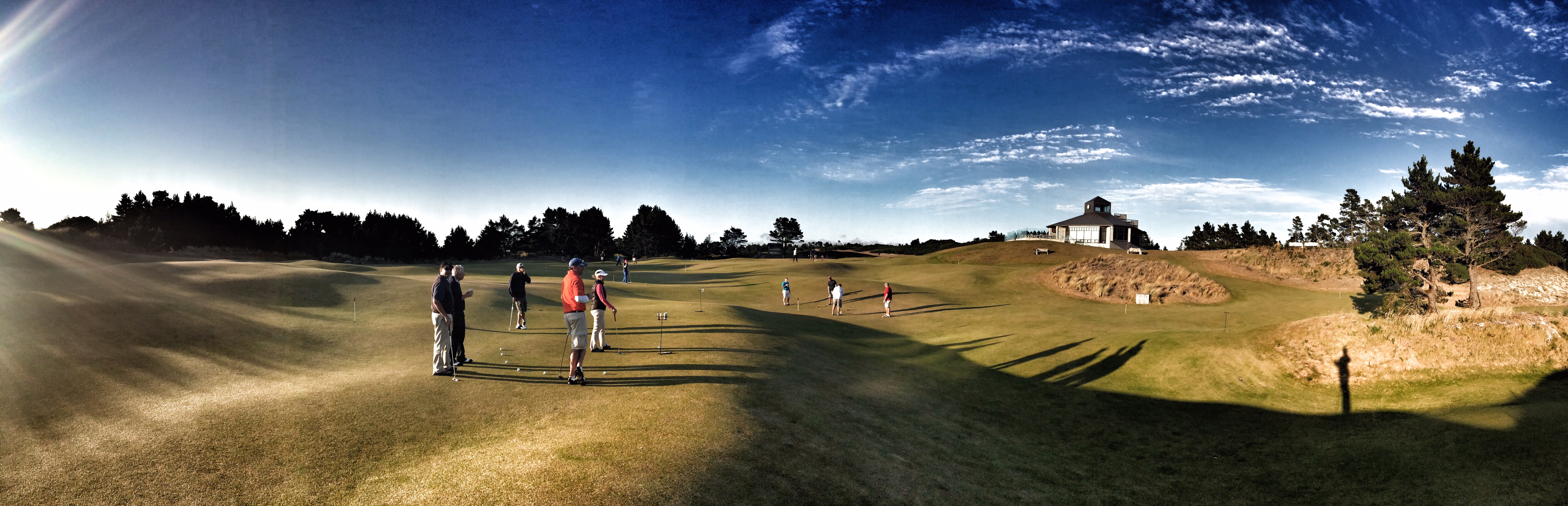
Sunday evening, our final Bandon sunset, found us embroiled in another epic putting competition over a new set of 18 holes at Punchbowl, the massive 100,000+ square foot, real grass, putting course at the resort. The length of the holes had changed and so had the size of our group. The friends, with which our friend PJ had met up while on a separate golf trip, had joined in the fun. They were his friends from law school or grad school or business school and, like him, were fun loving, funny and not particularly concerned with the state or quality of their golf games.

punchbowlcup

The putting green was packed so we placed our “team” golf ball in the slot that determined order of play, noticed the cocktail waitress was busy assisting other customers, and headed for the bar to order a first round of drinks. Avoiding the risk of running dry because of the busy waitress we ordered doubles and sipped while we started the match. By the time the waitress made it our way for another round the beverages and the banter were flowing freely and, with the exception of our friends KM and KB, the putting suffered from it. Since they were on the same team in the five on five (or was it six on six) battle of big breaks the match wasn’t even close. But my team, which included my wife and good friend BP, led by a wide margin in terms of insults so we felt pretty good about that. When it’s mostly dark and everyone is half drunk a well-timed zinger is more satisfying than a well struck putt any day, or night, of the week.

punchbowlgroup

The genuine laughs and the counterfeit insults continued as we regrouped in the cottage, opened up bottles of scotch and wine and ordered burgers off the room service menu. Once the food was gone the friends, old and new, began to file out around 10:30. KB had disappeared into her corner bedroom of the cottage and my wife and I were ready to do the same into ours. If we wanted it breakfast was bright and early the next morning before our 8 AM tee time at the resorts newest course, Old MacDonald, and we still had to pack. Our trip was coming to an end but we had one more round of golf.

At one point, while playing Bandon Dunes on Sunday, we looked out across the landscape at Old MacDonald. “We call him Old MacMullett,” one of our caddies Eric “Rack“ Rackley said, “Short in the front and long in the back.” “At least we’re playing there in the morning,” our other caddie James “Jake” Muldowney added, “because when the afternoon winds get up over there it can be a bear.” We were playing in the morning and the morning turned out to be glorious. The huge American flag that stood guard between the practice putting green and the first tee lay flat, peaceful, quiet in anticipation of a steady stretching out that a certain wind would give it at some point during another day at Bandon Dunes. KB, my wife and I did get out of bed early enough to have a little breakfast and a cup of coffee while the rest of our group BP, KM and Pat from Chicago met us on the putting green. Our other friend, PJ, was nowhere to be found, maybe teeing it up somewhere later and maybe not.

Old MacDonald was designed by Tom Doak and Jim Urbina as homage to Charles Blair MacDonald. MacDonald was a renowned, Canadian born, player and architect who won the United States Amateur Championship in 1895 and designed The National Golf Links of America on Long island, NY in 1908. Most of his courses feature his version of holes from famous courses in Great Britain and include The Old White course at The Greenbrier, Piping Rock and The Yale University Golf Club.

oldmacwide

The course at Bandon Dunes was completed and opened for play in June of 2010 and in addition to being the newest it’s the most “links-like” and features the resort’s biggest greens. It plays 6,320 yards from the green tees and, true to Rack’s description from the day before, 1,642 or 26 per cent of those yards come courtesy of the last four holes ( 2 par fours and 2 par fives). We stopped for a quick peek inside the smallish golf shop to survey the merchandise and, as we had at the other shops on site, liked what we saw.

Our group was eclectic, well educated, well-travelled and knew a little bit about a lot of things and a lot about a few things. One of the things a few in our group knew a great deal about was marketing and branding and, according to them, Bandon Dunes had “hit it out of the park” when it came to logos. They consensus was all the courses individual logos were well done but the designs for Punchbowl and The Preserve(the 13 hole par three course) earned extra high marks. You can see them all at the Bandon Dunes website www.bandondunesgolf.com and decide for yourself. With selections mentally made for post round payment and pick up we headed to the first tee and met up with, for the last time, our caddies Rack and Jake.

We were back to two threesomes and once again our trio (KB, my wife and me) would go first. That meant I would strike the first tee shot at Old MacDonald. Just 304 yards on the card the first hole is relatively benign so I teed up my Titleist and let it fly. My shot sailed straight and plenty long enough making me four for four in first hole tee shots at Bandon Dunes. Sadly for me the short iron prowess I had exhibited the day before had deserted me completely as I began this round. I chunked a wedge, then chunked a chip before abandoning that strategy and putted my fourth from a few yards off the green. The back of the Old MacDonald scorecard lists the names of each hole and the first is called “Double Plateau”. I renamed it “Double Bogey”. Things didn’t go any better at “Eden”, the par three second hole. 139 yards is normally a good, solid 9 iron for me but off the tee on “Eden” I hit a “hellaciously” fat shot that travelled all of about 80 yards. A fourth consecutive chunk put me in the greenside bunker from which I couldn’t get up and in so the start to my day at Old MacDonald looked more like an In N Out Burger order, double double.

oldmacrack

On number three, “Sahara” I finally found some relief when, after another good drive flew over the hill and trundled down the other side near the green. Handing me my 60 degree wedge Jake said simply, “Commit to it and get down through it.” Since I had laid the sod over every other short iron, I approached this one with very little confidence but I heeded Jake’s advice, kept my upper body still and finally hit the golf ball first. Green in regulation, two putt par, yeah! I ended up playing the last seven holes on the front nine in the same number of strokes over par that I had played the first two posting a 42. Then I began the back nine with a swell three putt triple bogey seven.

oldmacbw

My wife had made three pars on her first nine including the last two holes and after adding up all nine scores the number I wrote down for her was 46. It was her best nine holes of the trip and among the best first nine holes of a round she had recorded in the dozen years we’d been playing golf together. She knew she was playing well and enjoying herself but she didn’t ask what she had shot. I wouldn’t have told her if she had. Her back nine started with a bogey but then spiraled a bit off the rails with a double and two triples before she was able to refocus and get things back on track. KB had also played well and limited the really big numbers to only a couple but her back nine was schizophrenic as well starting double, par, triple, par before playing the final five in just two over.

oldmacroad

As for my round at Old MacDonald I might remember the eleventh hole best. I have watched the British Open (excuse me, The Open Championship) for decades and have always been impressed by how difficult many of the bunkers looked. I also marveled at how easily the pros seemed to be able to extricate themselves from those hazards. I always wanted to attempt a shot from such a bunker one day and got my chance when a not quite perfectly struck 6 iron approach landed in the one fronting the green on the hole called “Road”. I climbed the steps down into the bunker and remembered the advice I had heard once upon a time. I opened the face of my 60 degree Vokey wedge a little more than usual and I settled in, aiming a tad further left than I normally do for sand shots. Swing, splash and out popped the ball on an excellent trajectory, landing on the green and rolling out to four feet from the cup. A good putt saved my par and reinforced what I tell people I love a great deal about the game of golf.

I can’t dunk. I have no chance of hitting a hundred mile an hour fastball and if I got hit head on by San Francisco Forty Niner linebacker Navarro Bowman my guess is I’d wake up in a hospital. But several times during a round of golf any one of us can hit a shot or a putt as well as the number one professional player in the world. I had done precisely that on “Road” at Bandon Dunes.

oldmacjake

I followed my par with three straight bogeys and then played “Old MacMullett”s” green mile (the last four holes) in one under par thanks to a most memorable utility wood second shot over the giant mound that shelters the green at the par four, 16th appropriately named “Alps”. KB and my wife had righted their respective ships, posting more bogies and pars than “others”, when we arrived at the final two holes of our trip. Seventeen, called “Littlestone” is a par 5 and eighteen, “Punchbowl” is a finishing par 4 that take you back to the clubhouse. On “Littlestone” KB creamed another drive that unluckily ended up in a fairway pot bunker Rack had told her she probably couldn’t reach. It might have been the only time either Rack or Jake had been wrong all weekend and in his defense he did say “probably couldn’t reach”. Undaunted by a difficult lie and unwilling to just punch out and play safe, KB smashed an iron that sailed over another bunker approximately 20 yards from the green and ended up just off the putting surface to the left, 30 feet for eagle. Two putts later she had her first birdie of the day, I made my par and after reaching the green in regulation the conventional way my wife uncharacteristically three putted for a bogey. It totaled up to even par 15 for the group.

On 18 I stood on the tee and said what I always say on my last hole of a four day golf trip, with good friends, to Bandon Dunes, “One last good one.” I swung and hit a bullet dead right into the high grass between the eighteenth and first fairways. “Believe it or not that won’t be too bad,” Jake said and he grabbed my driver and put it back in the bag for the last time. It turned out he was right. A seven iron second hit the huge green, bounced a couple of times, and slid to a stop just 15 feet from the hole. I made my only birdie of the day and the last of our excursion to the Oregon Coast.

A storybook ending would have me making that putt and after another good read by Jake and another rather rare perfect stroke by yours truly I made the storybook ending a reality. 84 for me, 88 for KB and my bride made a five footer for bogey at the last to break 100. We said goodbye to Rack and Jake, shopped a little, then grabbed a cold beverage and took it outside to wait for our friends and reflect on the trip.

oldmacrelax

Another golf adventure with this group is definitely in order, maybe Kiawah next time, maybe Pebble Beach. That could be decided at a later date. We did decide that we would all absolutely come back to Bandon Dunes. The trip was a blast, the company was outstanding and the golf was great. In terms of ranking the courses, it was easier to pick my least favorite, Pacific Dunes, than it was my favorite. In the end I decided to put Bandon Trails at number three and then rank Bandon Dunes first by the slightest of margins over Old MacDonald. Those rankings might completely flip if we go back and play at a different time of year in different conditions, but I doubt it.

bandonsunset

If you are thinking about going to Bandon Dunes I would only say stop thinking about it and get it done. It is not the least expensive golf trip you’ll ever take but, if you are a hard core golfer, it won’t be the most expensive either. Be prepared to be cold, to play in the wind, practice your lag putting and for goodness sake and your sake, pony up the dough for a caddie. You won’t regret it.

Special thanks to KB for first taking, then allowing me to use some of the wonderful photographs she took during the trip.

Posted in general observations, Golf, sports | Tagged , | Leave a comment

Bandon Brothers and Sisters Part 3


This is part three of a four part series on our recent trip to Bandon Dunes

DAY THREE – THE NAMESAKE

After a few rounds of cocktails and a round of putting on Punchbowl, the 18 hole, 100,000+ square foot putting green at Bandon Dunes, our group of seven (me, my wife, KB, BP, KM, PJ and Pat from Chicago) headed to the restaurant next to the golf shop at Bandon Trails for dinner. We ordered our food accompanied by a couple of bottles of “B” Pinot Noir (Bandon’s proprietary red).

At some point during the conversation KM and Pat from Chicago, buddies from grad school, decided they were good to go for 36 holes on Sunday in addition to the 36 we had all, except Pat, just finished. This change in plans came about because Pat hadn’t arrived yet when the group played Bandon Trails that morning and, having heard so many good things about the Tom Doak design, he wanted to tee it up there too. BP, my wife and I had been friends for years and were looking forward to playing together for the only time on the trip so he was out with them and in with us. PJ in a bizarre coincidence had run into another group of buddies enjoying a golf trip of their own to Bandon and had planned to join them the next day so he was out as well.

To accomplish what Pat wanted to accomplish the six of us decided to meet at The Preserve (the 13-hole par 3 course) at 8 AM and from there KM and Pat would head directly to Bandon Dunes for a morning round before the additional eighteen at Bandon Trails. That plan meant 31 holes for four of us and 49 for the other two. We said goodnight, parted ways with KM and Pat and headed back to the four bedroom cottage. Not surprisingly after 36 holes of walking and swinging in the wind, a good meal and an alcoholic beverage, or four, I slept like a dead guy then awakened in the morning ready for another day at Bandon.

My wife felt the same way and so did BP. Of our group only KB seemed a little slow on the uptake but a quick breakfast and a latte at the main lodge worked wonders. We met KM and Pat at The Preserve and made our way to the first tee. Number one is slightly downhill and only about 75 yards from the tee we played into, of course, a slight breeze. After deciding the match and the make-up of the teams (KM, my wife and I would take on KB, BP and Pat) I plopped a ball down and took a swipe at it with my 54 degree Vokey wedge. I carry three, 50, 54 and 60 degrees and I use and love them all. This one I hit on the nose and the ball flew straight and true eventually settling about 12 feet from the hole. There are 13 par threes at The Preserve and that morning I hit 12 of them in regulation using everything from a 7 iron to my 60 degree sand wedge. I couldn’t miss, much to my amusement and the amazement of the other five. The only green I didn’t hit was the result of choosing the wrong club the ball landing short and in the bunker after a perfectly struck pitching wedge. I got it up and in.

preserve

We learned on the first day of the trip that on the 13th and final hole of The Preserve it is customary to play a shot off the tee with a putter. The hole is straight down hill, anywhere from 75 to 109 yards long and conducive to rolling a ball from the very top to the bottom. We all tried and even on that shot I hit it square on the clubface, exactly where I aimed it. The ball rolled and rolled and rolled before reaching the putting surface then sliding just by the hole. From our perch 80 yards up the hill we thought I made a one but instead it ended up just 3 feet away and I made a two. It may have only been the par three course but I definitely had a little bounce in my step as we headed to Bandon Dunes for an early lunch.

After another satisfying meal (the food at Bandon Dunes is not gourmet but it is very, very good and on most every occasion it was the perfect salve before and after a good walk “unspoiled”) of burgers, bratwurst and banquet beer we stepped outside to meet up with our caddies “Rack” and “Jake”, or “Rake” as my wife had taken to calling them since day one, who were waiting with ready smiles.

Bandon Dunes was the first golf course designed on Mike Keiser’s land and he hired Scotsman David McLay Kidd to fulfill his vision. It opened in the late spring of 1999 and was one of McLay Kidd’s earliest works. Since then Bandon Dunes has become known and respected worldwide and McLay Kidd has gone on to design some of golf’s most interesting and talked about golf courses including South Africa’s Fancourt, which hosted the 2003 Presidents Cup Match, Nanea on the Big Island of Hawaii and Gamble Sands along the Columbia River in central Washington State. From my now customary green tee markers the course sets up at 6,221 yards on the card but there is NO WIND on the card! Sunday’s breeze was around 20 to 25 miles an hour as we got set to play and my caddie, Jake, looked at me with a grin and said, “This is what a normal Bandon wind feels like.” “Does it ever NOT blow?” I asked. “Sure,” he replied and then added, “the day before and the day after a storm.”

bandonduneswalk

Our good friend BP, a single digit handicap, plays most of his golf in the San Francisco Bay Area so the conditions (wind, sweater weather chill) seemed to affect him much less than it affected us. In fact, on the golf course, he wore shorts and a golf shirt with a long sleeve undershirt while I almost always had on a sweater and slacks. I did pack a pair of shorts but they never got unpacked. On the tee Jake handed me my driver, pointed out the desired direction and watched as I blasted another first tee shot right down the fairway. BP followed and ripped one down the left side about 20 yards past me and away we went.

I don’t know if it was because we were refreshed, or that BP had joined us, or simply because we had each played more than 60 (BP had played more than 78) holes of golf in two and a half days but we all played pretty well. My good technique, or was it good fortune, continued with the short irons and as we made the turn there weren’t more than a handful of scores worse than bogey on any of our scorecards. KB made the group’s first birdie with a nice 15 foot putt on the par three third while BP made his first birdie of the round by reaching the par five ninth, in two. No birdies for me or my wife but plenty of pars and bogeys led to respectable front nine scores.

bandonbeauty2

The tenth at Bandon Dunes is legendary, literally. After we had all hit our tee shots Rack started to tell us the tale of a group of Scots who came to Bandon very early on. While Rack spun the yarn Jake instructed BP to “walk this way” and they headed into the right rough. According to Rack’s story the Scotsmen buried a treasure (a very old, very good bottle of scotch) under a tree in the direction Jake and BP now wandered. Years later, the same group returned and set about unearthing, with hopes of enjoying, the golden liquid. “This is where it gets interesting,” Rack said and continued to relate the story. It seems, according to the legend, the men were unable to locate the bottle and assuming the grounds crew had subsequently found and drained the bottle they headed toward the superintendent’s office to get answers. Upon inquiring about the long buried treasure the Super let out a hearty laugh and exclaimed, “So that was YOUR bottle!” The Scotsmen said that indeed it was and announced their displeasure that it had been “stolen” from them and the liquid poured down some American greens keeper’s gullets. His honor questioned, the Super bristled and then assured the gentlemen that he and his crew had done no such thing and then he proved it. He led the return visitors back out to the tenth but stopped in a different place, under a different tree.

Without taking further questions he explained in the intervening years they had reworked the earth in that area and unearthed the bottle. After agreeing that something mysterious was at work the crew put the bottle, unopened, in a box and buried it again, albeit in a slightly different spot. And that’s where it sits to this day. Jake had shown BP the bottle but I passed on taking a peak, preferring to keep the details of the story safe in my imagination. BP birdied the hole while I made bogey from the middle of the fairway. Maybe I should have gazed upon the bottle after all.

After a good par for me and a three putt double bogey for BP at 11 I had the tee at the par three twelfth. From our teeing ground the card says the hole plays 153 but it’s a little downhill and the wind was helping slightly from right to left. “I like this,” Jake said while handing me my 9 iron. I took it, teed the ball up and stepped into my stance. My swing was good as was the contact and the ball beautifully rode the wind, landed on the front part of the green and rolled out to about 15 feet from the hole. “That’s as good as it gets right there,” said Rack. “Nice shot,” echoed Jake as he reclaimed the 9 iron and put it back in the bag.

Back on the first tee my three playing companions (I have no idea where I was) had determined that afternoon’s match. My wife and I would take on KB and BP. KB is a 17 and would get 8 shots, my wife is a 25 and they awarded her a stroke a hole. BP was prepared to give me 3. When I heard the bet, in some fit of bravado, or insanity, I said I would play BP straight up and we went ahead and lost the front 9, three down. After BP’s birdie at ten we went four down and one down and then KB poured salt on the wound with a stellar birdie at the eleventh. That meant the “good guys” lost the front nine, were down five on the 18 and two on the back nine needing something good to happen. Then it did, I finally followed Jake’s advice to perfection on the green at twelve and rolled in the putt for my first “real” birdie of the trip. That got us one hole back and my wife’s par net birdie on the par five 13th meant we were three down and all square in the match. We lost 14, and the 18 hole match, thanks to a KB par, halved the 15th and stood four down and one down on the picturesque par 4 16th tee.

bandontshot

The mighty Pacific Ocean takes up all the room to the right with tall grass, gorse and dunes if you miss left. That said the fairway, like most at Bandon Dunes, was expansive though riddled with several well placed bunkers. To add to the grandeur of the hole you also have to carry your tee shot over a ravine but Jake was reassuring when he handed me the driver and said, “It’s more intimidating than it looks. Just rip it over the fairway bunker on the right side of the fairway.” So I did. ”You,” he said to BP, “can drive the green.” He didn’t. His ball had the distance but not the direction and it sailed 30 yards left into the rough. From there his approach landed in a greenside pot bunker and his only play was back the same we from which he had come. In the meantime I had hit my 60 degree wedge on the green and my wife and KB, both getting a stroke) had reached the green in three. Three putts for KB later we had won the hole and had brought the only bet we still had a chance to win to all square with two to play.
BPbackwardsbunker

Throughout the course of this four part discourse I have mentioned fondly our caddies Rack and Jake. If I said they made our Bandon Dunes experience exponentially better once I could have said it a hundred times and not been overstating their impact for me. James “Jake” Muldowney, my guy, was the younger of the two. Fresh from a stint playing competitive college golf for the Runnin Rebels at UNLV he clearly knew, loved and was good at the game. I could sense he would much rather be playing out of my bag as opposed to carrying it and it won’t surprise me one bit if Jake has moved on to other adventures if, or when, we go back to Bandon Dunes.

bandonbeauty1

Eric “Rack” Rackley, on the other hand, is as much a part of the scenery at Bandon Dunes as the kite surfers, the whale spouts and the wind. My guess is he will be there as long as he can hoist a bag or two over his shoulders. Walking down the first fairway on Friday he was quick to mention, but humble enough not to dwell on, the fact that he was the very first caddie hired at the resort and then he never mentioned it again, didn’t have to. I know he plays but have no idea how often or how well. I also sensed, from those first moments, that he has great respect for the game and he LOVES Bandon Dunes. He did much more than give my wife and KB yardages, advice on clubs and great reads on the greens; he told us stories, jokes and imparted a sense of place at Bandon, an idea of what the resort is all about. Then on the 16th green (our 52nd hole together) he pulled a rabbit out of his hat.

“Hang on a sec,” Rack said as he dropped to his knees near the hole, “I have a special picture for you.” We, especially KB, had been taking pics all day, Mother Nature providing amazing natural photo op after amazing natural photo op. Now it was Rack’s turn to provide a man made one. We weren’t waiting on the group in front and the players behind us were at least a hole and half from catching up so we weren’t in a rush. We watched, with interest, as our caddie, turned director of photography, speared two tees into the inside of the hole just above the line of the cup. His next move was to place a golf ball on top of the tees and then he spoke again, “Okay now one of you pretend you just stroked a putt and hold your finish. The rest of you react like it went in to win the U S Open.” We wondered what he was up to but didn’t protest and did as we were instructed taking turns being the putter who made it and the appreciative gallery who reacted. The results, some posted here, were predictably humorous and, for us, another memorable moment in a trip more and more full of them.

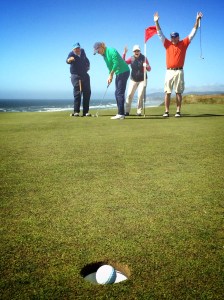
rackmagic1

rackmagic2

After, and maybe because of, the photo shoot, we all played the 17th like dogs but I won the hole with a six foot bogey putt which meant my wife and I stood on the par five, 18th tee, one up. KB stroked on the hole but made that irrelevant when she sailed her tee shot into the gorse on the right and lost her ball. The rest of us hit good tee shots then my wife and I laid up and watched BP go for the green in two. His second was long enough but missed a little right and ended up ten yards off the green but nearly pin high. My third was average, 25 feet from the hole, but my wife smacked a solid 5 iron that flew true, rolled straight when it hit the ground, and ended up 12 feet away from a natural birdie. The way she had putted all week, and with Rack’s read, a two-putt par for net birdie was a given so BP he knew he had to pitch his in for eagle to sweep all three matches of the bet. He didn’t but man did he come close! Played to perfection the ball landed, pitched forward and rolled toward the cup looking for the longest time like he was going to accomplish what he set out to do… break our hearts. In the end the shot carried just a little too much speed as it nicked the flagstick and settled less than a foot away.

My wife did indeed two putt for her par and we avoided the shutout. Handshakes, hugs and air kisses were exchanged and I penciled in a very respectable 84, with a birdie, on my line of the scorecard. We were more than ready for an evening cocktail, or two, and another go around on Punchbowl. The afternoon was outstanding and at that moment Bandon Dunes had become my favorite golf course on the property with only the newest, Old McDonald left to play.

Up next – The last day and Old MacDonald

Posted in Uncategorized | Leave a comment